Finding the best remote patient monitoring companies can be challenging. With over 200 companies offering various hardware and software solutions, selecting a partner requires a balance of clinical utility, technical ease, and financial viability. This guide breaks down the industry and provides a framework for choosing the right partner for your practice.
Best Remote Patient Monitoring Companies in 2026
The “best” company often depends on your specific clinical goals and whether you are a small private practice, a large health system, or a specialized surgical center. When evaluating vendors, be sure to look at all costs and what happens in situations such as poor patient adherence or manual billing errors. These can quickly erase any initial savings. Use this checklist to vet your potential partners:
1. EHR Integration and Interoperability
Your RPM data should not live on an island. The best remote patient monitoring companies offer seamless, bidirectional integration with major EHRs. If your staff has to manually copy-paste data from a portal into the patient’s chart, the program will likely fail due to administrative burnout.
2. Device Connectivity (Cellular vs. Bluetooth)
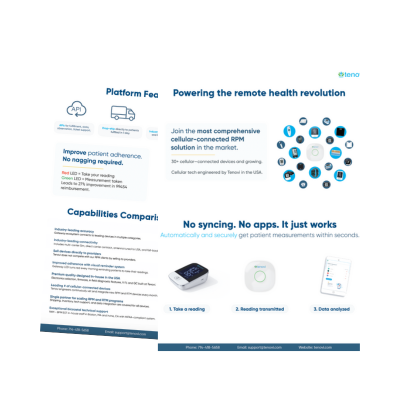
For senior and chronic care populations, cellular devices are superior. They transmit data automatically via 4G/5G networks. Bluetooth devices can require the patient to pair the device with a smartphone app, which often leads to technical frustration and lapsed monitoring. However, with a Cellular Gateway, multiple Bluetooth devices can be connected and you pay for just one cellular connection through the Gateway.
3. Clinical Staffing Support
Do you have the internal bandwidth to monitor alerts 24/7? Many of the best remote patient monitoring companies offer clinical monitoring services, where licensed nurses act as an extension of your team to triage alerts and only escalate critical issues to your providers.
4. Billing and Compliance Automation
Medicare updated its guidelines for 2026, allowing for more flexible billing thresholds (e.g., 2 to 15 days of monitoring for certain codes). Your vendor’s software should automatically track time spent on patient data and generate the necessary documentation for CPT codes such as 99453, 99454, and 99457.
Frequently Asked Questions
Navigating the technical and regulatory requirements of digital health can be a challenge for clinical teams. To help identify the best remote patient monitoring companies for a specific workflow, we’ve compiled the most common questions from healthcare providers. Whether you are concerned about Medicare reimbursement, EHR interoperability, or patient technology barriers, these answers provide the clarity needed to launch a successful RPM program.
What are the best remote patient monitoring companies for small practices?
For smaller medical practices, the best remote patient monitoring companies are those that offer turnkey solutions and managed clinical services. These companies provide the hardware, which are remote patient monitoring devices, patient onboarding, and even the licensed nursing staff to monitor alerts, which prevents small teams from being overwhelmed by new administrative tasks.
Do patients need a smartphone or Wi-Fi for RPM?
No. While some platforms use Bluetooth-connected apps, the industry leaders now prioritize cellular-embedded devices. These devices (like blood pressure cuffs or scales) have built-in SIM cards that automatically transmit data to the provider via 4G/5G networks the moment a reading is taken. This eliminates the “tech barrier” for elderly or rural patients.
Which RPM companies offer the best EHR integration?
Companies like CCN Health and Optimize Health are widely considered to have the best integration capabilities. They offer bidirectional syncing with major Electronic Health Records (EHRs) like eClinicalWorks, Epic, and Athenahealth. This ensures that patient vitals flow directly into the clinical chart without requiring manual data entry by your staff.
How does RPM reimbursement work in 2026?
The 2026 Medicare Physician Fee Schedule allows providers to bill for four primary activities:
- 99453: Setup and patient education: $22.00 (billed once)
- 99445: Supply of connected device and data transmission (2-15 days). Not to be combined with 99454 and 99457 in the same month. $52.00
- 99454: Device data transmission (16+ days): $47.00
- 99457: 20 minutes clinical time: $52.00
- 99458: Each additional 20 minutes: $52.00
- 99470: 10-19 minutes of treatment services $26.00
Is remote patient monitoring HIPAA compliant?
Yes. The best remote patient monitoring companies utilize end-to-end encryption and are SOC2 Type II certified. This ensures that all biometric data transmitted from the patient’s home to the doctor’s office meets strict federal privacy and security standards.
How do I choose between different RPM vendors?
When evaluating vendors, you should prioritize three factors.
- Ease of Use: Is the device “plug-and-play” for the patient?
- Billing Transparency: Does the software automatically generate audit-proof billing reports?
- Clinical Support: Can the company provide “back-fill” monitoring staff if your internal team is busy?
Ready to see how Tenovi works in the real world? Request a free demo and discover how simple connected care can be. You’ll discover why Tenovi offers a better RPM experience for patients, physicians, and healthcare teams. No Wi-Fi. No apps. It just works—automatic and secure transmission of patient measurements within seconds.