In December 2025, CMS annnounced $50 billion in awards to strengthen rural health in all 50 States. This unprecedented federal investment is aimed at helping states expand access to care in rural communities, strengthen the rural health workforce, and modernize rural facilities and technology with innovative models that bring high-quality, dependable care closer to home. Rural health transformation (RHT) grants empower states to transition toward sustainable, technology-enabled care that improves patient outcomes while reducing the operational burden on overstretched staff.
This article will explore how remote patient monitoring (RPM) infrastructure may help providers secure and implement rural health transformation grants by delivering measurable clinical outcomes, such as significant improvements among chronic care populations, as shown in recent research.
Transforming Care Delivery Through Rural Health Transformation Grants and RPM
Rural health transformation grants are specifically targeted at solving the core issues that have long plagued rural medicine: limited connectivity, fragmented technology, and a lack of visibility between visits. By prioritizing RHT grants, CMS aims to foster technology innovation that promotes efficiency and expands access to digital health tools. These rural health transformation grants provide the necessary capital to implement remote patient monitoring, a component of telehealth that uses digital technology to collect and transmit clinical data, such as blood pressure, heart rate, and oxygen levels, directly to providers for review and early intervention.
Strengthening Grant Applications with Proven RPM Outcomes
Rural health transformation grants applications are significantly bolstered when backed by measurable clinical data from successful RPM programs. Research demonstrates the power of rural health transformation grants:
- 42% improvement in blood pressure control.
- 19% improvement in A1C levels.
- 45% of patients were released from care after achieving stability.
- 74% patient engagement and compliance rate.
- 97% patient satisfaction, with patients crediting the RPM team for improving their quality of life and medication management.
Building Sustainable RPM Infrastructure with Rural Health Transformation Grants
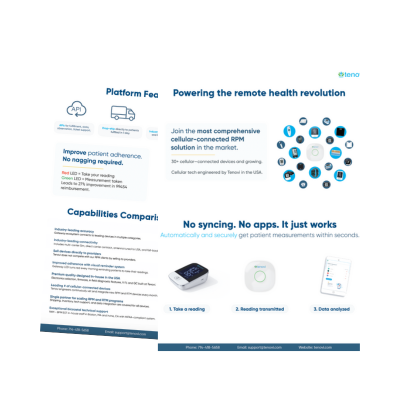
Rural health grants are most effective when used to build a unified, multi-condition infrastructure rather than isolated point solutions. Tenovi provides the specialized connectivity required by rural health transformation grants, featuring a universal cellular SIM that connects to the strongest available carriers without requiring apps, smartphones, or complex patient setup. This reliable, passive patient experience ensures high adherence and long-term engagement, directly aligning with the core priorities of RHT grants to create scalable and sustainable chronic care models.
Why Rural Health Transformation Grants Benefit from Tenovi Integration
Rural health transformation grants goals are best met by integrating a continuous and proactive care model that expands healthcare beyond the walls of the clinic. Tenovi supports over 50 connected devices across various conditions through a single data stream, making it the ideal partner for providers seeking rural health transformation grants to manage multiple chronic diseases without siloed tools. By utilizing rural health transformation grants to deploy Tenovi’s interoperable ecosystem, rural health systems can demonstrate measurable quality improvements, enhance equity through reliable rural access, and meet the high innovation standards set by CMS.
Would you like to learn more about Tenovi? Book a demo now. Or, download this RHT overview to learn more about how Tenovi can support Rural Transformation grants?
Sources:
American Heart Association (2022): Remote Patient Monitoring for Hypertension Management: An Evidence Review
Journal of Medical Internet Research (JMIR): The Impact of Remote Patient Monitoring on Chronic Disease Management
Annals of Internal Medicine (2021): Effectiveness of Remote Patient Monitoring for Chronic Conditions
Centers for Medicare & Medicaid Services (CMS): Remote Physiologic Monitoring Codes & Guidance
Agency for Healthcare Research and Quality (AHRQ): Remote Patient Monitoring Technologies for Acute and Chronic Condition
American Medical Association (AMA): Remote Patient Monitoring Implementation Playbook
Healthcare Information and Management Systems Society (HIMSS): How Remote Patient Monitoring Supports Value-Based Care