

Blood pressure by age is one of the most misunderstood topics in cardiovascular care. Patients often assume that a higher reading is acceptable simply because they are older. The clinical reality is more precise: diagnostic thresholds do not loosen with age, even though average measured readings climb across the lifespan. This reference explains what is normal blood pressure by age, separating the fixed clinical categories from the population averages that shift decade by decade.
Understanding this distinction matters because hypertension is the most common and most modifiable risk factor for cardiovascular disease. Interpreting a reading correctly, at any age, is the first step toward managing that risk.
The Two Numbers and What They Measure
Every blood pressure reading has two components. Systolic pressure, the top number, is the force in the arteries when the heart contracts. Diastolic pressure, the bottom number, is the force between beats when the heart is at rest. Both are recorded in millimeters of mercury (mm Hg).
The clinical weight of each number shifts with age. In middle-aged and older adults, systolic pressure is generally the stronger predictor of cardiovascular risk, though diastolic pressure remains clinically important throughout life. A landmark meta-analysis of roughly one million adults found that vascular mortality risk rises in a continuous, linear fashion starting from pressures as low as 115/75 mm Hg, which is why the concept of a single “safe” age-adjusted number does not hold up.
Adult Blood Pressure Categories Do Not Change With Age
The most important clinical point about blood pressure by age is that the diagnostic categories are identical for every adult. The American Heart Association and American College of Cardiology define five categories that apply to all adults regardless of age, and the August 2025 hypertension guideline reaffirmed these thresholds without change.
The AHA/ACC categories are as follows. Normal is below 120 systolic and below 80 diastolic. Elevated is 120 to 129 systolic and below 80 diastolic. Stage 1 hypertension is 130 to 139 systolic or 80 to 89 diastolic. Stage 2 hypertension is 140 or higher systolic or 90 or higher diastolic. A reading at or above 180/120 mm Hg is a hypertensive crisis that requires immediate attention.
These thresholds are population-level definitions, not personal targets, and a diagnosis is never made on a single reading. The 2025 guideline reaffirms a treatment and diagnostic threshold of 130/80 mm Hg and bases decisions on averaged readings taken across multiple occasions, weighed against overall cardiovascular risk. A 75-year-old and a 35-year-old with the same reading fall into the same category.
Blood Pressure by Age: Population Averages
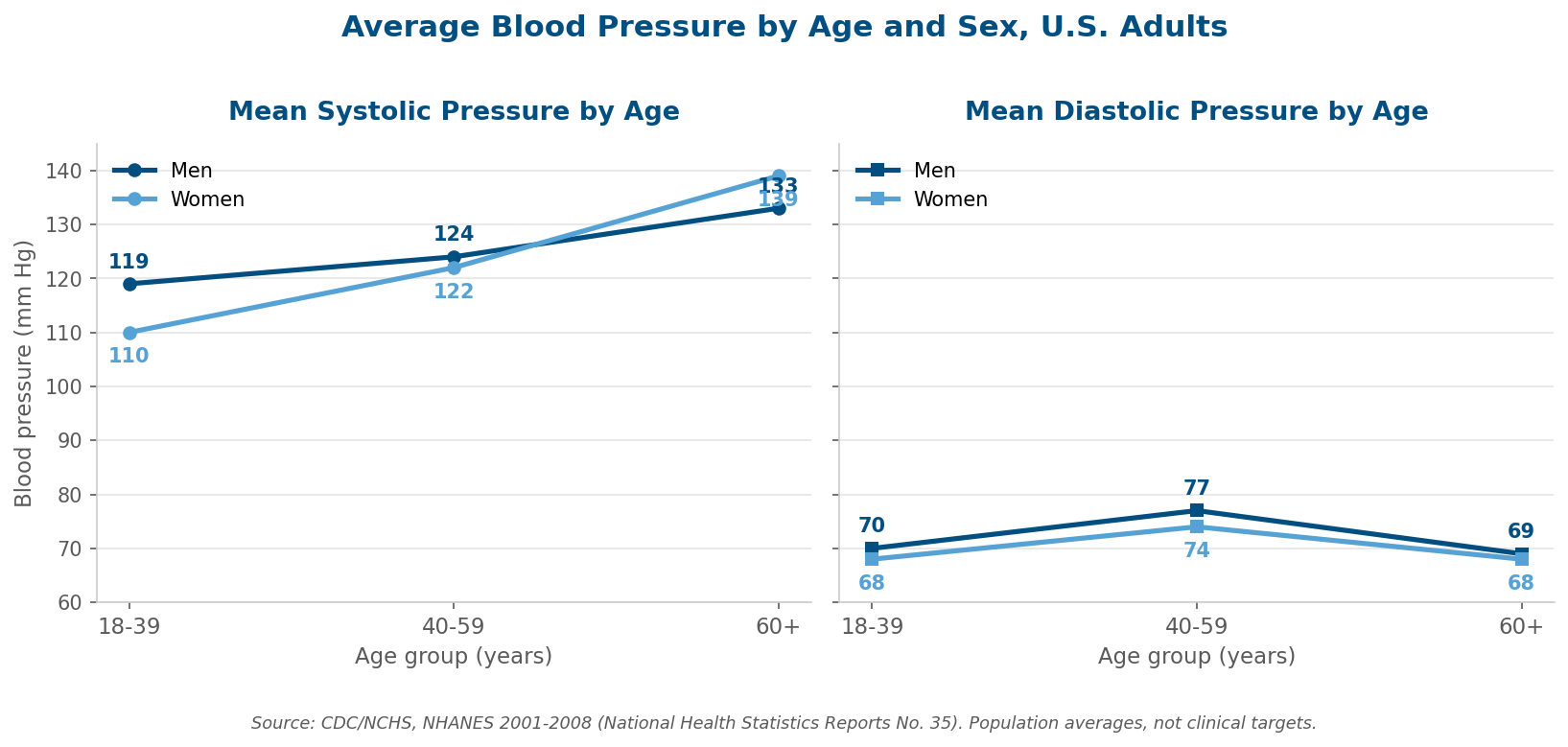
While the categories stay fixed, average measured blood pressure does rise across adulthood. This is a description of what populations look like, not a prescription for what any individual should aim for. National Health and Nutrition Examination Survey (NHANES) data collected by the CDC show a steady climb in average systolic pressure with each decade of adult life.
The pattern is consistent: systolic pressure rises fairly continuously with age, while diastolic pressure tends to plateau in midlife and can even decline after roughly age 60. Population averages by decade generally run near 115 to 120 systolic in early adulthood, drift into the low 120s through the 40s and 50s, and reach the mid-120s to 130s and higher in adults over 60. Individual values vary widely around these means. The key interpretive rule holds: a higher average in an older population does not make a higher reading healthy for a given patient.
Why Blood Pressure Rises With Age
The rise in systolic pressure across adulthood is driven mainly by arterial stiffening. Over decades, the continuous pulsing of blood flow breaks down elastin fibers in the walls of large arteries such as the aorta, and the body replaces them with stiffer collagen. Stiffer arteries do not expand and recoil as effectively with each heartbeat, so the same cardiac output generates a higher systolic pressure.
This mechanism also explains the diverging pattern between the two numbers. Because the arteries lose their recoil, diastolic pressure can fall in older adults even as systolic pressure keeps climbing. The result is a widening gap between the two numbers, known as pulse pressure, which itself carries cardiovascular significance in older patients.
Blood Pressure in Children and Adolescents
Pediatric blood pressure is interpreted differently from adult blood pressure, and this is where age matters most directly. For children under 13, there is no single normal number. Instead, normal is defined by percentiles based on the child’s age, sex, and height, following the American Academy of Pediatrics (AAP) clinical practice guideline.
Under the AAP classification, a child aged 1 to under 13 has normal blood pressure below the 90th percentile for their age, sex, and height. Elevated blood pressure runs from the 90th to below the 95th percentile. Stage 1 hypertension begins at the 95th percentile, and stage 2 at the 95th percentile plus 12 mm Hg or 140/90, whichever is lower. For adolescents 13 and older, the AAP thresholds align with the adult numeric cutoffs, beginning with normal below 120/80.
This percentile approach exists because children’s bodies vary so much by growth stage. A reading that is normal for a tall 12-year-old could be elevated for a shorter child of the same age. Pediatricians plot readings against reference tables rather than relying on any single measurement, and the trend over time matters more than one number.
Older Adults and Individualized Targets
Blood pressure management in older adults illustrates why fixed categories and individual targets are not the same thing. The 2025 hypertension guideline uses the same diagnostic categories for older adults, but it emphasizes individualized treatment decisions and team-based care. The guideline also introduced the PREVENT risk equations to estimate a patient’s 10-year cardiovascular risk and guide when to start medication, rather than relying on the reading alone.
For frail or older patients, clinicians balance the benefit of lower pressure against risks such as falls, dizziness, and excessive drops in pressure. This is a clinical judgment made patient by patient, which is why an accurate, consistent record of readings matters so much in this age group.
Why Accurate Measurement Underlies Every Age-Based Reading
None of these age-based interpretations hold up without accurate measurement. Because a small error can move a patient across a category threshold, technique and consistency are not optional. The AHA emphasizes averaging multiple readings taken on separate occasions before assigning a category or making a diagnosis.
Out-of-office measurement has become central to this process. The 2025 guideline elevates home and ambulatory monitoring to a primary role in confirming a diagnosis, since a single clinic reading can be distorted by white coat or masked hypertension. This is where consistent home measurement, captured reliably and delivered to the care team, connects directly to correct interpretation. Tenovi’s cellular-connected blood pressure monitor transmits each reading automatically, giving clinicians the repeated, out-of-office data that age-based interpretation depends on.
Frequently Asked Questions
1) Does normal blood pressure change as you get older?
The clinical category for normal does not change. For all adults, normal is below 120/80 mm Hg at any age. Average measured readings do rise with age due to arterial stiffening, but a higher population average does not make a higher reading healthy for an individual.
2) What is a normal blood pressure reading for adults?
For adults of any age, normal blood pressure is below 120 systolic and below 80 diastolic. Readings of 120 to 129 systolic are elevated, and 130/80 or higher falls into hypertension under current AHA/ACC categories.
3) How is blood pressure measured in children?
For children under 13, normal is defined by percentiles based on age, sex, and height rather than a single number. A reading below the 90th percentile is normal. Adolescents 13 and older use the same numeric cutoffs as adults.
4) Why does systolic blood pressure rise more than diastolic with age?
Arterial stiffening drives the difference. As large arteries lose elastin and become stiffer, they cannot recoil effectively between beats. This pushes systolic pressure up while diastolic pressure often plateaus or declines after about age 60.
5) Is higher blood pressure acceptable for older adults?
Diagnostic categories are the same across adulthood, but treatment targets are individualized for older patients. Clinicians weigh the benefits of lower pressure against risks like falls, so the target for a frail older adult may differ from the population threshold.
6) How many readings are needed to diagnose high blood pressure?
A diagnosis is based on an average of multiple readings taken on separate occasions, not a single measurement. Current guidance also favors confirming elevated office readings with home or ambulatory monitoring.
Understanding What is Normal Blood Pressure by Age
Blood pressure by age comes down to one clinical distinction: the categories are fixed, but the averages move. For all adults, normal remains below 120/80 mm Hg regardless of decade, while population averages rise as arteries stiffen and systolic pressure climbs. Children are interpreted by age, sex, and height percentiles rather than a single number, and older adults receive individualized targets layered on top of the same diagnostic categories. In every case, correct interpretation rests on accurate, repeated measurement.
Tenovi provides cellular-connected blood pressure monitors and other remote patient monitoring devices that transmit readings automatically to care teams, with no Wi-Fi or smartphone required. If your organization is building or scaling a remote monitoring program, contact us for a free demo and consultation to see how reliable home measurement supports accurate, age-appropriate care.