IoT health monitoring devices are connected medical tools that collect patient health data and send it to care teams automatically. These IoT health monitoring devices support remote patient monitoring (RPM) by tracking vital signs outside the clinic. The “Internet of Things” refers to devices that share data over a network without manual entry.
A blood pressure monitor, pulse oximeter, weight scale, or glucometer becomes an IoT device once it transmits readings to a secure platform. Care teams then review that data between visits. This model helps providers catch changes early and act before a patient needs the emergency room.
Chronic disease drives much of this growth. The CDC reports that six in ten U.S. adults live with a chronic condition. The World Health Organization links noncommunicable diseases to roughly 43 million deaths each year. Connected monitoring gives clinicians a steady view of these patients at home.
How IoT Health Monitoring Devices Work
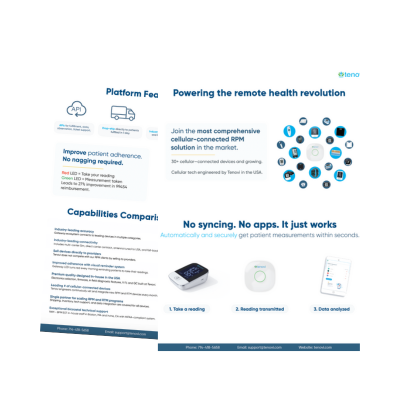
IoT health monitoring devices work through three steps: capture, transmit, and review. First, a patient takes a reading at home. Second, the device sends that reading to a platform through cellular or Bluetooth connectivity. Third, the care team reviews the data and follows up when values fall outside a set range.
The connection method matters for older and rural patients. Cellular devices work out of the box with no app, no Wi-Fi, and no pairing. Tenovi devices connect through the Tenovi Gateway, a small cellular hub that pairs with peripherals automatically. Patients simply take a reading, and the Gateway does the rest.
Data security sits at the center of this process. Readings travel over encrypted connections and land in HIPAA-compliant systems. Clinicians see trends, set thresholds, and receive alerts. This structure reduces manual work and keeps patient data accurate.
5 Common Types of IoT Health Monitoring Devices
IoT health monitoring devices cover most core vital signs used in remote patient monitoring. The most common categories include:
- Blood pressure monitors. Cellular and Bluetooth cuffs track hypertension, a leading risk factor for stroke and heart disease.
- Pulse oximeters. These clip-on sensors measure blood oxygen and heart rate for respiratory and cardiac patients.
- Weight scales. Daily weight trends help teams manage heart failure and sudden fluid gain.
- Blood glucose meters. Connected glucometers and continuous glucose monitors support diabetes care.
- Wearables and multi-sensor tools. Watches, bands, and newer sensor patches capture heart rate, activity, and movement.
Research shows how quickly this category is expanding. A May 2025 scoping review of wearable monitoring found that watches and bracelets appeared in 63% of studies. Diabetes and cardiovascular disease were the most studied conditions.
Benefits of IoT Health Monitoring Devices
The benefits of IoT health monitoring devices reach patients, providers, and health systems. When connected devices feed a care team steady data, small problems get attention before they grow. The main advantages include:
- Earlier intervention. Daily readings reveal trends that a single office visit can miss.
- Fewer hospital visits. Studies of connected monitoring report lower readmissions across chronic disease groups.
- Better access for rural patients. Cellular devices remove the need for broadband or a smartphone.
- Stronger engagement. Patients who track their own numbers often stay more involved in their care.
- Lower long-term costs. Preventive monitoring can reduce avoidable acute care over time.
These gains reflect a preventive model. Remote patient monitoring keeps patients healthier at home, and that focus also lowers the cost of care. For a fuller view of the model, see the Tenovi remote patient monitoring overview.
What the Research Shows in 2025 and 2026
IoT health monitoring devices continue to draw strong clinical interest. Two earlier studies showed how far low-cost sensing has come, and newer reviews confirm the direction.
One field study tested a smart belt with pressure sensors to estimate heart rate from ballistocardiogram (BCG) signals. Twenty-four volunteers wore the belt alongside a finger pulse oximeter for comparison. The system showed reliable data transmission, efficient processing, and low-cost deployment, even outside a controlled lab.
A second study proposed a low-power neural network processor for motion sensing. The design aimed to improve latency, power use, and programmability for wearable and portable devices. The work also explored mental fatigue detection in athletes using motion sensors.
Recent reviews back these findings. The 2025 scoping review noted that 85% of wearable studies monitored existing chronic disease, most often long-term conditions. Separate analyses of remote monitoring report notable drops in readmission, including a widely cited 40% reduction among heart failure patients in one health-system program. Artificial intelligence adds another layer by flagging risk patterns in the data, a topic covered in the Tenovi guide to AI in remote patient monitoring.
The Market for IoT Health Monitoring Devices in 2026
Demand for IoT health monitoring devices keeps rising as care shifts toward the home. Grand View Research values the remote patient monitoring system market near $30.9 billion in 2026, up from about $26.0 billion in 2025. The firm projects growth to more than $110 billion by 2033.
Chronic disease management drives the largest share of this spending. Hospitals and clinics remain the leading buyers, followed by home health and primary care. Wearables and cellular devices lead new adoption because they lower the setup burden for patients.
IoT Health Monitoring Devices and 2026 RPM Reimbursement
IoT health monitoring devices also connect to how providers bill for care. For 2026, the Centers for Medicare & Medicaid Services (CMS) finalized updates to remote patient monitoring and remote therapeutic monitoring (RTM) codes. The changes add shorter-duration options and raise several payment rates.
New codes support monitoring periods as short as 2 to 15 days in a 30-day window. That flexibility helps programs enroll patients who do not need daily tracking every month. It also makes RPM more practical for smaller practices and rural clinics.
These updates reward proactive care, not paperwork. The goal is to keep patients stable at home and reduce costly hospital stays. For the current code set, see the Tenovi guide to RTM CPT codes for 2026.
How to Choose IoT Health Monitoring Devices for Your Program
The right IoT health monitoring devices depend on your patient population and workflow. A few questions help narrow the options:
- Which conditions will you monitor? Match devices to the vitals that matter most for your patients.
- What connectivity fits your patients? Cellular suits older and rural patients who lack Wi-Fi or smartphones.
- How does data reach your team? Look for a platform with clear dashboards, alerts, and clean integrations.
- Is setup simple? Devices that work out of the box improve enrollment and adherence.
Tenovi builds for that simplicity. One Tenovi Gateway connects many peripherals, and readings flow through a single API and platform. That approach reduces training time and support calls for care teams.
Frequently Asked Questions About IoT Health Monitoring Devices
1) What are iot health monitoring devices?
They are connected medical devices that collect patient health data and send it to care teams automatically. Common examples include blood pressure monitors, pulse oximeters, scales, and glucometers used in remote patient monitoring.
2) How do iot health monitoring devices help patients with chronic conditions?
They give care teams steady data between visits. That view helps clinicians spot changes early, adjust treatment sooner, and reduce avoidable hospital visits for conditions like hypertension, heart failure, and diabetes.
3) Do patients need Wi-Fi or a smartphone to use these devices?
Not with cellular devices. Tenovi devices connect through the Tenovi Gateway, a cellular hub that pairs automatically. Patients take a reading, and the data transmits without an app or home internet.
4) Are iot health monitoring devices covered by Medicare?
Medicare reimburses many remote patient monitoring and RTM services. For 2026, CMS added shorter-duration codes and raised several rates. Coverage depends on the service, the device, and documentation, so confirm current rules before billing.
5) Are these devices secure and HIPAA compliant?
Reputable platforms encrypt data in transit and store it in HIPAA-compliant systems. Tenovi is built to protect patient data across every reading, from the device to the care team dashboard.
Understanding IoT Health Monitoring Devices
IoT health monitoring devices give care teams a clear, current view of patients at home. They capture vital signs, transmit readings automatically, and help clinicians act early. Research and market data both point the same way: connected monitoring lowers readmissions, supports chronic disease care, and continues to grow through 2026. New CMS codes make these programs easier to run and bill, while cellular devices widen access for rural and older patients. The through line is preventive, patient-first care that keeps people healthier and lowers long-term cost.
Tenovi makes remote patient monitoring simple to launch and scale. Our cellular Gateway and connected devices work out of the box, and our single API and platform keep patient data clean and secure. To see how Tenovi can support your program, contact us for a free demo and consultation.