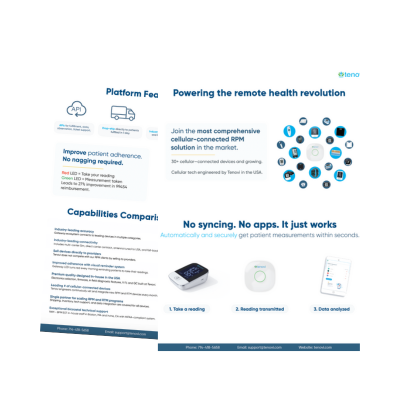

RPM facts give care teams a quick, credible way to advance a conversation about remote patient monitoring. Whether you are briefing a stakeholder, building a business case, or explaining the field to a new colleague, a handful of current statistics carries weight. The RPM facts below draw from primary sources such as federal agencies, professional societies, and peer-reviewed research, and each is chosen to reflect where the field stands today.
Remote patient monitoring has matured from a pandemic-era workaround into a standard part of chronic disease management. These RPM facts show why.
12 Remote Patient Monitoring Statistics and RPM Facts
Below is a current sampling of RPM facts drawn from published sources. We update these remote patient monitoring statistics as new data becomes available.
Fast Fact #1: Telehealth access has clinician backing
More than 80 percent of physicians report that patients have better access to care because of telehealth, according to the American Medical Association. Access is one of the clearest, most durable RPM facts to lead with in any stakeholder conversation.
Fast Fact #2: Patients want to keep virtual care
Patient demand has held steady. Surveys consistently find that a large majority of patients who have used telehealth want continued access to it, a pattern reflected in J.D. Power telehealth satisfaction research. Patient preference is among the most persuasive RPM facts for organizations weighing investment.
Fast Fact #3: Chronic disease drives the need
Six in ten U.S. adults live with a chronic disease and four in ten have two or more, per the CDC. Chronic conditions account for the majority of the nation’s health spending, which is the underlying reason RPM facts matter to payers and providers alike.
Fast Fact #4: Remote monitoring reduces hospitalizations
Multiple studies and health-system programs report meaningful reductions in hospital admissions and readmissions with remote patient monitoring. One widely cited example is AdventHealth in Florida, which reported a 60 percent reduction in hospital admissions among high-utilizing chronic-condition patients enrolled in remote monitoring.
Fast Fact #5: Medicare reimbursement is established
Remote patient monitoring has a stable set of CPT codes and a defined Medicare reimbursement pathway, maintained by CMS. Reimbursement clarity is one of the RPM facts that most often moves a stalled internal discussion forward.
Fast Fact #6: Growth remains strong
Remote patient monitoring is among the faster-growing segments in health technology, with independent analysts projecting sustained double-digit annual growth through the early 2030s. While estimates vary by source, the direction is consistent, which makes growth a safe RPM fact to cite.
Fast Fact #7: Hospital-at-home has federal support
By April 2024, CMS had approved more than 130 hospital-at-home programs across dozens of states under its Acute Hospital Care at Home waiver, according to CMS program data. Remote monitoring is a core component of these programs, making this one of the more forward-looking RPM facts.
Fast Fact #8: Patients prefer care at home
Surveys of patients and caregivers consistently find a strong preference for receiving acute and chronic care at home when it is clinically appropriate. Preference for the home setting is one of the RPM facts that resonates most with patient-experience and quality leaders.
Fast Fact #9: RPM supports rural and underserved care
Remote patient monitoring extends specialist reach into communities with limited local access. Federal telehealth funding has repeatedly targeted rural health and underserved populations, reflecting the role RPM plays in narrowing access gaps. Equity is among the most compelling RPM facts for public and community health stakeholders.
Fast Fact #10: Oncology is an expanding use case
Cancer care is a growing application for remote monitoring. Federal investment in telehealth oncology, including National Cancer Institute funding for telehealth research, signals where remote monitoring in specialty care is heading. Specialty expansion is one of the RPM facts that shows the field is still widening.
Fast Fact #11: Aging in place fuels demand
The U.S. population age 65 and older is projected to grow from roughly 58 million toward 82 million by 2050, per U.S. Census Bureau projections. An aging population that prefers to stay home is a structural driver behind many RPM facts.
Fast Fact #12: Human oversight stays central
Even as AI-enabled tools spread, care teams and patients strongly favor keeping a clinician in the loop. This is a useful RPM fact to close on, because it frames remote monitoring as a tool that extends care teams rather than replacing them.
RPM Facts at a Glance
| RPM fact | Figure | Source type |
|---|---|---|
| Adults with a chronic disease | 6 in 10 | Federal agency (CDC) |
| Physicians reporting better access via telehealth | 80%+ | Professional society (AMA) |
| AdventHealth admission reduction | 60% | Health-system report |
| CMS hospital-at-home programs approved | 130+ | Federal agency (CMS) |
| Projected U.S. population 65+ by 2050 | ~82 million | Federal agency (Census) |
Frequently Asked Questions About RPM Facts
1) What are remote patient monitoring statistics?
Remote patient monitoring statistics are data points that describe the use, outcomes, cost, and reimbursement of RPM. Reliable RPM facts come from federal agencies, professional societies, and peer-reviewed studies rather than marketing sources.
2) Why do RPM facts matter for stakeholders?
RPM facts give leaders concrete evidence to weigh adoption. Statistics on outcomes, patient demand, and reimbursement help move an internal discussion from concept to decision.
3) Does remote patient monitoring reduce hospitalizations?
Yes. Many health-system programs and studies report reduced admissions and readmissions with remote patient monitoring, particularly for patients with chronic conditions who use the service consistently.
4) Is remote patient monitoring reimbursed by Medicare?
Yes. Medicare reimburses remote patient monitoring through an established set of CPT codes maintained by CMS. Reimbursement clarity is one reason adoption continues to grow.
5) Where do the most credible RPM facts come from?
The most credible RPM facts come from primary sources such as the CDC, CMS, the American Medical Association, the U.S. Census Bureau, and peer-reviewed journals. Tenovi cites these sources and updates its statistics as new data appears.
Understanding RPM Facts
Taken together, these RPM facts describe a field that is established, growing, and grounded in patient need. Remote patient monitoring improves access, reduces avoidable hospitalizations, carries stable Medicare reimbursement, and meets a clear preference among patients to receive care at home. For stakeholders weighing a program, current remote patient monitoring statistics turn an abstract idea into a measurable opportunity, and they keep the conversation focused on better care rather than technology for its own sake.
Tenovi gives healthcare organizations the cellular-connected devices and infrastructure to run remote patient monitoring programs at scale, with reliable data and simple setup for patients. To see the difference for your team, contact us for a free demo and consultation.