On Wednesday, January 14, 2026, a massive cellular outage disrupted service for approximately 2 million Verizon customers across the United States. There were 33,000 reported issues in a single evening. Washington, D.C., and New York City were forced to issue emergency alerts advising residents to seek alternative communication methods. When cellular connectivity in remote patient monitoring (RPM) fails, the bridge between a patient and their care team vanishes. For the healthcare industry, this was a critical risk.
While many providers scrambled during the disruption, Tenovi remained 100% operational. Because Tenovi utilizes multiple cellular carriers in the U.S., our devices automatically bypassed the outage, ensuring that life-saving health data never stopped flowing.
The Critical Role of Cellular Connectivity in Remote Patient Monitoring
The recent outage underscores that an RPM program is only as reliable as its connection. Cellular connectivity in remote patient monitoring provides a consistent, real-time link for vital sign tracking without requiring the patient to have home Wi-Fi or a smartphone.
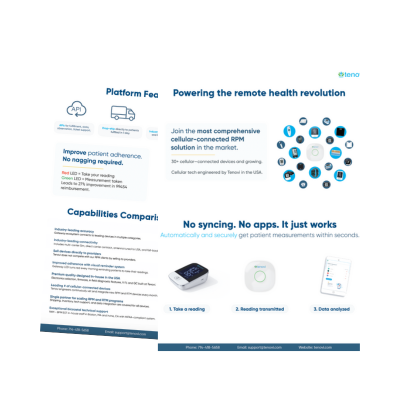
The Tenovi RPM Cellular Gateway serves as the central hub for this data. By aggregating health data from multiple Bluetooth-enabled devices, such as blood pressure monitors, scales, and pulse oximeters, the gateway transmits information directly to providers via a secure cellular network.
Cellular vs. Wi-Fi vs. Bluetooth for Remote Patient Monitoring
Not all RPM connectivity is created equal. The transport method a device uses determines how reliably patient data reaches the care team — and how much troubleshooting falls on the patient.
| Factor | Cellular (Multi-Carrier) | Wi-Fi | Bluetooth |
|---|---|---|---|
| Patient setup | Works out of the box, no pairing or apps | Requires home router and password | Requires pairing, often to a smartphone |
| Internet required? | No — connects over cellular networks | Yes — depends on home internet | Yes — needs a paired internet-connected device |
| Reliability during outages | Stays online by switching carriers | Fails if router or ISP goes down | Fails if paired device loses connection |
| Rural / dead-zone coverage | Strong with U.S.-tuned, multi-carrier hardware | Limited to home network range | Limited to short-range pairing |
| Best fit | Patients of all tech levels, especially seniors | Tech-comfortable patients with stable internet | Lower-cost programs with hands-on support |
Why Tenovi’s Connectivity is Different
In light of the Verizon disruption, it is clear that relying on a single carrier is a liability. Tenovi has engineered a “no patient left behind” approach to ensure uninterrupted access to care:
- Multi-Carrier SIM & Direct Contracts: We don’t rely on just one provider. Our devices are equipped to switch between carriers, meaning if one network goes down as it did with Verizon, the device stays online.
- USA-Tuned Hardware: Our antennas are specifically tuned for U.S. frequencies to maximize signal strength in rural or “dead zone” areas.
- Cellphone app fallback plan. For ultimate redundancy, our Gateway can pivot to an App if cellular signals are completely unavailable.
- Engineering Excellence: All Tenovi cellular integrations are completed by our engineers in the USA, ensuring a premium, defective-free experience for patients.
Benefits of a Reliable, Multi-Carrier RPM Gateway
For patients managing chronic conditions, a dropped connection isn’t an inconvenience — it’s a missed clinical signal. Consider congestive heart failure: a sudden weight gain can indicate dangerous fluid retention, the kind of early warning that lets a care team intervene before a hospitalization. If that patient’s weight scale depends on home Wi-Fi and the router is down, the reading never reaches the clinician, and the window for early action closes. Multi-carrier cellular connectivity keeps that data flowing regardless of local network conditions, so the clinical picture stays complete day to day.
When cellular connectivity in remote patient monitoring is guaranteed, the benefits to the healthcare landscape are transformative:
- Enhanced Care Coordination: Real-time data sharing allows healthcare teams to monitor conditions between appointments, regardless of local network fluctuations.
- Timely Medical Interventions: Proactive alerts can signal the need for immediate intervention, preventing emergencies before they escalate.
- Improved Patient Outcomes: Consistent data collection allows for tailored, data-driven treatment plans that lead to better long-term health.
- Reduced Healthcare Costs: By ensuring connectivity is never broken, providers can effectively reduce the risk of ER visits and hospitalizations caused by missed symptoms.
The Future of RPM Adoption
Currently, remote patient monitoring devices are being used by nearly 50 million people across the United States. The 2026 outage is a reminder for the 40% of healthcare programs currently implementing or piloting RPM. As adoption grows, the focus must shift from simple connectivity to resilient connectivity.
The necessity for contingency plans in healthcare communication systems has never been more apparent. Remote patient monitoring is transforming healthcare delivery, but it requires a foundation that can withstand national service disruptions.
Frequently Asked Questions About Cellular Connectivity in Remote Patient Monitoring
Choosing the right connectivity for a remote patient monitoring program raises a lot of practical questions about reliability, patient setup, rural coverage, and what happens when a network goes down. Below are answers to the questions providers and care teams ask most often about cellular connectivity in remote patient monitoring
What is cellular connectivity in remote patient monitoring?
Cellular connectivity in remote patient monitoring is the use of mobile networks — the same ones that power cellphones — to transmit patient vital signs from home to the care team. It removes the need for home Wi-Fi or a smartphone, sending data automatically from the device to the provider’s platform.
1.) Is cellular connectivity in remote patient monitoring more reliable than Wi-Fi?
For most patients, yes. Wi-Fi depends on a working home router and internet service; if either fails, data transmission stops. Cellular devices — especially those using multiple carriers — stay online by connecting to whichever network is strongest, making them more dependable for continuous monitoring.
2.) What happens if a cellular network goes down?
With a single-carrier device, a network outage can interrupt data transmission. Multi-carrier devices avoid this by automatically switching to another available carrier, so monitoring continues even when one network experiences a regional outage.
3.) Do patients need internet access for cellular RPM devices?
No. Cellular RPM devices connect directly over mobile networks and work right out of the box. There is no router to configure, no password to enter, and no app to download, which makes them especially well suited to older or less tech-comfortable patients.
4.) What is a multi-carrier SIM and why does it matter for RPM?
A multi-carrier SIM lets a single device connect to more than one cellular network. If one carrier has weak coverage or an outage in a given area, the device uses another, providing broader coverage and protecting against the data gaps that a single-carrier outage can cause.
5.) Why is cellular connectivity in remote patient monitoring important in rural areas?
Rural and underserved patients often lack reliable home internet. Cellular devices with U.S.-tuned hardware and multi-carrier coverage can maintain a connection where Wi-Fi cannot, helping close care gaps for the populations that benefit most from remote monitoring.
Secure Your Patient Data Today
Whether you are looking to increase patient engagement, create a more efficient workflow, or protect your program from the next major network outage, Tenovi provides the most reliable cellular connectivity in remote patient monitoring. Schedule a free demo to learn more today.