
For the millions of Americans acting as family caregivers, as well as the patients they support, digital health offers incredible benefits, including improved connection to medical teams, better management of chronic conditions, and increased safety. However, this shift has also introduced a new vocabulary that can feel overwhelming. Understanding digital health terms is the first step toward reclaiming control over a health journey.
We bridge the gap between complex medical technology and daily life by providing intuitive, cellular-connected devices. Our goal is to make these tools accessible, but true accessibility requires literacy. This glossary is designed to empower caregivers and patients with the knowledge they need to navigate modern healthcare confidently.
Understanding Digital Health Terms and Their Impact on Your Care
When you first encounter modern healthcare technology, the overarching language can be confusing. Here are the core definitions you need to know to understand the different types of digital care available to you and your loved ones.
- Digital Health: This is the broad, “umbrella” term that includes all categories where technology is used to improve health and wellness. It encompasses everything from the mobile apps you use to track steps to complex hospital software systems.
- Source for definition: U.S. Food and Drug Administration (FDA)
- Telehealth: This refers broadly to electronic and telecommunications technologies used to support remote clinical healthcare, patient and professional health-related education, and public health administration. It is important to know that telehealth is not always the same as telemedicine; telehealth is the broader category.
- Source for definition: American Academy of Family Physicians (AAFP)
- Telemedicine: A specific subset of telehealth that refers exclusively to the remote delivery of clinical services. Think of this as a virtual “doctor’s visit.”
- Source for definition: American Medical Association (AMA)
- mHealth (Mobile Health): The use of mobile and wireless technologies (such as smartphones, tablets, and wearables) to support health objectives. This includes apps for medication management, fitness tracking, and nutrition.
- Source for definition: World Health Organization (WHO)
Digital Health Terms for Monitoring at Home
As a caregiver, you are often responsible for tracking vital signs and ensuring therapeutic plans are followed. These digital health terms are critical for understanding how you can use technology to reduce stress and improve safety at home.
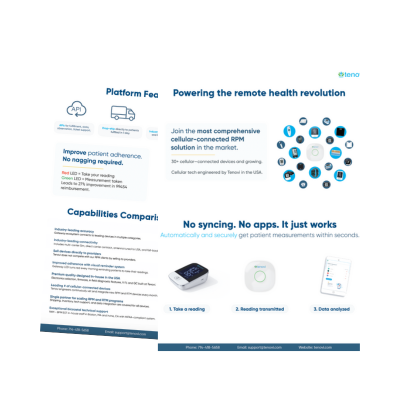
- Remote Patient Monitoring (RPM): This is the heart of at-home digital care. RPM uses digital technologies to collect medical and other forms of health data from individuals in one location and electronically transmit that information securely to healthcare providers in a different location for assessment and recommendations. At Tenovi, we specialize in cellular-connected RPM devices that are wireless with no apps and easy set up. Just plug in the Gateway, use the device, and the data is transmitted automatically.
- Remote Therapeutic Monitoring (RTM): A newer category of monitoring that focuses specifically on the therapeutic aspects of care rather than physiologic (like blood pressure). RTM devices are used to monitor therapy adherence (e.g., did the patient use their inhaler?) and therapy response (e.g., what is the patient’s pain level?).
- IoMT (Internet of Medical Things): The collection of medical devices and applications that connect to healthcare IT systems through online computer networks. Medical devices equipped with Wi-Fi, cellular connectivity, or Bluetooth allow the machine-to-machine communication that makes RPM possible.
- Wearable Health Technology: Non-invasive, autonomous devices designed to be worn on the body (such as watches or patches) that capture and track personal health data in real-time. Examples include smartwatches that track heart rate and sleep patterns.
- Source: NIH / PubMed
- Digital Therapeutics (DTx): Evidence-based therapeutic interventions that are driven by high-quality software programs to prevent, manage, or treat a medical disorder or disease. Unlike general wellness apps, these are regulated by the FDA and can be prescribed like medication to help treat specific conditions.
- Source: FDA
Terms for Getting the Right Information
The digital part of digital health is about communication, and getting the patient’s data from the home to the doctor, and the doctor’s advice back to the home. Knowing these digital health terms ensures that you can access your loved one’s records and that the care team is always informed.
- EHR (Electronic Health Record): A digital version of a patient’s paper chart. EHRs are real-time, patient-centered records that make information available instantly and securely to authorized users. Unlike EMRs, EHRs are designed to go beyond standard clinical data collected in a provider’s office and can be shared with other health care providers, such as laboratories and specialists.
- Source for definition: ONC / HealthIT.gov
- EMR (Electronic Medical Record): Digital versions of the paper charts in clinician offices, clinics, and hospitals. EMRs contain the standard medical and clinical data collected in one provider’s office. They are generally not designed to be shared easily outside the specific practice.
- Source for definition: ONC
- Interoperability: The ability of different information systems, devices, and software applications to communicate and exchange data accurately, effectively, and consistently, and to use the information that has been exchanged. When systems have high interoperability, it means the blood pressure data collected by your Tenovi scale can “talk” seamlessly to the hospital’s main EHR.
- Source for definition: Healthcare Information and Management Systems Society (HIMSS)
- Patient Portal: A secure online website that gives patients 24-hour access to personal health information from anywhere with an Internet connection. Through a patient portal, you and your loved one can view lab results, schedule appointments, request prescription refills, and communicate with the care team.
- Source for definition: ONC
- PHI (Protected Health Information): Any information in a medical record that can be used to identify an individual and that was created, used, or disclosed in the course of providing a health care service, such as a diagnosis or treatment. Protecting PHI is the foundation of privacy law.
- Source for definition: U.S. Department of Health & Human Services (HHS)
- HIPAA (Health Insurance Portability and Accountability Act of 1996): A federal law that required the creation of national standards to protect sensitive patient health information from being disclosed without the patient’s consent or knowledge. Any digital health tool used for RPM must be HIPAA-compliant.
- Source for definition: CDC
Digital Health Terms for Safer Care
The final section of our glossary covers the skills and ethical concepts required to use digital care tools effectively. This is where caregivers can truly ensure that technology acts as a bridge, rather than a barrier.
- Digital Health Literacy: The ability to seek, find, understand, and appraise health information from electronic sources and apply the knowledge gained to addressing or solving a health problem. It combines functional literacy (the ability to read and write) with computer literacy and information literacy. For caregivers, this is your most important skill.
- Source for definition: NIH / Healthy People 2030
- Digital Divide: The gap between individuals, households, businesses, and geographic areas at different socio-economic levels with regard to both their opportunities to access information and communication technologies (ICTs) and to their use of the internet for a wide variety of activities. Closing this divide is critical to equitable care.
- Source for definition: NIH
- Artificial Intelligence (AI) in Healthcare: The use of complex algorithms and software to emulate human cognition in the analysis, interpretation, and comprehension of complicated medical and healthcare data. In RPM, AI can be used to analyze large amounts of vitals data to predict which patients are at high risk of needing hospitalization before an emergency happens.
- Source for definition: FDA
Find out more about the benefits of remote patient monitoring and how Tenovi remote health monitoring is better RPM experience for patients, physicians, and healthcare teams. Schedule a free demo and consultation today with Tenovi. No syncing. No apps. It just works—automatic and secure transmission of patient measurements within seconds.