
Choosing among remote health monitoring companies has become both more important and more complicated. The market has matured from a pandemic-era novelty into core infrastructure for chronic care, and the number of vendors has grown accordingly. Asking the right questions up front is what separates a program that scales from one that stalls, because remote health monitoring companies are not interchangeable. The hardware, software, fulfillment, billing support, and clinical services they offer vary widely, and the right fit depends entirely on your clinical goals, patient population, and internal resources.
This guide lays out a practical framework for evaluating remote patient monitoring companies in 2026. It covers what these vendors actually do, how the landscape and Medicare reimbursement have changed this year, the factors that matter most when comparing options, and how to match a vendor to your specific care model. The goal is to help you build a shortlist with confidence rather than choosing on price or brand recognition alone.
What Remote Health Monitoring Companies Actually Do
“Remote patient monitoring” is often used as a catch-all, which is part of why vendor selection goes wrong. In practice, the term covers several distinct functions, and few companies do all of them equally well. Broadly, remote health monitoring companies fall into a few overlapping categories:
- Device manufacturers and connectivity providers: companies that build the FDA-cleared sensors and the cellular or Bluetooth infrastructure that transmits readings from the patient’s home.
- Software and platform providers: companies that aggregate device data, surface alerts, and present readings to care teams, often with EHR integration and billing tools.
- Full-stack and managed-service providers: companies that combine hardware, software, fulfillment, billing support, and sometimes licensed clinical staff who monitor patients on your behalf.
A common reason programs underperform is selecting a vendor whose strengths are misaligned with the actual need — for example, buying a feature-rich dashboard when the real bottleneck is device logistics, or buying devices when the real gap is clinical staffing. Naming your bottleneck before you shop is the single most useful thing you can do.
The 2026 Landscape: Why Partner Selection Has Changed
Three shifts have reshaped the market. First, remote monitoring is now a mainstream revenue and quality strategy rather than an experiment. Estimates of the global market vary, but it was valued in the multibillion-dollar range as of 2023 and is widely projected to keep growing through the end of the decade as the population ages and chronic disease prevalence rises. The clinical evidence has also strengthened: one Medicare claims-based analysis of hypertensive patients found that RPM use was associated with a 34% reduction in all-cause mortality over six months compared with non-RPM peers, alongside lower hospitalization rates.
Second, cellular-enabled devices have become the de facto standard. Devices that transmit automatically over a cellular network — with no app, no Wi-Fi, and no Bluetooth pairing — consistently outperform Bluetooth-dependent setups on long-term adherence, especially among older Medicare patients who may struggle with smartphone setup. Because billing depends on patients actually transmitting data, connectivity that removes friction directly protects revenue.
Third, market consolidation and the sheer number of vendors mean buyers now have to look past the dashboard demo. The strongest partners differentiate on operational depth — fulfillment, billing accuracy, clinical services, and compliance — not on whether they can display a blood pressure reading.
What Changed in 2026 Reimbursement
The 2026 Medicare Physician Fee Schedule introduced the most significant RPM billing update in years, and it should factor directly into vendor selection. The CMS final rule added two new CPT codes effective January 1, 2026, while leaving all prior codes in place:
- CPT 99445: device supply and data transmission for 2–15 days in a 30-day period. Previously, the existing 99454 code required 16 or more days of transmission, so shorter monitoring periods generated no device-supply revenue at all.
- CPT 99470: treatment management for the first 10–19 minutes of clinical time per month. Previously, the 99457 code required a full 20 minutes, so sessions that fell short went uncompensated.
Both new codes close gaps that left real clinical work unpaid. Notably, CMS finalized 99445 at the same reimbursement rate as 99454, roughly $47 to $52 depending on locality, even though it covers fewer days, because the practice still supplies the device for the full period. The new codes are not additive with their counterparts: for each patient in each billing period you bill either 99445 or 99454, and either 99470 or 99457, not both. Depending on how programs are layered with chronic care management, monthly per-patient reimbursement now ranges from roughly $78 at the lower thresholds to $245 or more with full management and data interpretation.
There is also good news for safety-net providers. Federally Qualified Health Centers and Rural Health Clinics can now bill the individual RPM CPT codes at national rates, following the sunset of the older bundled G0511 code on September 30, 2025. For these settings, a vendor’s ability to track transmission days and management time accurately is now central to capturing revenue.
A company’s billing software should automatically count transmission days, detect which code applies, track management time to the minute, and document the interactive communication CMS requires. Ask any prospective vendor exactly how their platform handles the 2026 codes — it is one of the clearest tests of whether they keep current.
Eight Factors to Evaluate Before You Commit
Use these criteria to compare remote health monitoring companies side by side. Weight them according to your own priorities; not every factor matters equally for every organization.
1. Connectivity: Cellular vs. Bluetooth
Cellular-connected devices transmit automatically and require only that the patient plug in a gateway or power on a device. Bluetooth devices depend on pairing to a smartphone or hub, which introduces setup friction and dropped readings. For Medicare-heavy or rural populations, cellular connectivity is usually worth prioritizing because it protects adherence — and adherence is what makes a program billable.
2. Device Breadth and Condition Coverage
Match the device catalog to the conditions you manage. A program built around hypertension, diabetes, COPD, and congestive heart failure needs blood pressure monitors, glucometers or CGMs, pulse oximeters, peak flow meters, and connected scales. Ask how many FDA-cleared devices a vendor supports, whether they add new devices regularly, and whether they integrate third-party sensors from established manufacturers.
3. Fulfillment and Device Logistics
Device shipping, provisioning, replacement, and supply replenishment are the hidden bottleneck of most programs. A vendor that offers direct-to-patient and bulk shipping, pre-provisioned devices, and fast turnaround removes a substantial operational burden from clinical staff. If you are scaling, ask about warehousing and how the vendor handles defective or returned units.
4. Software, Data Aggregation, and EHR Integration
Patient data should not live on an island. The strongest platforms aggregate readings from multiple devices into a single feed and integrate bidirectionally with major EHRs so vitals flow into the chart without manual entry. If a vendor offers API and webhook access, confirm it covers data, device activation, and fulfillment so you can automate workflows rather than rekeying information.
5. Billing and Compliance Support
Given the 2026 code changes, billing support is now a primary differentiator. Look for automatic transmission-day counting, time tracking with threshold detection, audit-ready documentation, and built-in handling of the interactive-communication requirement. Weak billing tooling quietly erases ROI through denials and missed codes.
6. Clinical Monitoring Services: Build vs. Buy
Decide honestly whether you have the staff to review incoming data and triage alerts. Some companies provide licensed clinicians who act as an extension of your team, escalating only critical issues. Others provide only the technology, leaving monitoring to you. Choosing a device-and-dashboard vendor when you lack monitoring capacity is a frequent cause of program failure.
7. Security and HIPAA Compliance
Biometric data moving from the home to the chart must be protected end to end. Confirm HIPAA-compliant infrastructure, encryption, and recognized certifications such as SOC 2. Patient de-identification capabilities and clear data-handling policies should be table stakes, not upsells.
8. Support and Customer Experience
Onboarding and ongoing support determine whether patients and staff actually use the system. Ask about response times, whether support is handled in-house, the availability of multilingual and video resources, and how the vendor incorporates client feedback. The best partners reduce operational load instead of adding another vendor relationship to manage.
Matching the Company to Your Care Model
The “best” remote health monitoring company depends on who you are:
- Primary care and specialty practices usually benefit most from a full-stack partner that handles devices, fulfillment, billing, and optionally clinical monitoring, so a lean team is not overwhelmed.
- Health systems and hospital-at-home programs tend to need deep EHR integration, enterprise security, and the ability to support acute and post-acute use cases at scale.
- FQHCs and Rural Health Clinics should prioritize cellular connectivity for connectivity-limited patients and a vendor fluent in the post-G0511 individual-code billing that took effect in 2025–2026.
- Telehealth, CCM, and RPM software companies often want a connectivity-and-fulfillment backbone they can build on through APIs, rather than a competing front-end dashboard.
Whatever the setting, the most reliable evaluation method is a short pilot: enroll a defined patient cohort for 30 to 60 days and track adherence, data quality, billing accuracy, and staff workload before committing more broadly.
How Tenovi Fits Into the Landscape
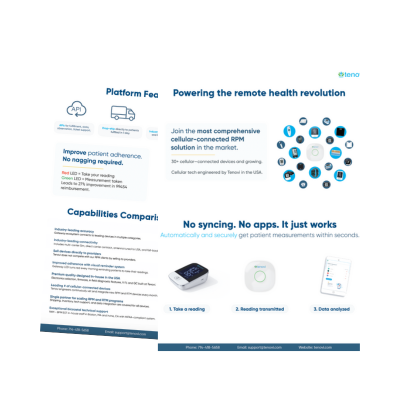
As one example of a connectivity-and-fulfillment focused provider, Tenovi concentrates on the infrastructure layer rather than competing as a front-end clinical dashboard. Its Cellular Gateway connects a broad catalog of FDA-cleared Bluetooth RPM and RTM devices and transmits readings automatically over cellular networks, no app, no Wi-Fi, no pairing, with a simple red/green LED reminder system designed to support measurement adherence.
For organizations whose primary gaps are device connectivity, fulfillment, and data aggregation through APIs, that focus can be a fit; organizations that need an all-in-one clinical platform with built-in monitoring staff would weigh it differently. As with any vendor, the right test is whether its strengths map to the bottleneck you identified at the start.
Understanding How to Evaluate Remote Health Monitoring Companies in 2026
Remote health monitoring companies play a central role in modern chronic care, but they are far from one-size-fits-all. Start by naming your real bottleneck, devices, software, fulfillment, billing, or clinical staffing, then evaluate vendors against the eight factors above, with particular attention to cellular connectivity and 2026 billing readiness. Match the shortlist to your care model, run a short pilot, and let measured adherence and billing accuracy, rather than a polished demo, make the final call.
Frequently Asked Questions
1) What should I look for in a remote patient monitoring company?
Evaluate device reliability and connectivity (cellular generally beats Bluetooth for adherence), device breadth for your conditions, fulfillment and logistics, EHR integration, billing and compliance automation, optional clinical monitoring services, security certifications, and the quality of onboarding and support. The best vendors reduce operational burden rather than adding another dashboard to manage.
2) How did Medicare RPM reimbursement change in 2026?
CMS added two new CPT codes effective January 1, 2026: 99445 for device supply over 2–15 days (reimbursed at parity with the 16-plus-day 99454 code) and 99470 for the first 10–19 minutes of treatment management. All prior codes remain in place. The new codes are not additive with their counterparts, so providers choose one or the other per patient per period. FQHCs and RHCs now bill individual CPT codes after the G0511 bundle was sunset.
3) Is cellular or Bluetooth better for remote monitoring?
For most chronic-care populations, cellular is better. Cellular devices transmit automatically and avoid app and pairing friction, which improves long-term adherence — the key driver of both clinical value and billing eligibility. Bluetooth can work for tech-comfortable patients but tends to see more dropped readings over time.
4) How much revenue can a remote monitoring program generate?
Under the 2026 code set, monthly per-patient Medicare reimbursement generally ranges from roughly $78 at lower thresholds to $245 or more when device supply, extended management time, and data interpretation are billed and, where appropriate, layered with chronic care management. Actual rates vary by geographic locality and by how consistently patients transmit data.
Ready to compare options for your program? Book a free demo with Tenovi to see how a cellular-first connectivity and fulfillment layer could fit your remote monitoring strategy.