
Healthcare providers know that the Centers for Medicare and Medicaid Services (CMS) update remote patient monitoring (RPM) CPT billing codes yearly to allow healthcare providers to implement RPM for their patients and bill for their services. This comprehensive guide outlines 2026 RPM CPT code reimbursement rates, guidelines, and documentation requirements for codes 99453, 99454, 99457, 99458, and the new 99445 and 99470 codes. This overview will help you understand how reimbursement works while remaining compliant with Medicare standards.
New RPM CPT Codes 2026
In 2026, healthcare providers have more flexibility with 2026 RPM CPT codes for fewer data transmissions and shorter care management time. However, these new codes may not be combined with the 16-day measurements codes 99454 and 99457 in the same month. The following sections provide an overview of the billing guidelines for all RPM CPT codes in 2026, including the average reimbursement rate and requirements for RPM programs.
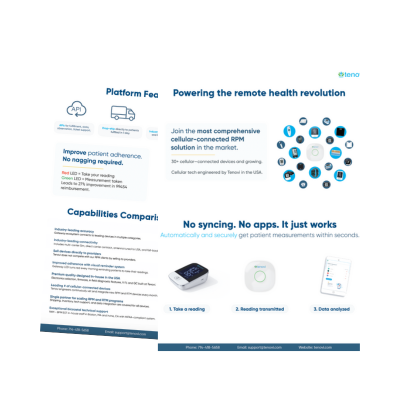
Download Tenovi’s CPT Code Descriptions with 2026 rates, below.
New RPM CPT Code 99445
The first of the new RPM CPT Codes for 2026 is CPT Code 99445. This new code covers the supply of a connected device and data transmission for 2-15 days, within a 30-day period. It allows billing for patients with lower engagement levels than the previous CPT code 99454’s 16-day minimum requirement. It is designed to be used for ongoing monitoring of post-discharge for members or patients with short-term needs. It can be billed one time per 30-day period, but cannot be combined with the 16-day measurements codes. The average national payment rate for this code is $52.00.*
Rates are based on non-facility national averages and vary by region.
New RPM CPT Code 99470
The second of the new RPM CPT Codes for 2026 is CPT Code 99470. This RPM CPT code is used for the first 10 minutes of RPM treatment management services, in a calendar month. To bill for this, one real-time interactive communication between a member or patient and a caregiver is required. It helps clinicians manage patient data from devices that are shorter impactful interactions from 10-19 minutes total. However, these new codes may not be combined with the 16-day measurements codes 99454 and 99457 in the same month. The average national payment rate for this code is $26.00.*
Rates are based on non-facility national averages and vary by region.
Existing RPM CPT Codes 2026
In 2026, CMS has introduced greater billing flexibility, and a code structure that better reflects how remote care is delivered. The existing CPT codes 99453, 99454, 99457, and 99458 are unchanged in 2026 aside from the updated rate. Below is an explanation of each RPM CPT Code for 2026, including, explanation of the code, requirements and standard rates, based on non-facility national averages, which may vary by region.
2026 RPM CPT Code 99453
The first of the RPM CPT Codes for 2026 is CPT code 99453. This covers initial one-time per device set-up and patient education on using equipment for remote physiological monitoring, such as blood pressure, pulse oximetry, and blood glucose. Furthermore, this one-time code is billed after the initial 16 days of monitoring in a 30-day period (episode of care days). The average national payment rate for CPT 99453 is $22.00.*
Rates are based on non-facility national averages and vary by region.
RPM CPT Code 99454
This RPM CPT code 99454 covers the cost of providing devices, transmitting data, data collection, and reporting services. It may be used once per month per patient, regardless of the number of devices the patient uses. The patient must use the device for at least 16 days per month. In addition, CPT 99454 is billable every 30 days. The average national payment rate for this code is $47.00*
Rates are based on non-facility national averages and vary by region.
2026 RPM CPT Code 99457
RPM CPT code 99457 comprises an initial 20 cumulative minutes of RPM services by a physician, clinical staff, or qualified healthcare professional over a 30-day period. An unspecified portion of that 20 minutes must involve interactive remote communication with the patient. There is no explicit explanation of how interactions must be provided. It is assumed that video, phone, email, and text messages all suffice. The average national payment rate for this code is $52.00.*
Rates are based on non-facility national averages and vary by region.
Moreover, RPM CPT code 99457 can be billed as ‘incident to’ under general supervision. This means that Medicare providers can contract third-party RPM companies to outsource and assist with care manager RPM services. Ultimately, offering providers the opportunity to manage more patients. Thus, resulting in more company revenue without significantly impacting the workflow. Code 99457 is billed one time each during a 30-day calendar month.
RPM CPT Code 99458
RPM CPT code 99458 encompasses reimbursement for additional increments of 20 minutes of RPM services, after the initial 20-minute minimum is met. Similar to 99457, documentation of how the time is distributed is required. The average national payment rate for CPT 99458 is $41.00.*
Rates are based on non-facility national averages and vary by region.
What are the Billing Requirements for RPM?
All Medicare beneficiaries can participate in remote patient monitoring. Some requirements exist for those who qualify for RPM. A summary of the requirements to bill for RPM CPT Codes in 2026 is as follows:
- An RPM device must fit the FDA’s definition of a medical device.
- The patient must opt in for the service before ordering the remote patient monitoring device.
- A new patient evaluation is required for a new patient to join RPM.
- Patients enrolled in RPM during the Public Health Emergency (PHE) can continue receiving RPM services.
- The patient must use the RPM device for at least 16 days a month to bill for CPT codes 99453 and 99454. This requirement is expected to be removed in January 2026.
- Data collection must be HIPAA-compliant.
Looking for More on Remote Patient Monitoring?
There are many benefits of remote patient monitoring in remote health. Medicare recognizes that RPM programs play a significant role in the future of value-based patient care. By implementing remote patient monitoring solutions, clinicians can improve the quality of care and generate more revenue.
We have also updated billing requirements and 2026 CPT Codes for remote therapeutic monitoring (RTM) and chronic care management. If you are a chronic care, telehealth, RPM services, or software company member, book a consultation and free demo to learn more about leveraging Tenovi’s remote patient monitoring devices and service solutions.