
RPM programs give care teams a steady view of how patients are doing between visits. The best ones share a clear structure, and the remote patient monitoring facts below show why that structure matters. Remote patient monitoring (RPM) has grown fast in Medicare, and so has federal attention to how it is delivered.
This guide walks through each part of a working program. It covers patient selection, consent, device choice, onboarding, monitoring cadence, escalation, staffing and documentation. It closes with a listicle of verified facts from CMS, the HHS Office of Inspector General (OIG) and peer-reviewed research.
How to Build RPM Programs, Step by Step
A program is a set of repeatable decisions. Write each one down before the first device ships. That way every nurse, care coordinator and clinician works from the same playbook.
1. Define Patient Selection Criteria
Start with who the program serves. CMS guidance in its Telehealth & Remote Monitoring booklet sets the baseline for Medicare. RPM requires an established patient relationship. The patient must have an acute or chronic condition, and monitoring must be reasonable and necessary.
Within those rules, set clinical criteria your team can apply the same way every time. Common starting groups include:
- Patients with uncontrolled hypertension
- Patients with heart failure who need weight and symptom tracking
- Patients with diabetes who need glucose trends between visits
- Patients recently discharged who face a higher readmission risk
Hypertension is a common first cohort for a reason. CDC data show only about one in five adults with hypertension has blood pressure controlled below 130/80 mm Hg.
2. Build a Clear Consent Process for RPM Programs
CMS requires patient consent at the time RPM services are provided. Make consent a scripted step in every enrollment. Explain what device the patient will use, how often readings are expected, who reviews them and how the team will respond. Record the consent in the chart with a date, so it is easy to find on audit.
3. Choose Devices That Fit the Patient
CMS requires that the device meet the FDA definition of a medical device. Data must be collected electronically and uploaded automatically to a secure location.
Clinical accuracy matters too. The American Medical Association and American Heart Association joint statement on self-measured blood pressure calls for validated devices and patient education on proper technique.
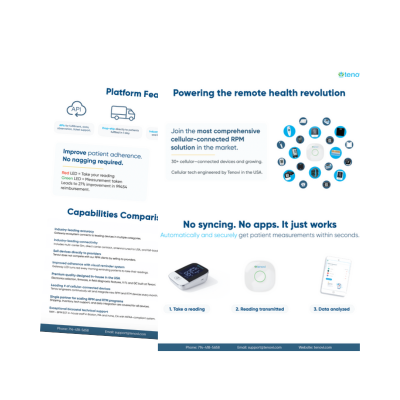
Ease of use drives adherence. Cellular-connected devices send readings without apps, pairing or Wi-Fi. That removes a common setup barrier for patients in their later years and for households with limited internet access.
4. Plan Onboarding Before Enrollment
Onboarding sets the tone for the whole episode of care. A good first session covers:
- How to take a reading correctly (for blood pressure, the AMA notes resting five minutes and emptying the bladder first)
- When and how often to measure
- What happens after a reading is sent
- Who to call with questions about the device or their health
Confirm the first reading arrives before the session ends. A patient who sees it work on day one is more likely to keep measuring.
5. Set a Monitoring Cadence
Cadence has two parts: how often the patient measures and how often staff review. The care plan sets the clinical frequency. CMS rules now recognize data collection of 2 to 15 days or 16 or more days in a 30-day period, depending on the code.
On the review side, assign a daily owner for incoming data and alerts. Michigan Medicine’s home monitoring program, for example, has nurses review vital signs and contact patients when they spot signs of trouble, with patients able to call on weekdays and weekends.
6. Write an Escalation Protocol
Escalation turns data into care. Each program needs written answers to these questions:
- Which readings trigger an alert, as set by the ordering clinician for each patient?
- Who responds first, and within what time frame?
- When does a nurse contact the patient, and when does a clinician step in?
- When is the patient directed to urgent or emergency care?
- How is each action documented?
Keep thresholds individualized. A single blanket number rarely fits every patient in a cohort.
7. Staff RPM Programs for the Work It Creates
Under current CMS guidance, auxiliary personnel can furnish remote monitoring services under the general supervision of the billing practitioner. Only physicians and practitioners eligible to bill evaluation and management services can bill RPM.
The work itself suits a team model. The AMA notes that education and counseling can come from nurses, care coordinators and pharmacists. It adds that more intense cointerventions are linked to larger improvements in blood pressure control.
Watch for policy change here. The CMS CY 2027 proposal would allow payment only when RPM or RTM is performed by clinical staff employed by the practice. It would also require a separately reportable initiating visit. These were proposals as of this writing, so confirm the final rule before changing your staffing model.
8. Document Every Component
Documentation shows the patient received the care that was ordered. For each patient, keep a record of:
- The order and the clinical reason for monitoring
- Consent, with date
- Device education and setup
- The type of data monitored and the number of days with readings
- Treatment management time and the clinical actions taken
The OIG has flagged gaps in exactly these areas, as the facts below show. Tenovi’s breakdown of the OIG report covers what it means for day-to-day billing practice.
Keep the Workflow Inside the EHR
Staff time is the scarcest resource in most RPM programs. Every extra login or copied number takes time away from patients.
Tenovi’s partnership with eClinicalWorks (eCW) addresses this directly. Readings flow through the Tenovi Cloud into the eCW dashboard and the patient record. Staff review trends and act on them in the system they already use. There is no switching between platforms and no re-keying of data. The result is a simpler daily review, cleaner documentation and one place to see the full picture.
12 Remote Patient Monitoring Facts RPM Programs Should Know
These remote patient monitoring facts come from federal agencies and peer-reviewed studies. For a broader list, see Tenovi’s fast facts on remote monitoring.
- Medicare use grew more than tenfold. About 55,000 Medicare enrollees received RPM in 2019. Slightly more than 570,000 did in 2022, according to the HHS OIG report.
- Payments grew more than twentyfold. Medicare RPM payments rose from $15 million in 2019 to more than $300 million in 2022 (OIG).
- Many patients missed a component. About 43 percent of enrollees who received RPM in 2022 did not receive all three components: education and setup, device supply and treatment management (OIG).
- Setup was the most often missed step. About 28 percent had no record of education and setup, about 23 percent had no device supply record and 12 percent had no treatment management record (OIG).
- Medicare lacks key data. OIG found Medicare has no information on the types of health data being monitored. It recommended that CMS require RPM to be ordered and capture the ordering provider.
- Shorter monitoring periods now count. For 2026, two new CPT codes cover 2 to 15 days of monitoring (99445) and the first 10 minutes of monthly treatment management (99470), per Medicare contractor Noridian.
- One practitioner per period. Only one practitioner can bill remote monitoring per patient in a 30-day period, and RPM and RTM cannot be billed together (CMS).
- Hypertension is widespread and often uncontrolled. Adult hypertension prevalence was 47.7 percent in 2021 to 2023, and 71.6 percent among adults 60 and up. Only 20.7 percent of adults with hypertension had blood pressure controlled (CDC).
- Hospitalizations dropped after home monitoring. In a Michigan Medicine study of more than 1,700 patients published in Telemedicine and e-Health, hospitalizations fell 59 percent in the six months after monitoring. Excluding COVID-19 patients, the relative reduction was 49 percent.
- Activated patients were hospitalized less often. In a JAMA Network Open cohort study, 2.4 percent of patients who activated RPM were hospitalized, compared with 3.9 percent who did not. The adjusted odds ratio was 0.68. The design was observational.
- Simple technology can be cost-effective. A 2022 systematic review of 22 studies on self-measured blood pressure with support found lower cost per unit of effectiveness with simple technologies (American Journal of Preventive Medicine, via CDC Stacks).
- More rules may be coming. The CMS CY 2027 proposed rule seeks comment on bundling RPM and RTM CPT codes into four new HCPCS G-codes, an option CMS says would address OIG recommendations.
FAQ About RPM Programs
This section answers common questions from practices planning or refining RPM programs. It covers eligibility, consent, devices, staffing, timing and EHR workflow.
1) Who is eligible for remote patient monitoring under Medicare?
Under CMS guidance, RPM requires an established patient with an acute or chronic condition, and monitoring must be reasonable and necessary. The ordering clinician decides which patients will benefit based on clinical need.
2) When does a patient need to give consent for RPM?
CMS requires patient consent at the time RPM services are provided. Most programs capture it during enrollment and record it in the chart with a date.
3) What kind of device can be used in an RPM program?
The device must meet the FDA definition of a medical device and must collect data electronically and upload it automatically to a secure location. For blood pressure, the AMA and AHA recommend devices validated for clinical accuracy.
4) Who can perform RPM work on a care team?
Under current CMS guidance, auxiliary personnel can provide remote monitoring under the general supervision of the billing practitioner. CMS has proposed for 2027 that this work be done by staff employed by the practice, so programs should confirm the final rule.
5) How many days of readings does an RPM program need each month?
CMS now recognizes data collection of 2 to 15 days or 16 or more days in a 30-day period, depending on the code. The clinical schedule for readings should still follow each patient’s care plan.
6) How does EHR integration help RPM programs run day to day?
When readings arrive in the EHR, staff can review trends and document actions in one place. With Tenovi and eClinicalWorks, readings flow through the Tenovi Cloud into the eCW dashboard and patient record without re-keying.
Understanding RPM Programs
RPM programs work best when each step is defined in advance. Clear patient criteria, documented consent, accurate devices, careful onboarding, a set review cadence and written escalation rules all support safe care at home. Federal data show rapid growth and real gaps in delivery, so complete documentation protects patients and practices alike. There are many advantages to remote patient monitoring. For more on program design, see Tenovi’s guide to RPM best practices.
Tenovi provides remote monitoring infrastructure for care that goes home with the patient. Practices get 60+ cellular-connected devices through the Tenovi Gateway or SIM-embedded devices, all on one API. Tenovi handles fulfillment, provisioning and support, so care teams can focus on patients. Contact Tenovi for a free demo and consultation.
This article is for informational purposes only and is not billing, coding, or legal advice. Reimbursement rates and coverage rules vary by payer and location and change over time. The billing provider is responsible for confirming codes, documentation, and medical necessity requirements with the payer before submitting claims. CPT® is a registered trademark of the American Medical Association.