Cellular enabled remote monitoring lets patients send vital sign data to their care team over the same cellular networks that carry mobile phone calls, with no home internet, smartphone, or device pairing required. For a patient, that often means pressing one button. For a care team, it means reliable data arriving on schedule from patients who might otherwise fall out of a program. This guide explains what cellular enabled remote monitoring is, how it works, how it differs from other connectivity methods, and why the choice of technology has a direct effect on outcomes.
Connectivity is not a technical footnote in a remote monitoring program. It is the single point where many programs succeed or quietly fail. When a device cannot transmit, the reading never reaches the clinician, the patient looks non-adherent, and the billing requirement goes unmet. Cellular enabled remote monitoring exists to remove that failure point.
What Is Cellular Enabled Remote Monitoring?
Cellular enabled remote monitoring is a form of remote patient monitoring (RPM) in which the connected medical device transmits readings over a cellular network rather than through home WiFi or a paired smartphone. Each device carries its own embedded cellular radio and SIM. When a patient takes a measurement, the device connects to the cellular network on its own and sends the reading to a secure platform, where the care team reviews it.
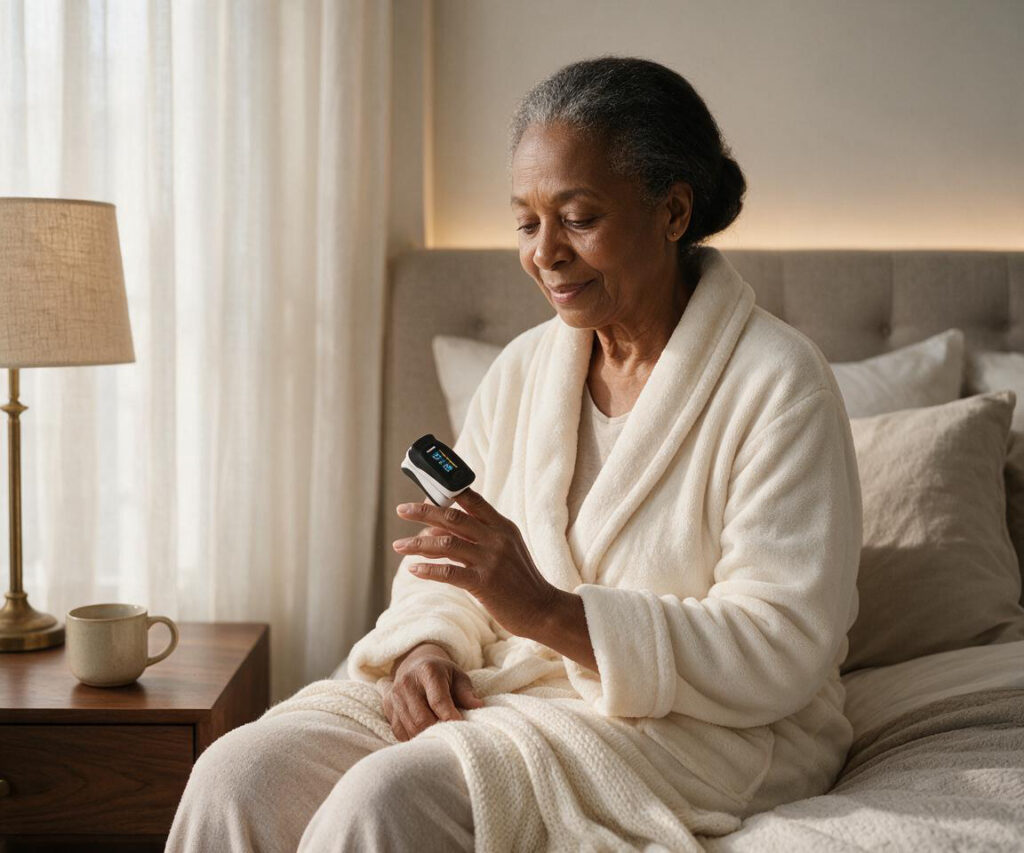
The distinction from other RPM setups is the SIM inside the device itself. A cellular blood pressure monitor, scale, glucose meter, or pulse oximeter is a self-contained unit. There is no phone to pair, no app to open, no hub to plug in, and no home internet to configure. The patient takes a reading, and the device handles the rest.
That self-contained design delivers the core promise of cellular enabled remote monitoring: the patient supplies nothing but a measurement. The connectivity lives in the device, not with the patient.
How Cellular Enabled Remote Monitoring Works
The mechanics are straightforward by design, because simplicity is the point. A typical cellular enabled remote monitoring workflow looks like this:
- The patient receives a device that arrives pre-configured and ready to use, with the SIM and data plan already active.
- The patient takes a measurement. With most cellular-enabled devices, this is a single button press.
- The device connects to the nearest available cellular network on its own and transmits the reading.
- The data flows to a secure, HIPAA-compliant platform and appears in the care team’s dashboard, often within moments.
- The clinician reviews trends, sets threshold alerts, and adjusts the care plan as needed.
Two design details separate a strong cellular enabled remote monitoring setup from a fragile one. The first is network flexibility. A device tied to a single carrier fails wherever that carrier’s coverage is weak. A device with a multi-carrier SIM connects to whichever network is strongest at the patient’s location. The second is offline resilience. Better devices store a reading when no signal is available and transmit it once a connection returns, so no data is lost in a coverage gap.
Why Cellular Enabled Remote Monitoring
The case for cellular enabled remote monitoring rests on three practical realities: many patients lack reliable home internet, adherence rises when setup is simple, and reliable transmission keeps the clinical picture complete enough to act on.
It Reaches Patients WiFi-Based Monitoring Leaves Behind
Remote monitoring is often needed most in the places where home internet is least reliable. As of June 2024, about 94 percent of U.S. homes and businesses had access to broadband from at least one provider, according to a Federal Communications Commission report, but access is not the same as a working subscription. Rural households continue to lag, and in 2024 the urban-rural gap in high-speed broadband widened in dozens of states after the Affordable Connectivity Program, which had helped more than 23 million low-income households afford service, ended. Peer-reviewed research has linked this digital divide directly to gaps in telehealth access, since approaches that depend on home broadband exclude the households least likely to have it.
A cellular enabled remote monitoring program sidesteps this barrier. If a patient has cellular coverage, they can be monitored, whether or not they have WiFi, a computer, or a smartphone.
It Improves Adherence by Removing Friction
Adherence is where connectivity quietly decides outcomes. Every extra step between the patient and a successful reading is a chance for the program to break down. Pairing a device to a phone, keeping an app updated, staying within Bluetooth range, and maintaining a home internet connection are each points of failure that generate missed readings and support calls.
Cellular enabled remote monitoring removes those steps. Clear visual cues help further: a device that signals when it is time to take a reading, and confirms when a reading has transmitted, gives patients feedback without requiring them to interpret anything on a screen. This matters most for patients managing chronic conditions such as heart failure, diabetes, kidney disease, or Alzheimer’s, where consistent daily data drives the care plan. Research in Telemedicine and e-Health found that patients who uploaded biometric data daily achieved better glycemic control than those who transmitted less often, a reminder that the value of monitoring depends on readings actually arriving.
It Keeps the Clinical Picture Complete
The value of remote monitoring comes from continuity. A single reading tells a clinician little, but a steady daily record reveals the trend that signals a patient is stabilizing or slipping. When transmission is unreliable, that record develops gaps, and the care team is left making decisions on a partial picture, the readings most likely to go missing being the ones from patients who are hardest to reach in the first place.
Cellular enabled remote monitoring protects that continuity. Consistent, reliable data means a rising blood pressure trend or a steady weight gain in a heart failure patient is caught early, while there is still time to adjust the care plan and prevent a hospitalization. Steady data also sustains the daily engagement that keeps patients connected to their own care. Reliable transmission carries a financial benefit as well, since Medicare reimbursement under codes such as CPT 99454 depends on a minimum number of days of readings, but the reason to want dependable data is the patient it keeps well, not the claim it supports.
Cellular Enabled Remote Monitoring vs. Bluetooth and WiFi
No single connectivity method is right for every patient. The honest comparison below helps match the technology to the population.
| Factor | Cellular enabled | Bluetooth (phone-paired) | WiFi-dependent |
|---|---|---|---|
| Home internet required | No | Sometimes | Yes |
| Smartphone required | No | Usually | Varies |
| Patient setup | Minimal, often one button | Pairing and app setup | Network setup |
| Works while traveling | Yes, within coverage | Only near paired phone | No |
| Main limitation | Cellular coverage gaps | Range, pairing, phone dependence | Excludes patients without WiFi |
| Best fit | Seniors, rural patients, low digital literacy | Tech-comfortable patients, lower device cost | Patients with reliable home internet |
Bluetooth devices can be a sound choice for tech-comfortable patients and often cost less. WiFi-based devices work where home internet is dependable. Cellular enabled remote monitoring earns its place with the populations that remote monitoring most often struggles to reach: patients who are older, rural, or new to technology, and those without a smartphone or reliable broadband at home.
What to Look for in a Cellular Enabled Remote Monitoring Program
Not all cellular setups are equal. When evaluating cellular enabled remote monitoring, these features separate reliable programs from ones that generate support tickets:
- Multi-carrier connectivity. A device that can switch to the strongest available network avoids single-carrier dead zones. Single-carrier programs are vulnerable to outages, as the 2026 Verizon network outage demonstrated for programs with no fallback.
- Offline storage. The ability to hold a reading and transmit it once signal returns prevents lost data in coverage gaps.
- No apps or pairing. The fewer steps a patient must complete, the higher the adherence, particularly for seniors.
- Clear on-device feedback. Simple visual cues that signal when to take a reading and confirm a successful transmission help patients follow their schedule without a screen to interpret.
- Clean data integration. Readings that flow through one API into any RPM dashboard keep the clinical workflow simple, even when a patient uses more than one cellular device.
Frequently Asked Questions About Cellular Enabled Remote Monitoring
1) What is cellular enabled remote monitoring?
Cellular enabled remote monitoring is remote patient monitoring in which the medical device sends readings over a cellular network instead of home WiFi or a paired smartphone. Patients need no internet, app, or pairing, which makes the technology accessible to a wider population.
2) How is cellular enabled remote monitoring different from Bluetooth monitoring?
Bluetooth devices usually pair to a nearby smartphone and often depend on home internet to relay data. Cellular enabled devices transmit directly over cellular networks, so they work without a phone or WiFi and tend to require far less setup.
3) Does cellular enabled remote monitoring work without internet?
Yes. That is its central advantage. As long as the patient has cellular coverage, the device can transmit, which reaches households that lack a broadband subscription or a smartphone.
4) Why does connectivity affect remote monitoring outcomes?
A reading only helps a patient if it reaches the clinician. Reliable connectivity keeps data flowing, which supports better clinical decisions, higher adherence, and continued eligibility for Medicare reimbursement that depends on a minimum number of transmitted readings.
5) Who benefits most from cellular enabled remote monitoring?
Patients who are older, live in rural or underserved areas, have limited experience with technology, or lack reliable home internet benefit most. These are the same populations that WiFi-based and phone-paired monitoring most often fail to reach.
6) What should care teams look for in a cellular monitoring program?
Look for multi-carrier connectivity, offline data storage, no apps or pairing, a single integration path for the data, and support for a broad range of devices. Together these features keep readings arriving reliably and reduce the support burden on staff.
Understanding Cellular Enabled Remote Monitoring
Cellular enabled remote monitoring solves the problem that quietly undermines many remote monitoring programs: getting reliable data from patients who lack WiFi, a smartphone, or the comfort to manage either. By transmitting readings over cellular networks with minimal steps for the patient, it reaches populations that other connectivity methods leave behind, improves adherence by removing friction, and keeps the steady stream of data that lets care teams intervene before a problem becomes a hospitalization. The strongest programs pair that simplicity with multi-carrier connectivity and offline resilience, so a reading taken in a rural kitchen still reaches the care team on time. Connectivity, in other words, is not a detail. It is the foundation a program stands on.
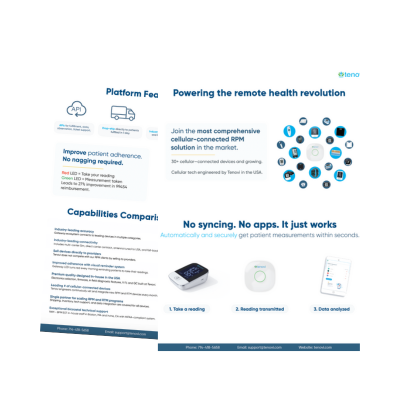
Tenovi builds cellular enabled remote monitoring around that principle. Its cellular-enabled devices, including a blood pressure monitor, weight scale, blood glucose meter, and pulse oximeter, each carry an embedded cellular connection with a multi-carrier SIM, so they connect to whichever network is strongest and are not left stranded by a single-carrier outage. Readings transmit over LTE technology to any RPM dashboard through one API, with no apps, no syncing, and clear visual cues that support daily use. To see how reliable connectivity can strengthen your program, contact Tenovi for a free demo and consultation.