
The landscape of Medicare is undergoing a fundamental shift. For years, technology-enabled care has struggled to fit within traditional fee-for-service (FFS) models that prioritize the volume of activities over the quality of results. However, a recent announcement from the CMS Innovation Center marks a turning point for healthcare providers and digital health innovators. The introduction of the CMS ACCESS Model (Advancing Chronic Care with Effective, Scalable Solutions) represents a major step toward modernizing Medicare’s care infrastructure through Outcome-Aligned Payments.
What is the CMS ACCESS Model?
The CMS ACCESS Model is a transformative initiative designed to expand access to technology-supported chronic disease management such as remote patient monitoring. Unlike traditional billing codes that reimburse for specific tasks (20 minutes of monitoring), this model introduces Outcome-Aligned Payments (OAPs).
As outlined in recent research published by JAMA, this payment option rewards measurable clinical outcomes. Instead of checking boxes, your organization is rewarded for the actual health improvements your patients achieve relative to their baseline.
Research and Insights on the CMS ACCESS Model
In their perspective for JAMA, Jacob Shiff, MBA, and Abe Sutton, JD, highlight how the CMS ACCESS Model bridges a critical gap in care. While Medicare Advantage patients often benefit from remote care tools, original Medicare beneficiaries have historically lacked integrated, technology-enabled support.
The research emphasizes three critical shifts for businesses:
- Traditional FFS models can incentivize more activities to increase revenue. The ACCESS model flips this by paying for clinical control, such as stabilized blood pressure or blood sugar.
- Because payments are tied to results rather than specific minutes, organizations have the flexibility to deliver care virtually, in person, or through asynchronous monitoring.
- The model covers four essential care tracks: cardio-kidney-metabolic, musculoskeletal, and behavioral health conditions.
Q&A: Understanding the Practicalities of the CMS ACCESS Model
For organizations looking to scale in the value-based care space, below are commonly asked questions surrounding the CMS ACCESS Model. We break down the technicalities and operational shifts required to move from activity-based billing to outcome-aligned success, to help position your practice to capture maximum reimbursement while improving patient lives. For more detail questions on the CMS ACCESS Model, you can visit CMS’s frequently asked questions page.
How do Outcome-Aligned Payments (OAPs) work?
OAPs are recurring payments for managing a patient’s qualifying condition. CMS determines the final payment based on the share of patients who meet defined clinical targets, such as a specific reduction in blood pressure or HbA1c levels. Typically, 50% of the Medicare portion is paid monthly, while the remaining 50% is withheld and reconciled based on your ability to meet these clinical outcome thresholds.
Which clinical areas are covered?
The model is currently divided into four distinct tracks:
- Early Cardio-Kidney-Metabolic (eCKM): Focuses on hypertension, prediabetes, and obesity.
- Cardio-Kidney-Metabolic (CKM): Covers advanced diabetes, CKD, and heart disease.
- Musculoskeletal (MSK): Targets chronic pain management.
- Behavioral Health (BH): Addresses depression and anxiety disorders.
What are the technical requirements for participating businesses?
To qualify, organizations must be enrolled in Medicare Part B and have a designated physician Clinical Director. On the technical side, you must be able to submit clinical data electronically via FHIR-based APIs—manual data entry is not permitted. You also need the infrastructure to capture biometric data (like weight or blood pressure) and Patient-Reported Outcome Measures (PROMs).
How does ACCESS coordinate with primary care and referring providers?
ACCESS integrates with traditional care so that primary care and referring clinicians can refer patients to participating organizations. Clinicians receive electronic updates from ACCESS organizations on each of their patients’ progress. A new co-management payment is then billed for documented review and coordination activities.
Why Your Business Needs to Adapt Now
Transitioning to an outcome-aligned payment structure requires a change in billing, but more important: a robust technology infrastructure. To earn the full rewards under the CMS ACCESS model, organizations must accurately track and report clinical indicators like blood pressure, HbA1c, and weight.
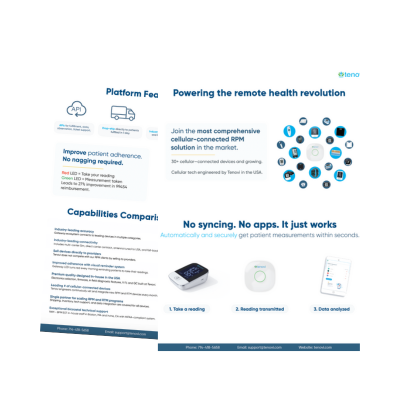
This is where Tenovi can help. We provide the cellular-connected remote patient monitoring devices and data-driven insights necessary to prove these clinical improvements. By leveraging our infrastructure, your practice can focus on patient care while our technology handles the rigorous data capture required for the ACCESS model.
Ready to Scale with Tenovi?
The CMS ACCESS Model offers a stable, 10-year horizon for organizations to invest in long-term, technology-enabled care strategies. Don’t wait for the industry to pass you by—start building your outcome-based practice today.
Explore how we help you succeed under the CMS ACCESS Model here.