
Federally Qualified Health Centers (FQHCs) enter 2026 with a different set of rules for FQHC remote patient monitoring than in the past. FQHCs and Rural Health Clinics (RHCs) serve patients who often live far from specialists and face long gaps between visits. Remote patient monitoring helps close those gaps by collecting physiological data between appointments and sending it to the care team.
How FQHC Billing Differs From a Physician Practice
The codes are the same, but the payment context is not. FQHCs are paid under the Medicare Prospective Payment System (PPS) for face-to-face visits, and RPM sits outside that PPS encounter rate. That separation is what makes remote patient monitoring additive revenue rather than a service folded into an existing visit payment.
Because of the PPS structure, most general RPM billing guides do not apply cleanly to a health center. The setup and management codes still require the same clinical work, the same live interactive contact each month, and the same contemporaneous documentation. What differs is where the payment lands and how it stacks on top of the center’s core funding.
FQHCs can also pair RPM with Advanced Primary Care Management (APCM), the bundled monthly care model available to health centers using codes G0556 through G0558. When a patient receives both, RPM and APCM can be reported in the same month, which lets a center combine steady monthly care coordination with condition-specific monitoring.
Documentation Is the Audit Line
Every minute of staff time, every patient contact, and every data review has to be logged as it happens, not reconstructed at month end. The Office of Inspector General has flagged RPM documentation as a growing audit focus, and reconstructed logs are exactly what draws scrutiny.
For a health center, the safest approach is automated time tracking inside the RPM platform, so the audit trail builds itself. The record should show the number of transmission days, which supports the 99445 versus 99454 decision, and the total management minutes, which supports the 99470 versus 99457 decision. Clean logs are what turn a compliant program into a durable one.
Rural Health Transformation Funding and RPM
The billing changes are only half of the 2026 story. The other half is new capital. In December 2025, CMS announced that all 50 states would receive awards under the Rural Health Transformation (RHT) Program, a $50 billion initiative running from federal fiscal year 2026 through 2030 at $10 billion per year.
First-year state awards average roughly $200 million, ranging from about $147 million to $281 million. Half of each year’s funding is split equally among approved states, and half is allocated by rural population, facility condition, and the quality of a state’s proposed projects. The program was established under Public Law 119-21.
This is where FQHC remote patient monitoring connects to the funding conversation. RHT dollars do not flow directly from CMS to a health center. They flow to states through cooperative agreements, and states decide how to deploy them locally. Remote patient monitoring is named across state plans as a qualifying use, alongside broader goals like adopting innovative technology, expanding remote care access, and strengthening the rural workforce.
For an FQHC, that means the money to stand up or expand an RPM program may be available through the state, not only through Medicare reimbursement. Health centers can position themselves as implementation partners or sub-award recipients under their state’s plan. The practical steps are to track your state’s RHT website, watch for funding opportunities and requests for proposals, and map where your center’s RPM goals align with state priorities. Our rural health monitoring overview covers how these programs fit rural care delivery.
Because states move at different speeds, some were operational in early 2026 while others were still finalizing budgets with CMS, timing matters. Centers that understand their state plan early are better placed to capture funding when it opens.
Building a Program That Lasts
Reimbursement rules and grant funding both reward the same thing: a program that is well run and well documented. A sustainable FQHC remote patient monitoring program starts with matching devices to the patient population, whether that is blood pressure, blood glucose, weight, or pulse oximetry, and choosing hardware that patients can actually use without heavy support.
From there, the pieces that keep a program compliant and profitable are a HIPAA-compliant platform, reliable cellular-connected devices that do not depend on a patient’s home internet, staff trained on both the clinical workflow and the 2026 billing rules, and metrics that prove the program’s value. Useful measures include patient and provider satisfaction, clinical outcomes at the population and individual level, adherence to the monthly billing thresholds, and return on investment. Our remote patient monitoring ROI guide can help frame those numbers.
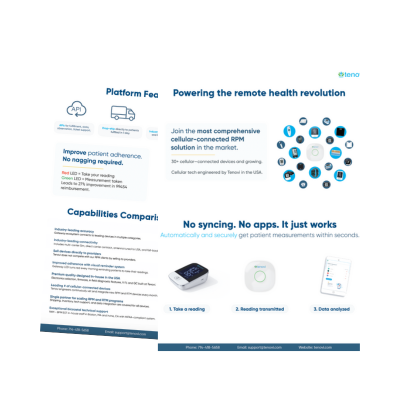
Devices that transmit automatically, without asking patients to pair phones or manage apps, tend to hold adherence better in FQHC and RHC populations. Higher adherence means more billable transmission days and stronger clinical data, which supports both reimbursement and outcomes.
What Changed for FFS FQHC Remote Patient Monitoring in 2026
For years, FQHCs and RHCs billed care management, including RPM, through a single bundled HCPCS code, G0511. That code is no longer valid. CMS sunset G0511 on September 30, 2025, after a six-month transition window, and it should not appear on any 2026 claim. Claims submitted with G0511 after that date are denied.
In its place, FQHCs now report the individual RPM CPT codes at the national non-facility Physician Fee Schedule (PFS) rate. This is the same code set physician practices use, and for most centers it pays more per patient than the old bundled rate did. The practical effect is that FQHC remote patient monitoring is now billed with precision rather than lumped into one flat payment.
This matters for revenue. Under G0511, a center received one bundled payment regardless of how much monitoring a patient needed. Under the individual codes, a center is paid for setup, device supply, and management time separately, so higher-touch patients generate more appropriate reimbursement.
The 2026 RPM CPT Codes FQHCs Use
Beginning January 1, 2026, FQHCs and RHCs may bill the following RPM codes at national non-facility PFS rates. Rates are national averages and vary by region.
- CPT 99453 covers the one-time patient setup and education, roughly $22.
- CPT 99454 covers device supply and data transmission for 16 or more days in a 30-day period, roughly $47.
- CPT 99445 is new for 2026 and covers device supply for 2 to 15 days of data in a 30-day period, roughly $47. It is mutually exclusive with 99454.
- CPT 99457 covers the first 20 minutes of treatment management time with at least one live interactive contact, roughly $52.
- CPT 99470 is new for 2026 and covers 10 to 19 minutes of management time with at least one live interactive contact, roughly $26. It is mutually exclusive with 99457.
- CPT 99458 covers each additional 20 minutes of management time, roughly $41, and can be billed in repeat increments once 99457 is met.
This material is provided for general informational and educational purposes only and does not constitute legal, compliance, billing, coding, or reimbursement advice. CPT® codes, descriptions, and Medicare payment rates referenced here are drawn from publicly available sources, are subject to change, and may vary by payer, locality, and patient circumstances. Tenovi makes no representation or guarantee regarding coverage, payment, or the appropriateness of any code for a particular patient or service, and any presented are illustrative only. Providers are solely responsible for independently determining medical necessity and applicable coding, coverage, documentation, and billing requirements and for submitting accurate claims. Consult applicable payer guidance and qualified billing, coding, compliance, or legal professionals before making billing decisions. CPT® is a registered trademark of the American Medical Association.
Understanding FQHC Remote Patient Monitoring in 2026
FQHC remote patient monitoring changed in two ways this year. The $50 billion Rural Health Transformation Program gives states new funding that can support RPM, though those dollars flow through state plans rather than directly from CMS. Together, these shifts make 2026 a practical moment for health centers to build or expand a program, with both a clearer payment path and a potential source of startup capital. Strong documentation and the right devices remain the foundation of a program that stays compliant and delivers proactive, preventive care to the patients who need it most.
Tenovi helps care organizations, providers, and health centers build remote patient monitoring programs around FDA-cleared, cellular-connected devices and a platform that transmits data automatically. If your team is planning an FQHC or RHC program for 2026, we can help you match the right devices and software to your patient population. Contact us for a free demo and consultation.