
This article is part of the Tenovi RPM Outcomes Case Study Series that spotlights data, results, and insights from remote patient monitoring programs running on Tenovi connected devices. Each installment features one anonymized client success story, showing what happens when reliable at-home data reaches a care team in time to act, and the outcomes that follow for patients.
Case Studies in the series:
- How a Remote Patient Monitoring Program Improved Blood Pressure Control in One Quarter
- How One RPM Company Turned 2.5 Million Data Points Into Better Patient Outcomes
- How RPM Caught a Heart Failure Warning Sign Overnight (Current Article)
For a closer look at the results, download the full Case Study <<Case Study Link>>
Remote patient monitoring can help reduce heart failure hospitalizations by catching the earliest warning signs at hom, often days before a patient feels sick enough to call. Sudden weight gain is one of the clearest signals of fluid retention in congestive heart failure, and it can appear overnight. This case study is the story of one patient at a multi-specialty virtual care practice whose 8-pound overnight weight gain was flagged in real time, letting her care team intervene the same day and prevent a trip to the ER.
Remote Patient Monitoring and Heart Failure: Catching the Warning Signs Early
Remote patient monitoring for heart failure works because the earliest warning signs often show up at home, days before a patient feels sick enough to call. Sudden weight gain is one of the clearest signals of fluid retention in congestive heart failure (CHF), and it can appear overnight. CHF weight monitoring gives care teams a way to see that change as it happens, not after a patient lands in the emergency room.
This is the story of one patient at a multi-specialty virtual care practice, and how continuous monitoring turned a dangerous overnight change into a same-day intervention.
What Happened: An 8-Pound Overnight Weight Gain
A 60-year-old woman with heart failure was enrolled in the practice’s remote patient monitoring program, using a Tenovi connected scale as part of her daily routine. One morning her weight reading jumped 8 pounds compared to the night before.
A gain of that size in a single day is a recognized red flag for fluid overload in heart failure patients. According to the American Heart Association, a weight gain of 2 to 3 pounds in a day or 5 pounds in a week can signal worsening heart failure and should prompt a call to a care provider.
Because the reading transmitted automatically through the Tenovi Gateway, the care team saw it right away. There was no waiting for the patient to notice symptoms or schedule a visit.
The Same-Day Response
The care team confirmed active CHF symptoms the same day. They reviewed her current medications and escalated the case to a heart failure nurse practitioner. An oral diuretic was recommended within hours.
The next day, her weight dropped 10 pounds and her symptoms resolved. A potential emergency room visit was avoided entirely.
This is what proactive, preventive care looks like in practice. The value was not the device on the counter. It was the data reaching a clinician in time to act.
Why Reliable Monitoring Matters for Heart Failure
Heart failure is one of the most common reasons for hospital readmission in the United States. Research published by the National Institutes of Health shows that daily weight tracking paired with prompt clinical response can reduce heart failure hospitalizations when the data is actually monitored and acted upon.
The key phrase is “acted upon.” A scale alone does not change outcomes. Remote patient monitoring changes outcomes when three things line up:
- Devices reliable enough that clinicians trust the readings
- Continuous transmission so no reading is missed
- A monitoring team ready to respond the same day
At this practice, that combination produced a 22% decrease in hospitalizations across enrolled patients.
Inside the Program
The practice built its program on Tenovi remote patient monitoring infrastructure. The scope of the deployment shows how broad a modern RPM program can be:
- 5,000+ connected Tenovi devices in the field
- 5+ device types, including blood pressure monitors, scales, glucometers, and pulse oximeters
- Partnership launched in 2025
- 22% decrease in hospitalizations across enrolled patients
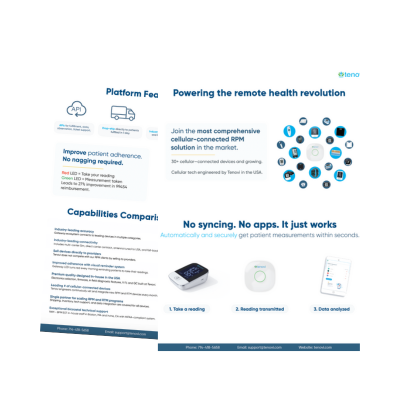
Patients never log a number by hand. Readings from the connected scale, blood pressure monitor, or other devices transmit through the Tenovi Gateway to the care team automatically. That reliability is what let the team catch an 8-pound overnight change before it became an emergency.
Download the full Case Study <<Case Study Link>>
Frequently Asked Questions
1) How does remote patient monitoring help heart failure patients?
Remote patient monitoring lets care teams track daily vitals like weight, blood pressure, and oxygen saturation from a patient’s home. For heart failure, daily weight tracking is especially useful because sudden weight gain signals fluid retention. When readings transmit automatically, clinicians can intervene early, often before the patient feels sick enough to seek care.
2) Why is weight gain a warning sign in congestive heart failure?
In congestive heart failure, the heart cannot pump efficiently, which causes fluid to build up in the body. That fluid shows up as rapid weight gain. A jump of 2 to 3 pounds in a day or 5 pounds in a week is a common threshold for concern and usually warrants a call to a care provider.
3) Can remote patient monitoring prevent hospitalizations?
Remote patient monitoring can help reduce avoidable hospitalizations when reliable devices are paired with a clinical team that acts on the data. In the case described here, the practice saw a 22% decrease in hospitalizations across its enrolled patient population.
4) What devices are used in a heart failure monitoring program?
Common devices include connected weight scales, blood pressure monitors, pulse oximeters, and glucometers. The right mix depends on the patient’s conditions. A heart failure program almost always includes a connected scale for daily weight tracking.
Understanding Remote Patient Monitoring for Heart Failure
Remote patient monitoring for heart failure gives care teams a continuous view of the vitals that predict trouble, with daily weight as one of the most important. In this case, a Tenovi connected scale flagged an 8-pound overnight gain, the care team intervened the same day, and the patient’s weight dropped 10 pounds within 24 hours with no emergency room visit. Across the program, reliable monitoring contributed to a 22% decrease in hospitalizations, all built on 5,000+ connected devices and 5+ device types.
Tenovi provides the connected device infrastructure that powers remote patient monitoring programs like this one, capturing patient data continuously and delivering it to care teams in real time. If you want to see how Tenovi can support your RPM program, contact us for a free demo and consultation.