Remote health solutions are technologies that deliver clinical care, monitoring, and consultation to patients outside a traditional healthcare facility. The four main categories are telehealth and telemedicine, remote patient monitoring (RPM), store-and-forward services, and mobile health applications. Together they extend care to patients who cannot easily reach a clinic.
These technologies now reach a large and growing share of American patients. According to an HHS Office of Inspector General report, nearly one million Medicare enrollees received remote patient monitoring in 2024 — up 27% from the prior year, and up from just 44,500 patients in 2019. As of January 1, 2026, CMS broadened the monitoring durations Medicare covers, extending eligibility to patients who previously did not qualify.
This guide covers what each category of remote health solution does, where each one fits clinically, how to evaluate hardware and platform options, and which patients Medicare covers as of 2026 — including for the rural and underserved communities where access gaps are widest.
The Four Types of Remote Health Solutions
Most remote health programs combine two or more of these categories rather than relying on a single one.
| Type | How it works | Best suited for | Connectivity needed |
|---|---|---|---|
| Telehealth / telemedicine | Live video or phone visits between patient and provider in real time | Primary care follow-ups, behavioral health, specialist consults | Reliable video-grade broadband |
| Remote patient monitoring (RPM) | Connected devices capture physiologic data at home and transmit it to the care team | Hypertension, diabetes, heart failure, COPD, post-discharge care | Low — cellular devices need no home internet |
| Store-and-forward | Clinical images or data are sent asynchronously for a specialist to review later | Dermatology, radiology, ophthalmology, pathology | Intermittent; no live session required |
| Mobile health (mHealth) | Smartphone apps track symptoms, medications, and wellness goals | Medication adherence, self-management, patient education | Intermittent; data can queue and sync later |
Telehealth and telemedicine
Telehealth platforms provide HIPAA-compliant environments for virtual consultations, chronic disease review, telepharmacy, and EHR-integrated documentation. Live video is the most widely used form of remote care because it lets a provider examine and observe a patient directly.
Its main constraint is bandwidth. A video visit needs sustained upload and download capacity, which makes telemedicine the category most exposed to broadband gaps. Telehealth in rural communities works best where that infrastructure already exists.
Remote patient monitoring
Remote patient monitoring uses connected medical devices — blood pressure cuffs, glucometers, pulse oximeters, weight scales, peak flow meters, and pillboxes — to collect physiologic readings in the patient’s home and transmit them to the clinical team between visits.
RPM differs from the other categories in one operationally important way: it does not require the patient to have home internet. Cellular-connected devices transmit over the mobile network on their own, which makes RPM the most deployable remote health solution in areas with poor broadband. This is the practical distinction that determines whether a program can serve rural patients at all.
RPM is most established in hypertension, diabetes, congestive heart failure, and COPD, where frequent measurement changes clinical decisions. It also supports post-surgical recovery, pregnancy and postpartum care, and medication adherence — our guide to what remote patient monitoring is used for covers the full range of conditions and the devices matched to each.
Store-and-forward
Store-and-forward telehealth transmits clinical data, images, or video asynchronously to a specialist who reviews and responds later. Because no live session is required, it functions on intermittent connections. Teledermatology, teleradiology, teleophthalmology, and telepathology are all mature store-and-forward specialties.
The Indian Health Service runs one of the longest-standing examples: the IHS-Joslin Vision Network teleophthalmology program, which screens for diabetes-related blindness.
Mobile health applications
Mobile health apps extend care through smartphones and wearables — symptom tracking, medication reminders, digital therapeutics, and patient education. Because apps can store data locally and transmit when a network becomes available, they tolerate connectivity gaps that would break a video visit. Wearable devices fall into this category when they feed patient-facing apps rather than clinical monitoring workflows.
Key Benefits of Remote Health Solutions
Expanded access. Roughly 60 million Americans — about 20% of the population — live in rural areas with limited healthcare access. Remote solutions remove travel distance as a barrier to routine care.
Earlier intervention. Continuous or frequent data lets clinicians catch deterioration before it becomes an emergency. Patients with reduced access to preventive care are more likely to delay treatment until a condition becomes acute, which worsens outcomes and raises costs for patients and health systems alike.
Better chronic disease control. In the UC Davis Health ACTIVATE program, run with community health centers in underserved and rural communities, 50 patients transmitted more than 10,000 glucose and blood pressure readings in the first six months. By the program’s end, most participants had reached healthy glucose levels and lower blood pressure.
More care per clinician. A nurse reviewing transmitted readings works asynchronously and by exception, rather than one appointment at a time. That lets a single care team follow a much larger panel of patients than a clinic schedule allows — which matters most where clinician shortages are worst.
Longer, steadier engagement. Patients stay in remote programs longer than they used to. Average Medicare RPM episode length grew from 1.7 months to 5.2 months between 2019 and 2023, a sign that patients are staying engaged rather than dropping out after a few weeks. For chronic conditions, sustained monitoring is what changes outcomes.
Less travel burden. Eliminating trips for routine checks and chronic care management saves patients hours and mileage — a substantial barrier when the nearest clinic is an hour away — and frees clinic capacity for visits that genuinely require in-person care.
How to Choose a Remote Health Solution
Three questions determine which solution fits, and they are worth answering in order.
1. Do you need hardware, a software platform, or clinical services?
These are separate layers, and vendors rarely do all three well.
- Hardware is the connected device layer — the cuffs, meters, scales, and gateways that generate the data, plus the API that delivers it.
- Software platforms provide the clinical dashboard, alerting, care plans, documentation, and billing workflow.
- Clinical services supply the staff who review readings and log the monthly management time that reimbursement requires.
A program can source these from one vendor or assemble them. Sourcing hardware separately usually gives you a wider device catalog and avoids being locked into a single platform’s roadmap.
2. What condition and setting are you monitoring?
Condition drives device selection. Hypertension needs a validated blood pressure monitor; diabetes needs a glucometer or CGM; heart failure needs a scale and blood pressure; COPD and asthma need a pulse oximeter and peak flow meter; medication adherence needs a smart pillbox or pill-bottle sensor.
Setting drives connectivity. A patient in a connected suburban home can use a Bluetooth device paired to a smartphone. A patient in a rural county with no home internet and limited phone literacy needs a cellular device that transmits on its own.
3. How will patients actually connect?
This is where remote health programs most often fail. Bluetooth pairing requires a smartphone, an app, and a patient willing to maintain both. Cellular devices remove all three requirements — the patient takes a reading and the data transmits automatically.
For any population that skews older, lower-income, or rural, cellular connectivity is not a nice-to-have. It is the difference between an enrolled patient and an adherent one.
Remote Health Solutions for Rural and Underserved Communities
Rural patients face long travel distances, fewer facilities, and limited provider options. Those barriers contribute to higher premature mortality from the five leading causes of death: heart disease, cancer, unintentional injuries, chronic lower respiratory disease, and stroke.
The broadband picture in 2026
Rural connectivity has improved substantially, but the gap that matters for telehealth remains. In the FCC’s 2026 broadband deployment report, 96.9% of Americans have access to fixed terrestrial broadband at 100/20 Mbps, and the share of rural Americans lacking that benchmark fell more than 44% over two years. Yet combined fixed-wireline and 5G coverage reaches 98% in urban areas versus only 61.1% in rural areas. An estimated 10.5 million Americans still lack fixed terrestrial service at the 100/20 benchmark — more than 9 million of them in rural areas, plus roughly 500,000 on Tribal lands.
The operational takeaway: video-based telemedicine remains out of reach for a large rural minority, while cellular RPM does not depend on the home broadband that those patients lack.
Where the need is most acute
Appalachia. The 13-state Appalachian region faces persistent access challenges. A CDC analysis of BRFSS data found residents of distressed Appalachian counties were 1.4 times more likely to have diabetes than residents of non-Appalachian counties. Programs like the Growing Rural Economies with Access to Technology (GREAT) initiative have expanded broadband, and fiber adoption positions the region well for remote care.
Native American reservations. Roughly 24% of people living on Tribal lands lack broadband access, and the FCC’s 2026 report still counts about 500,000 residents of Tribal lands without fixed service at the 100/20 Mbps benchmark. The Indian Health Service runs two national telehealth programs — the IHS-Joslin Vision Network for diabetes-related blindness prevention, and the Telebehavioral Health Center of Excellence — plus numerous regional programs, with specialty coverage in behavioral health, dermatology, endocrinology, wound management, and rheumatology that varies by location.
Midwest and Great Plains. Altru Health System, a North Dakota nonprofit, went from 180 providers using telemedicine before the pandemic to almost all of its 393 providers — delivering video visits, phone visits, message-based eVisits, and provider-to-provider consults across its coverage area. Altru participates in the Great Plains Telehealth Resource and Assistance Center (gpTRAC), a federally funded program offering free telehealth training, consultations, and resources to organizations implementing or expanding remote care.
Adoption is not the same as equity
Remote care expanded sharply during the pandemic but still failed to reach many underserved populations, and significant disparities persist. Closing them takes deliberate design choices — cellular over app-dependent hardware, asynchronous over live-video workflows, and enrollment support for patients with low digital literacy.
Remote monitoring also works better when it addresses the behavioral side of self-management, not just the physiologic one. Building psychological flexibility into remote care strategies is what connects data collection to actual behavior change.
Remote Health Solutions from Tenovi
Tenovi supplies the hardware and data layer for remote health programs. We build cellular and Bluetooth remote monitoring devices and deliver their readings through a single API to whichever clinical platform a program already uses.
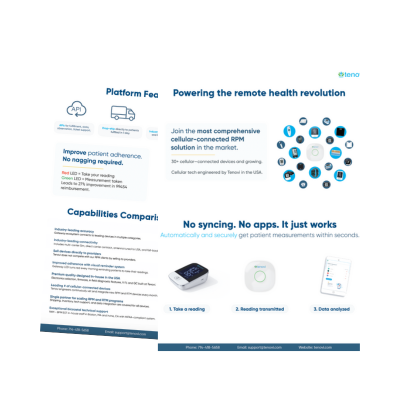
How the connectivity works. Tenovi devices transmit through a cellular gateway or built-in cellular radio. No smartphone app, no Bluetooth pairing, no home Wi-Fi. A patient takes a reading and the data arrives in the care team’s platform automatically. That design is why Tenovi devices deploy in rural counties and among elderly populations where app-based programs struggle to hold adherence.
Device catalog. More than 40 FDA-cleared and FDA-listed devices across blood pressure, blood glucose, pulse oximetry, weight, bariatric weight, temperature, peak flow, medication adherence, activity, contact-free monitoring, and fetal doppler — including Tenovi-built devices alongside A&D Medical, Omron, Welch Allyn, Nonin, Trividia, Hailie, PatchRx, and Xandar Kardian. Browse the full device catalog.
One API, any platform. Tenovi is hardware-agnostic by design. Software platforms, health systems, and payers integrate once and add device types without new integration work. API documentation is public.
Fulfillment included. Device configuration, kitting, and direct-to-patient shipping are handled as part of the service, so clinical teams are not running a warehouse.
Built for scale and compliance. SOC 2 attested, HIPAA compliant, and architected to scale from a single pilot to a million patients.
Programs serving rural populations can read more on our rural health remote monitoring page, and organizations working through payer partnerships or CMS Access have dedicated overviews as well. New to remote monitoring? Start with the RPM quick start guide.
Which Patients Medicare Covers in 2026
Coverage rules shape who can actually be enrolled in a remote monitoring program, and 2026 widened the eligible population meaningfully.
Medicare’s established RPM codes, detailed in the CMS Telehealth and Remote Patient Monitoring booklet, cover setup and patient education (99453), device supply and data transmission for at least 16 days in a 30-day period (99454), the first 20 minutes of monthly management time (99457), and each additional 20 minutes (99458).
Effective January 1, 2026, CMS added two codes that open the door to patients the old rules left out:
- 99445 — device supply and data transmission for 2 to 15 days in a 30-day period. This is the consequential change. The previous 16-day minimum excluded anyone who needed a short monitoring window or could not sustain near-daily readings: post-discharge patients, medication titration, intermittent monitoring, and patients whose adherence is realistically imperfect. Note that 99445 and 99454 cannot both be used in the same 30-day period.
- 99470 — covers the first 10 minutes of treatment management, versus the 20 minutes 99457 requires. Patients who need lighter clinical oversight are no longer effectively excluded.
The practical effect is that shorter, lighter-touch monitoring is now a legitimate clinical option. That especially helps patients in rural and underserved areas, where sustaining consistent daily readings is harder.
Confirm current rules against the CMS Physician Fee Schedule; requirements and rates vary by locality.
Frequently Asked Questions
What are remote health solutions?
Remote health solutions are technologies that deliver clinical care, monitoring, and consultation to patients outside a traditional healthcare facility. The four main categories are telehealth and telemedicine, remote patient monitoring, store-and-forward services, and mobile health applications.
What is the difference between telehealth and remote patient monitoring?
Telehealth is a live virtual visit between patient and provider, usually by video. Remote patient monitoring uses connected devices to collect physiologic data — blood pressure, glucose, weight, oxygen saturation — in the patient’s home and transmit it to the care team between visits. Telehealth replaces a visit; RPM fills the gap between visits.
Do remote health solutions require home internet?
Telehealth video visits require broadband. Remote patient monitoring does not, if the devices are cellular-connected: they transmit over the mobile network without home Wi-Fi, a smartphone, or an app. This makes cellular RPM the most deployable option in areas with limited broadband.
Which conditions are best suited to remote monitoring?
Hypertension, type 1 and type 2 diabetes, congestive heart failure, COPD, and asthma are the most established, along with post-discharge monitoring and maternal health. These conditions benefit because frequent measurement changes clinical decisions.
Does Medicare cover remote health solutions?
Yes. Medicare covers remote patient monitoring under CPT 99453, 99454, 99457, and 99458, and as of January 1, 2026, under two new codes — 99445 for 2 to 15 days of monitoring in a 30-day period and 99470 for the first 10 minutes of treatment management. Nearly one million Medicare enrollees received remote monitoring in 2024.
How do remote health solutions help rural patients?
They remove travel distance as a barrier to routine and chronic care. About 20% of Americans live in rural areas with limited healthcare access, and rural residents face higher premature mortality from the five leading causes of death. Because only 61.1% of rural areas have combined fixed-wireline and 5G coverage, cellular remote monitoring reaches rural patients that video-based telehealth cannot.
What should I look for in a remote health solution vendor?
Decide first whether you need hardware, a clinical software platform, or clinical staffing — these are separate layers. Then match devices to the conditions you treat, and match connectivity to your patient population. For older, rural, or lower-income patients, cellular devices that need no app or pairing produce materially better adherence than Bluetooth alternatives.
Choosing the Right Remote Health Solution
Remote health solutions have moved from pandemic stopgap to standard infrastructure, and the 2026 coverage changes widen which patients they can reach. The programs that succeed are the ones that match the solution to the patient’s actual circumstances — condition, setting, and connectivity — rather than deploying a single technology everywhere.
For rural and underserved communities in particular, the choice between app-dependent and cellular hardware is the choice between a program on paper and a program that works.