
Ground Your Program in Value-Based Care
The point of remote patient monitoring is better outcomes, not billing volume. When RPM catches a rising blood pressure trend or a missed glucose reading early, it prevents an emergency visit and the cost that comes with it. Build your program around that goal first. Accurate reimbursement follows naturally when care is genuine, documentation is honest, and the codes you bill reflect work you actually performed.
This matters more now. CMS has proposed changes to the CY2027 Medicare Physician Fee Schedule that would affect how RPM and RTM are paid and reviewed. Programs built on real clinical value are far better positioned for policy shifts than programs built to squeeze the maximum out of every code.
Understand Current Remote Patient Monitoring Reimbursement Codes
To bill for RPM services correctly, teams should be familiar with these 2026 CMS CPT codes:
99453: Initial setup and patient education. 99445: Device supply and data transmission for 2 to 15 days of readings in a 30-day period (new for 2026). 99454: Device supply and data transmission for 16 to 30 days of readings in a 30-day period. 99470: First 10 minutes of RPM treatment management services per month (new for 2026). 99457: First 20 minutes of RPM treatment management services per month. 99458: Each additional 20 minutes of RPM treatment management services per month.
Using these codes correctly is the foundation of compliant billing.
This material is provided for general informational and educational purposes only and does not constitute legal, compliance, billing, coding, or reimbursement advice. CPT® codes, descriptions, and Medicare payment rates referenced here are drawn from publicly available sources, are subject to change, and may vary by payer, locality, and patient circumstances. Tenovi makes no representation or guarantee regarding coverage, payment, or the appropriateness of any code for a particular patient or service, and any presented are illustrative only. Providers are solely responsible for independently determining medical necessity and applicable coding, coverage, documentation, and billing requirements and for submitting accurate claims. Consult applicable payer guidance and qualified billing, coding, compliance, or legal professionals before making billing decisions. CPT® is a registered trademark of the American Medical Association.
Know Which Codes Cannot Be Billed Together
The two new 2026 codes add flexibility, but they carry pairing rules that affect compliance:
99445 and 99454 are mutually exclusive in the same 30-day period. Use 99445 when the patient transmits 2 to 15 days of readings and 99454 when the patient transmits 16 or more days. You cannot bill both for the same period. CMS reimburses 99445 and 99454 at the same rate, which is helpful for patients who monitor less frequently but still need support. It also removes any incentive to push a patient toward more readings than their care actually requires.
99470 and 99457 also cannot be billed in the same month. Bill 99470 once clinical time reaches 10 minutes, and bill 99457 once time reaches 20 minutes. Additional time beyond the first 20 minutes continues under 99458 in 20-minute increments. Bill the increment that reflects the time you genuinely spent managing the patient’s care.
Meet Minimum Time Requirements Honestly
Each treatment management code has a minimum time requirement:
99470 requires at least 10 minutes of RPM treatment management services per month. 99457 requires at least 20 minutes of RPM treatment management services per month. 99458 can be billed for each additional 20-minute increment after the first 20 minutes.
All treatment management codes (99470, 99457, and 99458) require at least one real-time, interactive communication with the patient or caregiver during the month, by phone or video. These thresholds exist to make sure billed time reflects real clinical work. Track time as it happens rather than reconstructing it later, and never round up to reach a threshold you did not meet. Accurate time tracking protects both your patients and your program.
Use Technology for Efficient Data Collection and Analysis
Invest in user-friendly remote patient monitoring devices and software that make data collection and review straightforward. Good tools free up clinical time for the patients who need attention, so your team spends its hours on care rather than administration. That efficiency improves outcomes and keeps documentation clean.
Educate Patients on the Value of RPM
Patient engagement leads to better health outcomes and more consistent data. Understand who is a good candidate for remote patient monitoring, then explain the benefit in plain terms: fewer surprises, earlier intervention, and more time between visits when things are stable. When patients understand how RPM helps them, they participate more consistently, which improves both their care and the reliability of your program.
Train Staff on Compliance and Documentation
Make sure your team understands RPM billing rules, minimum time requirements, and documentation standards. Regular training keeps everyone current as codes and policies change, and it reduces the risk of honest billing errors. Frame training around compliance and patient care rather than revenue targets, since staff incentives shape behavior.
Implement a Robust Documentation System
Accurate, detailed documentation is the backbone of a defensible RPM program. Develop a standardized system for recording: Time spent on data review and analysis Patient interactions, including the required interactive communication Clinical decisions and care plan adjustments Documentation supports the care provided.
Support Patient Adherence for Consistent Care
Consistent participation improves care and supports accurate billing. For the full device supply rate under 99454, Medicare still requires at least 16 days of readings in a 30-day period. The new 99445 code lets providers bill device supply for patients who transmit as few as 2 days of readings, which better fits patients who monitor less often. The aim is to meet patients where they are, not to chase a day count. To help patients transmit consistently:
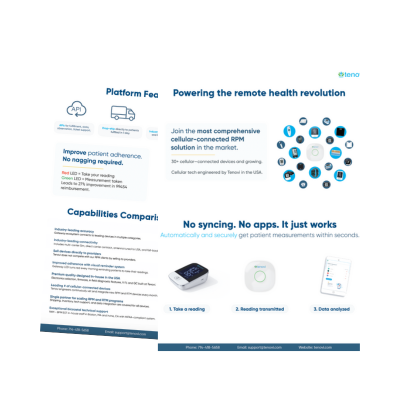
Use devices with built-in reminders. Tools like Tenovi’s Cellular Gateway with visual reminders can improve adherence. The Gateway uses a simple red and green light cue: red prompts the patient to take a measurement, and green confirms the reading transmitted successfully.
Implement a follow-up system. Check in with patients who miss measurements to address concerns or technical issues, since a missed reading is often a care signal.
Provide clear instructions. Make sure patients understand how and when to measure, and why consistency helps their health. Offer multiple measurement options. When possible, let patients choose the device or method that fits their daily life. Focusing on adherence helps patients get the care they need while keeping your program clinically sound.
Consider Outsourcing RPM Services
If managing an in-house program is difficult, consider partnering with a specialized RPM company. These partners can handle device fulfillment, data aggregation, and parts of the billing workflow, which reduces administrative burden and lets your clinical team focus on patients. Choose a partner whose processes reinforce compliance rather than working around it.
Stay Informed About Regulatory Changes
RPM reimbursement policy is evolving. CMS finalized the CY2026 Physician Fee Schedule on October 31, 2025, adding 99445 and 99470 effective January 1, 2026. CMS has since issued proposed changes for CY2027 that could adjust RPM and RTM payment and oversight, so the rules that apply today may shift. Track updates from CMS, Medicaid, and private payers, and adjust your program as policy changes. Providers who want to weigh in can submit comments during CMS rulemaking periods, and industry groups such as the Alliance for Connected Care follow these proposals closely.
Understanding Remote Patient Monitoring Reimbursement
Remote patient monitoring reimbursement is what keeps these programs running, but the programs that last are the ones built on real patient value. When you match codes to the care you deliver, document honestly, and keep patients engaged, accurate reimbursement follows and your program stays resilient through policy changes like the proposed CY2027 rule. RPM is proactive, preventive care that helps patients avoid costly complications, and billing done right simply reflects that work.
Tenovi provides the cellular gateways, connected devices, and data aggregation layer that healthcare organizations and their partners use to run reliable remote patient monitoring programs. If you want to build an RPM program grounded in patient care and clean compliance, contact us for a free demo and consultation.