Remote patient monitoring (RPM) is the use of connected medical devices to collect a patient’s health data at home and send it to their care team. Remote patient monitoring services let providers track vital signs such as blood pressure, weight, blood glucose, pulse oximetry, and respiratory flow between office visits. The data moves securely to clinicians, who review trends and act before small problems become emergencies.
RPM sits inside the broader category of telehealth. Where a video visit captures one moment, remote patient monitoring captures a continuous picture of a patient’s condition. That steady stream of readings supports proactive, preventive care for people with chronic conditions such as hypertension, heart failure, diabetes, and COPD.
Adoption has grown quickly. More than 75 million patients were monitored through remote platforms in 2024, up from 48 million in 2021, according to industry tracking compiled by Market.us. Roughly 68 percent of healthcare providers were integrating remote monitoring tools by 2025. The market is expected to grow from about $36 billion in 2026 to $66 billion by 2031, a compound annual growth rate near 13 percent, per MarketsandMarkets.
A Brief History of Remote Patient Monitoring
The idea behind remote patient monitoring is older than most people expect. In the 1960s, NASA tracked astronauts’ vital signs from the ground during spaceflight. Around the same time, the Holter monitor let cardiologists record a patient’s heart rhythm over a full day outside the clinic.
Home-based programs came next. In the early 2000s, the U.S. Department of Veterans Affairs launched a large Care Coordination and Home Telehealth program to monitor veterans with chronic conditions. Results showed fewer hospital admissions, which helped build the evidence base for remote care.
The modern era began with reimbursement. In 2019, CMS started paying separately for RPM through CPT codes 99453, 99454, and 99457, which gave practices a sustainable way to run programs. The COVID-19 pandemic then accelerated adoption sharply in 2020, as patients and providers moved routine care into the home. CMS added remote therapeutic monitoring (RTM) codes in 2022 and has expanded remote care billing nearly every year since.
How Remote Patient Monitoring Works
A remote patient monitoring program follows a clear, repeatable process. The steps below apply whether a practice runs the program itself or partners with a remote care vendor.
The quality of step three depends heavily on the connectivity layer. Devices that rely on patient smartphones tend to see lower adherence. Cellular-connected systems, such as the Tenovi Cellular Gateway, transmit readings on their own, which keeps data flowing without patient effort.
1) Enrollment and consent
A provider identifies an eligible patient, explains the program, and obtains consent. Eligibility usually rests on a chronic or acute condition that benefits from regular tracking.
2) Device setup and education
The patient receives connected devices and learns how to use them. Simple, cellular-connected hardware removes the need for apps, Bluetooth pairing, or home Wi-Fi.
3) Daily data capture
The patient takes readings at home. Devices transmit each measurement automatically to the care team.
4) Clinical review and alerts
Staff monitor incoming data and receive alerts when a reading falls outside a set range. This is where early intervention happens.
5) Interactive management
Clinical staff contact the patient to adjust medication, reinforce habits, or escalate care. This monthly interaction is central to both outcomes and billing.
What Conditions Remote Patient Monitoring Manages
Remote patient monitoring works best for conditions where daily numbers guide treatment. The most common programs track:
1)Hypertension
Home blood pressure readings reveal patterns that a single clinic visit can miss, including white coat and masked hypertension. Because RPM data is objective and continuous, it also supports medication titration. A clinician can adjust a dose, watch the response over days, and refine the plan without waiting for the next appointment.
2) Heart failure
Daily weight and blood pressure help catch fluid retention early, a leading cause of readmission.
3) Type 2 diabetes
Connected glucometers show how diet, medication, and activity move blood sugar over time.
4) COPD and asthma
Pulse oximeters and peak flow meters flag declining lung function before a crisis.
5) Post-surgical recovery
Short-term monitoring supports safe transitions from hospital to home.
6) Maternal and high-risk pregnancy care
Blood pressure tracking supports early detection of preeclampsia.
Devices Used in Remote Patient Monitoring
The device is where the patient meets the program, so simplicity matters. Common remote patient monitoring devices include:
- Blood pressure monitors for hypertension, heart failure, and pregnancy care.
- Weight scales for heart failure and weight management.
- Blood glucose meters for diabetes management.
- Pulse oximeters for COPD, heart failure, and post-viral recovery.
- Peak flow meters for asthma and COPD.
- Thermometers for infection and post-operative monitoring.
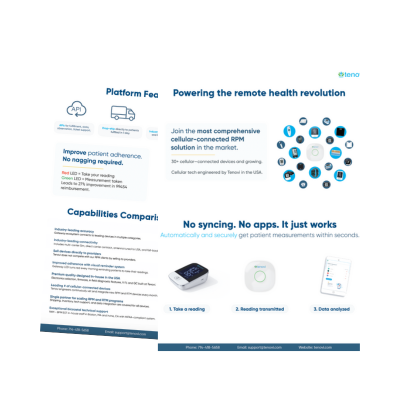
Tenovi connects more than 40 FDA-cleared Bluetooth devices through a single Tenovi Gateway. The Gateway aggregates readings from partner devices, including Omron blood pressure monitors and Trividia blood glucose meters, then transmits them to HIPAA-compliant servers over cellular networks. Patients plug the Gateway in and start taking readings. There are no apps to download and no syncing to manage.
Remote Patient Monitoring and Value-Based Care
Payers and health systems evaluate remote patient monitoring differently than a solo practice does. Under fee-for-service (FFS), RPM generates direct reimbursement per patient per month. Under value-based care (VBC), the value shows up in quality scores, shared savings, and reduced penalties.
The link to quality measures is direct. Higher HEDIS scores and Medicare Advantage Star Ratings translate into stronger performance in value-based contracts and larger bonus payments. One analysis cited by industry sources found that plans with higher HEDIS and Star performance can receive 5 to 20 percent higher bonus payments in Medicare Advantage contracts. Controlling blood pressure and managing diabetes are core Star and HEDIS measures, and remote patient monitoring supports both by improving adherence and enabling faster intervention.
For accountable care organizations (ACOs) and risk-bearing systems, RPM data supports several goals at once. It reduces avoidable readmissions that trigger penalties under the Hospital Readmissions Reduction Program. It surfaces gaps in preventive care. It gives care teams real-time visibility into the highest-risk patients in a population. Tenovi has published dedicated resources on how RPM helps improve HEDIS measures and improve Medicare Advantage Star Ratings.
For payers weighing new benefits, the takeaway is consistent. Remote patient monitoring shifts spending from reactive hospital care toward preventive management, which aligns clinical results with financial performance.
Remote Patient Monitoring vs. Remote Therapeutic Monitoring
Providers often confuse RPM with remote therapeutic monitoring (RTM). Both use connected data and monthly management, but they cover different information. Remote patient monitoring collects physiologic data, such as blood pressure and glucose, and is billed by physicians and qualified health professionals. Remote therapeutic monitoring collects non-physiologic data, such as medication adherence, respiratory response, and musculoskeletal progress, and can be billed by a wider set of practitioners, including therapists. Many practices run both, since a single patient may benefit from physiologic and therapeutic tracking at once.
2026 Remote Patient Monitoring CPT Codes and Reimbursement
RPM funds a care model that catches problems early and keeps patients out of the hospital. The billing structure simply makes that proactive work sustainable.
For 2026, the Centers for Medicare & Medicaid Services (CMS) finalized two new RPM codes alongside the four foundational ones. The additions are for shorter monitoring windows and shorter management time, per the CMS 2026 Physician Fee Schedule final rule. CPT codes are maintained by the American Medical Association.
| CPT code | What it covers | 2026 national rate (approx.) |
|---|---|---|
| 99453 | Initial setup and patient education on equipment | ~$22 |
| 99454 | Device supply and data transmission, 16-30 days | ~$47 |
| 99457 | Treatment management, first 20 minutes | ~$52 |
| 99458 | Treatment management, each additional 20 minutes | ~$41 |
| 99445 (new) | Device supply and data transmission, 2-15 days | ~$47 |
| 99470 (new) | Treatment management, first 10 minutes | ~$26 |
Providers bill 99454 once per patient per 30 days regardless of how many devices a patient uses. Providers cannot bill 99445 and 99454 in the same period, since they cover overlapping supply windows. RPM can be billed in the same month as chronic care management (CCM), transitional care management, and behavioral health integration, as long as the time counted toward each service is distinct. Pairing CCM and RPM is a common way to build a complete, reimbursable care model.
Rates shown are approximate national averages and change by locality and final rulemaking. Practices should confirm current rates and payer policies before billing.
This material is provided for general informational and educational purposes only and does not constitute legal, compliance, billing, coding, or reimbursement advice. CPT® codes, descriptions, and Medicare payment rates referenced here are drawn from publicly available sources, are subject to change, and may vary by payer, locality, and patient circumstances. Tenovi makes no representation or guarantee regarding coverage, payment, or the appropriateness of any code for a particular patient or service, and any presented are illustrative only. Providers are solely responsible for independently determining medical necessity and applicable coding, coverage, documentation, and billing requirements and for submitting accurate claims. Consult applicable payer guidance and qualified billing, coding, compliance, or legal professionals before making billing decisions. CPT® is a registered trademark of the American Medical Association.
The Clinical Evidence Behind Remote Patient Monitoring
The research base for remote patient monitoring has grown stronger. The clearest evidence sits in cardiovascular and hypertension care.
A meta-analysis of heart failure patients found that RPM reduced heart failure-related hospitalizations, with a pooled risk ratio of 0.80 (95 percent confidence interval 0.77 to 0.84), published in PMC. At UMass Memorial Health–Harrington Hospital, a remote monitoring program cut 30-day heart failure readmissions by 50 percent, as reported by the American Journal of Managed Care.
Hypertension results are also strong. Preliminary research presented at the American Heart Association’s Hypertension Scientific Sessions 2024 found that 74 percent of patients with resistant high blood pressure gained control within 12 months using a Bluetooth-enabled monitor paired with regular pharmacist contact.
These outcomes share a pattern. The device alone does not drive results. The combination of reliable data and consistent clinical follow-up is what lowers hospitalizations and improves control.
How to Start a Remote Patient Monitoring Program
Launching remote patient monitoring is more manageable than many teams expect. A practical rollout follows a few steps.
1) Define the patient population
Start with one or two conditions, such as hypertension or heart failure, where daily data changes decisions.
2) Choose a connectivity model
Decide between app-based and cellular-connected devices. Cellular hardware tends to produce higher adherence, which drives both outcomes and billing thresholds.
3) Assign clinical roles
Determine who reviews data, who contacts patients, and how alerts are escalated.
4) Build the billing workflow
Map each CPT code to a documented activity so claims are clean and compliant.
5) Set adherence targets
The 16-day threshold for 99454 depends on patients taking regular readings, so patient engagement is a program priority.
6) Measure and refine
Track readmissions, blood pressure control, and enrollment to prove value and expand.
Many organizations partner with a remote patient monitoring vendor for devices, logistics, and connectivity, then keep clinical management in house. This model lets a practice scale without building hardware and fulfillment operations from scratch.
Remote Patient Monitoring FAQs
1) What is remote patient monitoring in simple terms?
Remote patient monitoring is a service where patients use connected devices at home to send health data, such as blood pressure or weight, to their care team. Clinicians review the data and step in early when something looks wrong.
2) Who is eligible for remote patient monitoring?
Medicare and most payers cover RPM for patients with a chronic or acute condition that benefits from regular tracking. A provider must order the service and obtain patient consent before enrollment.
3) How much does remote patient monitoring reimburse in 2026?
Reimbursement varies by code and locality. Approximate 2026 national Medicare rates range from about $22 for setup to roughly $52 for the first 20 minutes of monthly management, with additional codes for device supply and extra time.
4) What is the difference between RPM and RTM?
RPM tracks physiologic data such as blood pressure and glucose. RTM tracks non-physiologic data such as medication adherence and respiratory or musculoskeletal response. RTM can be billed by a broader group of practitioners.
5) Does remote patient monitoring actually improve outcomes?
Yes. Studies link RPM to lower heart failure hospitalizations and better blood pressure control. Results are strongest when reliable device data is paired with consistent clinical follow-up.
6) Do patients need a smartphone or Wi-Fi for remote patient monitoring?
Not with cellular-connected systems. The Tenovi Gateway transmits readings over cellular networks, so patients do not need a smartphone, an app, or home internet.
7) Can a practice bill RPM and chronic care management together?
Yes. RPM and CCM can be billed in the same month for the same patient, as long as the time and activities counted toward each service do not overlap.
Understanding Remote Patient Monitoring
Remote patient monitoring has moved from a promising idea to a standard part of chronic care. It gives providers a continuous view of patient health, supports earlier intervention, and produces measurable results in conditions like heart failure, hypertension, and diabetes. The 2026 CPT code updates make programs more flexible, while HEDIS and Star Rating incentives connect RPM directly to value-based performance. For providers, health systems, and payers, the case is the same: proactive monitoring improves care and lowers the cost of avoidable events. Success depends on reliable devices, strong patient adherence, and consistent clinical follow-up.
Tenovi provides the connected devices and cellular connectivity that make remote patient monitoring simple to run at scale. More than 60 FDA-cleared devices connect through a single Tenovi Gateway, with no apps, no syncing, and no patient Wi-Fi required. If you are building or expanding a remote care program, contact us for a free demo and consultation to see how Tenovi can support your patients and your quality goals.