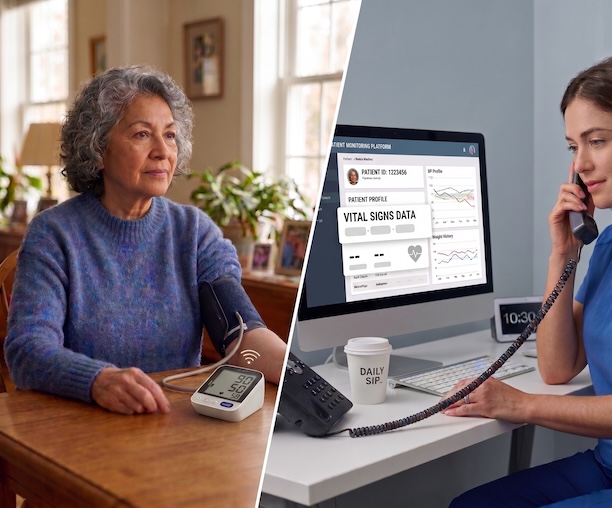
Patient success stories in remote patient monitoring have two halves that fit together. A connected blood pressure cuff sends reliable readings from a patient’s home. A care team member reviews those readings, recognizes what they mean for that particular patient, and picks up the phone. Together they produce a treatment decision that neither half produces alone.
The two cases below come from a hypertension monitoring program at a rural clinic in the Southeast. Both were presented in de-identified form at the 14th Annual Telehealth Summit of South Carolina. In both, the patient was at home, between appointments, and the person who found the problem was a nurse reading a trend and picking up the phone.
That sequence is the part worth studying, because it is where the technology and the care team meet.
What Happens Between Office Visits
Chronic care is managed in appointments that happen every three months, or every six. Between those visits, a patient’s condition keeps moving. Medications get taken correctly or they do not. A dose that was right in March may be wrong by May.
Historically, nobody saw any of that until the next visit. Remote patient monitoring changed the input side of that problem by making home readings visible to the care team as they happen. It did not, on its own, change who reads them.
This is where the strongest patient success stories live: in the weeks between visits when someone is watching the data, interpreting it, and acting before the situation becomes an appointment nobody scheduled.
Story One: The Nurse Who Noticed a Slow Drift
The patient was a woman in her seventies, enrolled for hypertension monitoring. She carried several chronic conditions alongside her high blood pressure, including a known tendency toward a slow heart rate. She was taking a rate-slowing calcium channel blocker.
Her readings did not spike. They stepped down. Systolic pressure eased lower week over week, and her heart rate settled at the bottom of her own established baseline. Read one day at a time, nothing stood out. Read as a series, the direction became clear.
The nurse called before escalating anything. She checked cuff placement, confirmed when the patient was taking her medication, and asked about symptoms. That call did specific diagnostic work. It ruled out technique error and it ruled out a device problem. The readings were real.
What reached the provider was a verified multi-week trend, delivered the same day, with the artifact question already closed. The provider discontinued the rate-slowing medication safely. One decision came out of one summary, and nobody had to schedule an extra visit or a hospital emergency.
Story Two: The Phone Call That Found the Pill Bottles
The second patient was a woman in her eighties with a history of dementia, cared for at home by her husband. She was also enrolled for hypertension monitoring. Her readings ran the opposite direction from the reason she was enrolled. The program was watching for high blood pressure. What developed over several weeks was a hypotension pattern.
The nurse called the home and asked the husband to bring the morning medications to the phone. Then she went through them one at a time. What he described did not match what the chart said he was giving her.
Both of them came to the clinic with every bottle from the house. The provider found wrong bottles, tablets being split when they should not have been, and a blood pressure medication that had been discontinued but was still in daily use. A medication reconciliation performed against the chart alone would have come back clean. The phone call is what surfaced it.
What These Patient Success Stories Show About the Care Team’s Role
Read side by side, these two remote patient monitoring patient experience cases point to five things the RPM nurse contributed to prevent a potential emergency.
- Reading the series, not only the reading —Both patterns developed across weeks. Recognizing a direction of travel is interpretive work. It requires someone who knows the patient’s baseline and can see where the line is heading.
- Verifying before escalating — In the first case, the nurse eliminated cuff technique and medication timing before the provider ever saw the trend. That is why the provider could act the same day rather than order a confirmatory visit.
- Asking the question the data cannot — No reading tells you which bottle a caregiver is opening at breakfast. The second nurse found that out because she asked, and because she asked in a way that walked through the medications one by one.
- Knowing the enrollment reason is not the whole picture — Both patients were on service for hypertension, and in both cases the risk that materialized was low blood pressure. A care team reviewing what the readings actually say will catch that. A process that only looks for the enrolled condition will not.
- Both providers made good decisions quickly — They could do that because a nurse had already turned raw readings into a clinical question worth answering.
How the Technology and the Care Team Work Together
Remote monitoring does not happens without the technology holding up its end, and the pieces have to work as a system rather than as separate parts. The device has to produce accurate readings without a setup process the patient has to manage. Cellular-connected remote monitoring removes the home network and the pairing step from the equation, which can help simplfy the process of taking a measurement. Reliable transmission is what makes a trend readable at all.
The data has to arrive somewhere the care team already works. Readings that require a separate login get create more work that when they appear in the chart, and an RPM workflow built around the team’s existing habits is helpful.
The interface has to show trends and not only exceptions. Threshold alerting does real work and belongs in every program, because it catches the acute event quickly. Reviewing where a series is heading over several weeks answers a different question. Both views are useful, and a care team needs access to each.
What none of that infrastructure does is make a clinical judgment or call a patient’s house. That work sits with people, and it happens in the care services wrapped around the monitoring.
What the Evidence Says
The clearest statement of this comes from an independent assessment rather than a single trial. The Peterson Health Technology Institute evaluation of digital hypertension management solutions, updated in June 2026, sorted the market into three approaches and measured each against usual care.
The first approach supports patients’ home monitoring and delivers the data back to the provider. The second pairs connected cuffs with dedicated virtual care teams that coordinate medication adjustments alongside the patient’s primary care team. The third focuses on behavior change through educational content, reminders, and coaching.
Only one of the three produced rapid, clinically significant blood pressure improvement over usual care, and it was medication management. Transmitting home readings back to a provider did not clear that bar on its own. Neither did the behavior change approach. PHTI’s recommendation is specific about the combination that works: connected blood pressure cuffs paired with virtual care teams that help manage prescribing and dosing.
The report also found that every category of digital hypertension solution raises spending in the short term. Only the medication management approach is projected to return long-term net savings, through the cardiovascular events it prevents.
That is the same conclusion the two nurses above reached in practice. The cuff produced the readings. The care team turned them into a medication decision.
Care Teams and Technology Together
The 2025 AHA/ACC multisociety hypertension guideline arrives at the same place from the trial literature. It notes that recent randomized trials found no blood pressure lowering benefit when home monitoring was enhanced only with a smartphone application, compared with home monitoring on its own. The application in those trials sent reminders, stored readings, and transmitted them. The guideline also reviews what does work. Trials and meta-analyses of team-based care involving nurses or pharmacists produced lower systolic and diastolic pressure than usual care, along with better achievement of blood pressure goals, better appointment keeping, and better medication adherence.
A 2025 analysis in BMC Medicine found the same split. Self-monitoring by itself showed no significant blood pressure reduction against usual care in any subgroup examined. Remote monitoring paired with guidance, including telephone follow-up when a reading came back abnormal, did produce reductions.
Real-world program data points the same way. A team-based RPM program at UC San Diego Health enrolled patients with hypertension alone or alongside diabetes or ischemic heart disease. Patients received a connected cuff feeding the electronic health record plus ongoing support from nurse care managers and a pharmacist. Average systolic reductions among active participants ran between roughly 13 and 17 mm Hg depending on the group.
The durability question has an answer too. In long-term follow-up of the HyperLink trial, home blood pressure telemonitoring with pharmacist case management outperformed usual care through the first 18 to 24 months. That advantage was no longer present at 54 months, after the pharmacist support had ended. The devices and the care team produced the result together, and it faded when one of the two was taken away.
The joint AHA and AMA policy statement on self-measured blood pressure monitoring in Circulation treats home measurement as a validated approach to out-of-office blood pressure, and is specific that it works when paired with co-interventions: counseling, behavior change support, medication management, and communicating decisions back to the patient. The CDC Million Hearts clinician guidance frames it identically and notes the combination is particularly useful for patients in their later years and those managing several chronic conditions. Both of these patients sat squarely in that group, and the population is large. The American Heart Association puts hypertension prevalence at roughly 46 percent of American adults, with higher rates in rural communities than urban ones.
The Medication Problem Hiding in the Chart
The second story is not a rare event. It reflects a documented and persistent gap, and it is the clearest example of why the phone call can help.
A primary care study that reconciled physician documentation against what patients were actually taking at home found discrepancies in nearly every patient studied. Undocumented drugs turned out to be relevant to patient safety, producing actual drug-related problems in around half of the patients involved. Most reconciliation research has been done in hospitals or at care transitions. This study looked at what was in the house.
Hospital data points the same direction. In one Swedish cohort using pharmacist-led reconciliation at admission, medication history errors were identified in 47 percent of patients.
For a care team, the practical takeaway is useful. The medication list in the record is a working assumption. Vital sign data that contradicts it is a reason to call, and tracking adherence is most effective when a person follows up on what the tracking shows.
Designing an RPM Program Around the Care Team
These cases point to a handful of concrete choices for anyone building a program.
- Staff for review time. Trend review is clinical work and it takes hours. Programs that count only enrollment and device shipment will under-resource the part that produces the outcomes.
- Give nurses trend views alongside alert queues. Both catches here came from looking at several weeks of the same metric. That view has to exist and it has to be quick to reach.
- Build the patient call into the workflow. In both cases the call produced information the data could not. Patient engagement is also downstream of this. Patients who hear from someone who noticed something tend to keep taking readings.
- Review all the readings, not just the enrolled condition. Both of these patients were monitored for high blood pressure and both were at risk from low blood pressure.
- Ask care teams to escalate conclusions rather than data. A verified pattern with the obvious alternatives ruled out is something a provider can act on immediately.
- Treat device reliability as a precondition. Consistent transmission is what makes trend review possible, and it is worth solving before anything else.
Frequently Asked Questions
1. What is a patient success story in remote patient monitoring?
A real-life story shows the decision the data supported. Name what the care team saw, what they did to verify it, and what the provider changed as a result. That is the version another program can learn from, because it shows technologies and care teams working together.
2. What does an RPM nurse actually do with the data?
The work is interpretive and it is relational. Nurses review readings against a patient’s own baseline, look for direction of travel across weeks, rule out technique and device problems, contact patients to fill in what the data cannot say, and hand providers a clinical question that is ready to act on.
3. Why does care between office visits matter so much in chronic disease?
Conditions change on a shorter cycle than appointments. A patient seen quarterly can develop a problem in week three and carry it for two months. Monitoring with a care team attached shortens that window from months to days.
4. Does remote patient monitoring improve outcomes on its own?
The evidence says the combination is what works. The Peterson Health Technology Institute’s 2026 assessment found that digital hypertension solutions built on transmitting home readings back to a provider did not produce clinically significant improvement over usual care, while solutions pairing connected cuffs with virtual care teams managing medication did. The 2025 AHA/ACC hypertension guideline reaches the same conclusion from the trial literature, pointing to trials where adding an app to home monitoring produced no blood pressure benefit over home monitoring alone.
5. How should a program handle readings outside the enrollment condition?
Review them the same way. Both patients described here were enrolled for hypertension and both were at risk from the opposite problem. Filtering data against the enrollment diagnosis discards the readings that can matter most.
6. Do these patient experiences apply outside of hypertension?
Yes. The pattern holds where slow change carries clinical weight, including weight trends in heart failure, glucose patterns in diabetes, and oxygen saturation in respiratory disease. The metric changes and the workflow does not.
Understanding Patient Success Stories in Remote Patient Monitoring
Patient success stories in remote patient monitoring are most instructive when they show the unglamorous version of the work. Neither of the cases here turned on a dramatic reading. Both turned on a nurse who read several weeks of data, recognized where the line was heading, and called the patient’s home before escalating anything. The technology did its part by delivering accurate readings reliably and putting them where the care team works. The nurse did the part that cannot be automated, which is interpreting what the readings meant for this particular patient and finding out what was happening in the house. What reached each provider was a clinical conclusion rather than a data dump, which is why both could act the same day. The guidelines, the trial evidence, and the independent assessments keep arriving at the same place. Home monitoring is the input. The care team is what ties the technology together into a decision that changes a patient’s treatment, and it does that work in the weeks when no appointment is scheduled.