
In December 2025, the Centers for Medicare and Medicaid Services (CMS) announced that all 50 states would receive awards under the Rural Health Transformation Program, a $50 billion federal investment running from fiscal year 2026 through 2030 to help fund rural remote care. Every state that applied was funded, with first-year awards averaging roughly $200 million and ranging from about $147 million to $281 million.
For anyone who has spent years watching rural hospitals close and rural patients drive hours for routine care, this is a genuine inflection point. But money alone does not transform care. The states that see real results will be the ones that turn funding into working programs, and that is where remote care, and the operational discipline behind it, comes in.
What the Rural Health Transformation Program Funds
The program is built around five pillars that shape how states can spend their awards:
- Make Rural America Healthy Again, focused on preventive care and better management of chronic disease and behavioral health.
- Sustainable access, helping rural providers find operating models that keep their doors open.
- Workforce development, recruiting and retaining clinical staff.
- Innovative care models, encouraging value-based and team-based approaches.
- Technology innovation, funding telehealth, remote patient monitoring (RPM), and other advanced tools.
Remote care sits squarely inside two of these pillars at once. Allowable technology uses named in the program include telehealth platforms, care coordination tools, and remote patient monitoring, diagnostics, and clinical decision support. For rural communities where the nearest clinic can be an hour away, rural remote care using RPM is one of the few tools that delivers preventive and chronic care management without asking patients to travel.
Sustainable Rural Remote Care Programs
Here is the uncomfortable truth that does not make it into most funding announcements. Standing up a rural remote care program is not the hard part. Sustaining one is. Plenty of programs launch with enthusiasm, enroll a first cohort of patients, and then stall. Devices end up in drawers. Staff get buried in alerts they do not have time to triage. Reimbursement does not materialize because the documentation was never set up correctly. None of these are technology problems. They are operational ones, and federal dollars do not solve them automatically.
States now have five years of funding and a clear mandate. The programs that last will be the ones that treat operations as the core of the work, not an afterthought.
What it Takes to Operationalize Rural Remote Care
Operationalizing remote care means designing for the day-to-day reality of a clinical team, not just the launch event. A few areas matter most.
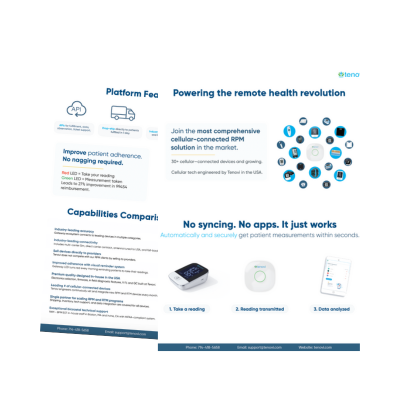
Patient onboarding makes or breaks adoption. The first interaction sets the tone for everything that follows. When devices are simple to use, work out of the box without apps, Wi-Fi, or pairing, and arrive with clear instructions, patients actually take their readings. When onboarding is confusing, adherence collapses in the first few weeks and never recovers. Rural patients in particular benefit from connectivity that does not depend on home broadband.
Clinical workflows have to absorb the data. A remote program generates a steady stream of readings, and someone has to act on them. Successful programs define who reviews data, how alerts are triaged, and what happens when a reading is out of range, before the first patient is enrolled. Without that, teams either drown in noise or miss the readings that matter.
Staffing and accountability need an owner. Remote care works when a specific person or team is responsible for enrollment, monitoring, and follow-up. Programs that bolt monitoring onto already-full schedules tend to fade. Programs that build a defined role around it tend to stick.
Reimbursement and documentation should be designed in from the start. The clinical and billing sides have to align so that the work is captured and sustainable. This is also where the program’s guardrails matter, including the cap on administrative spending and limits on direct payments to facilities, which push states toward building durable capabilities rather than one-time fixes.
Building for Sustainability
The five-year structure of the Rural Health Transformation Program is an opportunity and a warning. Funding tapers and expectations rise over time. A program that depends entirely on grant dollars to function will struggle when the structure changes.
Sustainable programs share a few habits. They start with a focused patient population, often a single chronic condition, and expand once the workflow is proven. They measure outcomes that matter to both clinicians and payers. They choose technology that lowers the operational burden rather than adding to it. And they plan for the program to stand on its own clinically and financially, so that the federal investment becomes a foundation rather than a crutch.
A Note on Utah
Utah offers a useful example of how fast RHT is moving. The state submitted its Rural Health Transformation Plan in November 2025 and was awarded roughly $195 million in first-year funding, with a baseline expectation of at least $100 million per year through 2030. Like many states, Utah has begun putting out funding opportunities and applications, and the early activity spans a wide range of rural health needs. Remote care is one of the clearest near-term opportunities within the technology pillar, but realizing it will still come down to execution on the ground.
Resources
For teams exploring how to use this funding well, these are good starting points:
- CMS Rural Health Transformation Program overview, for program structure, pillars, and timelines: https://www.cms.gov/priorities/rural-health-transformation-rht-program/overview
- CMS announcement of $50 billion in awards to all 50 states: https://www.cms.gov/newsroom/press-releases/cms-announces-50-billion-awards-strengthen-rural-health-all-50-states
- Utah Department of Health and Human Services rural health page and funding opportunities: https://dhhs.utah.gov/ruralhealth/funding-opportunities/
- Utah’s Rural Health Transformation Plan (November 2025): https://dhhs.utah.gov/wp-content/uploads/Rural-Health-Transformation-Plan.pdf
- Bipartisan Policy Center explainer on advancing technology innovation through the program: https://bipartisanpolicy.org/explainer/advancing-technology-innovation-through-the-rural-health-transformation-program/
Join the Conversation
We are continuing this discussion live. On Thursday, July 2, 2026, from 12:00 to 1:00 PM MT, Tenovi is presenting in the Rural Health Association of Utah Rural Resource Webinar Series on exactly this topic: how to operationalize remote care, the challenges programs face, what good onboarding looks like, and how to build for long-term sustainability. The session is educational, the recording will be posted on RHAU.org afterward, and registration is open now.