
Ask what is CCM and most answers stop at the definition: chronic care management, a Medicare service for people with multiple chronic conditions. That is accurate, but it misses the more interesting fact. CCM has existed since 2015, it pays reliably every month, and the clinical case for it is settled. Yet the majority of patients (96%) who qualify are never enrolled. Understanding what is CCM really means understanding that gap, because it defines both the opportunity and the work involved.
This guide explains chronic care management from the ground up: what it is, how a program runs month to month, who qualifies, what it pays in 2026, and why adoption stays low a decade after launch. It is written for remote patient monitoring companies, chronic care management organizations, and telehealth platforms building programs on top of this benefit.
What Is CCM, Plainly
Chronic care management (CCM) is a Medicare Part B service that pays clinicians for the coordination work that happens between office visits. Before 2015, that work was mostly unpaid. A physician might spend real time each month adjusting medications, coordinating with specialists, and checking on a patient with several chronic conditions, none of which fit into a billable visit.
The Centers for Medicare and Medicaid Services introduced CCM in January 2015 to close that gap, creating a separately billable code for non-face-to-face care coordination. The logic was direct. Roughly two-thirds of the Medicare fee-for-service population lives with two or more chronic conditions, and their needs do not pause between appointments. CCM gave that in-between care a payment structure for the first time.
Since then the program has expanded steadily. CMS added complex CCM codes in 2017, physician-time and add-on codes in later years, and in 2022 introduced principal care management for patients with a single serious condition. The direction has never wavered. Each rule has pushed further toward paying for continuous, longitudinal care rather than isolated visits.
How a CCM Program Works
The definition is simple. The operations are where practices succeed or fail. A working CCM program runs on a monthly rhythm, and every element has to be in place before a single claim goes out.
It starts with identifying eligible patients and getting consent. A patient must be told about the service, agree to enroll, and understand they can stop at any time. That consent has to live in the chart, not as a vague note that staff mentioned the program.
Next comes an initiating visit for new or inactive patients, followed by a comprehensive care plan. The plan is not a static problem list. CMS expects a living document that names conditions, assigns which provider leads each one, sets treatment goals, and gets revised as the patient changes.
From there, the program runs on recurring monthly work:
- A dedicated care coordinator, often a nurse or medical assistant, owns a panel of enrolled patients.
- The coordinator makes monthly contact, manages medications, handles transitions, and communicates with other clinicians.
- The patient has 24/7 access to the care team for urgent needs, not just front-desk hours.
- Every minute of clinical time is logged contemporaneously, with the staff member, activity, and duration recorded per session.
That last point drives billing. The base code requires at least 20 minutes of clock time in a calendar month. If a patient accumulates 18 minutes, the practice does not bill that month. If they hit 25, the practice bills the base code. As one billing guide puts it, if your team cannot say who calls the patient, where time is logged, and where consent lives in the chart, you do not have a CCM program, you have a billing code.
Who Qualifies for Chronic Care Management
Eligibility is defined by condition count and risk. A patient qualifies if they have two or more chronic conditions expected to last at least 12 months, or until death, and those conditions place them at significant risk of decline, acute exacerbation, or functional harm.
The qualifying conditions cover most of what fills a primary care panel: hypertension, diabetes, heart disease, chronic kidney disease, COPD, arthritis, depression, and many others. Because the threshold is two or more conditions, the eligible population inside any Medicare panel is large. A practice with 500 Medicare patients commonly has 200 to 300 who qualify.
Both Original Medicare and Medicare Advantage reimburse CCM, since it falls under Part B. Patients can opt out at any time without affecting their other benefits, which makes the initial consent conversation less of a commitment than many assume.
What CCM Pays in 2026
Reimbursement rose sharply for 2026. CMS finalized roughly a 10 percent increase across care management codes, one of the largest single-year bumps since the program began. National average rates run approximately:
- CPT 99490: first 20 minutes of clinical staff time, about $66 per patient per month.
- CPT 99439: each additional 20 minutes of staff time, about $50, billable up to twice per month.
- CPT 99487: 60 minutes of complex CCM, for patients needing moderate to high complexity decision-making.
- CPT 99491: first 30 minutes of physician-provided time, about $89.
- CPT 99437: each additional 30 minutes of physician time, about $63.
Only one CCM series can be billed per patient per month, and rates vary by region because of geographic cost adjustments. A well-run program typically adds a few thousand dollars in annual revenue per enrolled patient while returning several times the cost of the care coordinator’s labor. The point of the payment, though, is what it funds: consistent contact that keeps a chronic condition from turning into a hospitalization.
Why Most Eligible Patients Are Never Enrolled
Here is the part the definition leaves out. A decade after launch, CCM remains one of the most underused benefits in Medicare. Research on the first years of the program found that only about 1.1 percent of eligible beneficiaries received CCM services in 2015, rising to just 3.4 percent by 2019. Uptake was concentrated among the sickest and most frail patients, and varied widely by region.
The reason is not that the benefit fails to apply. It applies to the large majority of a typical Medicare panel. The reason is that enrollment requires a provider to proactively initiate it, build the workflow, capture consent, and sustain the monthly follow-through. Most clinics do not fail at CCM because the rules are too hard. They fail because nobody builds a process that fits a real workday.
For companies serving these practices, that gap is the whole opportunity. Every eligible patient who is not enrolled represents both a break in continuous care and recurring value left unrealized. The practices that benefit most are the ones that activate the largest share of the patients they already have, not the ones with more patients.
Where Remote Patient Monitoring Fits
CCM handles coordination. Remote patient monitoring (RPM) supplies the data that makes coordination timely. A care coordinator managing a patient with hypertension and diabetes works better when blood pressure and glucose readings transmit automatically from home, instead of waiting for the patient to remember and self-report.
The two programs were designed to work together and can be billed in the same month for the same patient. The one firm rule is that time cannot overlap. Minutes spent reviewing device data count toward RPM, and minutes spent on care coordination count toward CCM, documented separately. Combined, RPM and CCM give a practice both a live data stream and an active care relationship, which is where early intervention actually happens. Research on RPM for chronic disease links it to fewer emergency visits, shorter hospital stays, and earlier response when a reading crosses a threshold.
Frequently Asked Questions
1) What is CCM in healthcare?
CCM stands for chronic care management, a Medicare Part B service that pays clinicians for non-face-to-face care coordination for patients with two or more chronic conditions expected to last at least 12 months. It covers care plan management, medication oversight, care team communication, and monthly patient outreach.
2) When did chronic care management start?
CMS introduced CCM as a separately billable Medicare service in January 2015. The program has expanded since with complex CCM codes, add-on codes, principal care management, and reimbursement increases, including an approximately 10 percent bump under the 2026 Physician Fee Schedule.
3) Who qualifies for CCM?
Patients with two or more chronic conditions expected to last at least 12 months, or until death, who are also at significant risk of decline. Roughly two-thirds of Medicare beneficiaries meet the basic condition threshold, so most Medicare panels include a large eligible population.
4) How much does CCM pay in 2026?
National average rates rose about 10 percent for 2026. The base staff code (99490) pays roughly $66 per patient per month, with add-on and physician-provided codes paying more. Actual amounts vary by geographic region.
5) Can CCM and remote patient monitoring be billed together?
Yes. RPM and CCM can be billed for the same patient in the same month, as long as the clinical time logged toward each is documented separately and does not overlap.
Understanding What Is CCM
So what is CCM? It is a Medicare Part B benefit, active since 2015, that pays clinicians for the ongoing care coordination that keeps patients with multiple chronic conditions stable between visits. The 2026 fee schedule made it favorable, with roughly a 10 percent rate increase and clearer pathways for rural providers. The clinical value is well established, and the eligible population fills most Medicare panels. The persistent story is adoption: most patients who qualify are still never enrolled, not because the benefit does not fit them but because running a real program takes workflow, consent, and monthly follow-through that many practices never build. Remote patient monitoring extends the model by supplying the continuous data that makes coordination proactive.
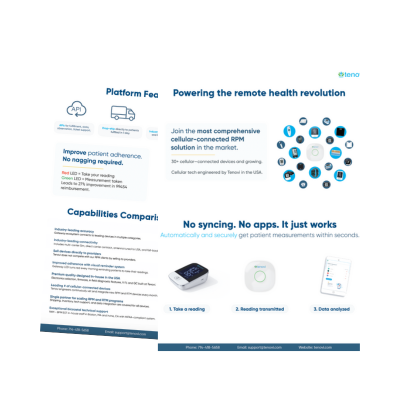
Tenovi is a connected care partner for remote patient monitoring and remote therapeutic monitoring programs, providing FDA-cleared devices, data aggregation, fulfillment, and technical support so RPM, chronic care management, and telehealth companies can build reliable programs at scale. To see how the platform supports chronic care management, contact us for a free demo and consultation.