
A recent press release announced RxHealing, OpenLoop, and Tenovi have launched a nationwide pharmacy-driven remote patient monitoring (RPM) program that helps independent pharmacies manage chronic care patients between provider visits. The program pairs community pharmacy relationships with virtual clinical operations and connected devices, giving pharmacists a structured way to monitor patients and bill for the work they are already doing.
Here is how the three companies divide the work. RxHealing brings the community pharmacy network and identifies eligible patients. OpenLoop provides clinical oversight, compliance, and billing infrastructure. Tenovi supplies the cellular-connected devices and data aggregation technology that move patient readings from the home to the care team.
What the Program Does
Most pharmacists already know which patients are slipping between visits. What has been missing is the clinical infrastructure to act on it: the oversight, the billing, and the compliance backbone. This pharmacy RPM program supplies that layer so pharmacies can extend care beyond the counter without building a virtual care operation from scratch.
Participating pharmacies identify patients who may benefit from monitoring, equip them with Tenovi devices, and rely on OpenLoop’s clinical team for oversight and reimbursement support. The result is a real-time feedback loop that puts data in clinicians’ hands before a condition escalates, rather than after a patient lands in the emergency room.
Why Community Pharmacies are a Strong Entry Point for Chronic Care
Independent pharmacies are expanding clinical services well beyond dispensing, even as the traditional pharmacy business model comes under pressure. The National Community Pharmacists Association’s 2025 Digest described independent pharmacies as healthcare destinations, reporting that 93% of respondents provided flu immunizations, 80% offered medication therapy management, and 73% performed blood pressure monitoring.
Access is also uneven, which is part of the opportunity. A pharmacy-shortage mapping tool launched by the NCPA and the University of Southern California found that roughly one in eight U.S. neighborhoods persistently lacked convenient access to pharmacy services, with the widest gaps in rural areas and underserved urban communities. For patients who live miles from standard care, the local pharmacy is often the most consistent healthcare touchpoint they have.
Phase I Focuses on Hypertension for Medicare Patients
The first phase targets hypertension management for Centers for Medicare & Medicaid Services (CMS) beneficiaries. Pharmacies identify eligible patients with a hypertension diagnosis and equip them with Tenovi remote monitoring tools, creating a continuous view of blood pressure between appointments.
The clinical case for this approach is well documented. In preliminary research presented at the American Heart Association’s Hypertension Scientific Sessions 2024, up to 74% of adults with resistant or difficult-to-control high blood pressure brought their readings below 140/90 mm Hg within 12 months through a program that combined remote blood pressure monitoring with pharmacist interactions. The AHA noted the findings are preliminary until published in a peer-reviewed journal, but the direction is consistent with what pharmacist-led monitoring has shown across multiple studies.
Hypertension is a logical starting point. It is common, it is reimbursable under existing CMS codes, and it responds well to the steady, between-visit engagement that pharmacists are positioned to provide.
The Technology Behind the Program
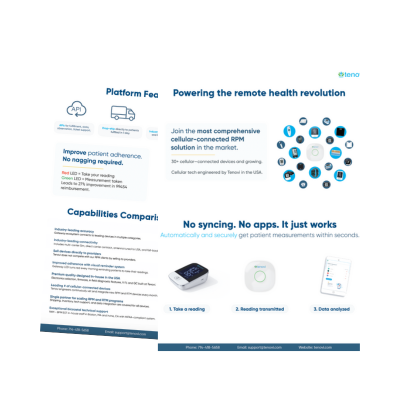
Tenovi provides the hardware and data layer that makes pharmacy-driven monitoring practical at scale. The Tenovi Cellular Gateway connects more than 60 FDA-cleared devices through one API, with no apps, Wi-Fi, syncing, or pairing required. Patients plug the Gateway into a power outlet, take a reading, and the data transmits automatically to the care team.
For Phase I, the relevant device is the Tenovi blood pressure monitor, an FDA-cleared cuff that sends systolic, diastolic, and pulse readings to clinicians without manual entry. As programs expand into medication-driven conditions, the Tenovi Smart Pillbox adds adherence tracking through the same Gateway, using visual reminders to prompt patients and confirm when a dose event reaches the care team. You can see how these fit together in our work on pharmacy medication adherence programs.
This is the design philosophy behind the partnership. Brandon Haag, Tenovi’s vice president of sales for PBM, payer, and pharmacy, framed it as combining high-tech cellular devices with the high-touch relationships community pharmacists already hold, which closes a real gap for rural patients who live far from standard care.
What This Means for Independent Pharmacies
For pharmacies, the pharmacy-driven remote patient monitoring program turns chronic care monitoring into a sustainable service line rather than uncompensated effort. By identifying eligible patients and supporting them with connected devices and clinical oversight, pharmacies can improve outcomes, help reduce downstream healthcare costs, and unlock new revenue through CMS reimbursement.
OpenLoop CEO Dr. Jon Lensing has described independent pharmacies as an underused entry point for chronic care, and this program is built to change that by supplying the oversight, billing, and compliance that pharmacies typically lack. RxHealing CEO Eric Lankford framed the partnership as a way to make connected care more accessible, scalable, and patient-centered, extending care into patients’ daily lives.
Frequently Asked Questions
What is pharmacy-driven remote patient monitoring?
Pharmacy-driven remote patient monitoring is a model in which community pharmacies identify and enroll eligible patients, equip them with connected devices, and work with a clinical partner for oversight and billing. Patient readings transmit from home to the care team between provider visits, which supports earlier intervention and qualifies for CMS reimbursement.
Who is involved in this program?
The program is a partnership between RxHealing, which brings the pharmacy network and patient identification, OpenLoop, which provides clinical oversight, compliance, and billing, and Tenovi, which supplies the cellular-connected devices and data aggregation technology.
What conditions does the program cover?
Phase I focuses on hypertension management for Medicare beneficiaries. The model is designed to expand to additional chronic conditions over time, including conditions that benefit from medication adherence monitoring.
How does Tenovi’s technology work?
Patients plug the Tenovi Cellular Gateway into a power outlet and take a reading on an FDA-cleared device. The Gateway transmits the data over cellular networks to the Tenovi Cloud and on to the clinical team through one API, with no apps, Wi-Fi, or pairing required.
Can pharmacies bill Medicare for remote patient monitoring?
Yes. RPM services are reimbursable under CMS when program requirements are met. In this partnership, OpenLoop provides the billing and compliance infrastructure so pharmacies can participate without managing those processes alone.
Bring connected chronic care to your patients
Tenovi powers remote monitoring programs for more than 180 partner programs and over 300,000 patients, with US-based support on both coasts. If you are building a pharmacy RPM program or want to see how the Tenovi Cellular Gateway fits your workflow, schedule a demo with our team.