
Principal care management is a Medicare-covered service for patients who need focused, ongoing support for one high-risk chronic condition. Where broader care management programs address a patient’s whole chronic disease picture, principal care management narrows the work to a single disease that is driving the greatest clinical risk. Medicare pays for it under the Physician Fee Schedule through four CPT codes, commonly abbreviated as PCM.
Many patients do not have several loosely connected conditions. They have one condition that keeps sending them to the emergency department. A patient discharged after a heart failure exacerbation, a patient whose type 2 diabetes has become brittle, or a patient with COPD who cannot stabilize between visits all fall into this group. PCM gives the care team a way to stay engaged with that patient between office visits, when most of the clinical risk actually accumulates.
For care-services companies and practices building out care management lines, PCM fills a gap that chronic care management alone leaves open. It reaches patients who would otherwise be enrolled in nothing.
Who Qualifies for Principal Care Management?
PCM is different from Principal Illness Navigation (PIN) which was created to help patients with a serious condition navigate the healthcare system that could be due to socioeconomic disadvantages or barriers to care. This pertains to navigating serious conditions including cancer, mental illness, behavioral health conditions and substance use disorder (SUD).
Patient eligibility for principal care management rests on a small number of clear criteria. A patient qualifies when all of the following apply.
- A single, complex chronic condition. The condition must be one identified disease, not a general burden of illness. Documentation should name it specifically.
- An expected duration of at least three months. The condition must be expected to last three months or longer, or to end in the patient’s death. This is a shorter horizon than chronic care management requires.
- Significant clinical risk. The condition should place the patient at risk of hospitalization, functional decline, acute exacerbation, or death. This is the clinical justification for disease-focused management.
- A need for disease-specific care planning. The patient must require a care plan built around that one condition, including ongoing revision as the picture changes.
- Patient consent and an initiating visit. As with other Medicare care management services, the patient must consent to enrollment and understand the cost-sharing that applies. CMS describes the consent and initiating-visit expectations for its care management family of services in its Chronic Care Management Services fact sheet.
Practices sometimes assume PCM is only for post-discharge patients. That is not the case. A stable-looking patient with poorly controlled hypertension may be a stronger candidate than a recently discharged patient whose condition has already resolved.
Principal Care Management CPT Codes Explained
The principal care management CPT codes divide along two axes: who performs the work, and how much time it takes. Four codes cover the full range.
CPT 99424 and 99425: Physician and QHP Time
CPT 99424 covers the first 30 minutes of PCM services delivered personally by a physician or other qualified health care professional in a calendar month. The time includes building the disease-specific care and treatment plan, not just talking to the patient.
CPT 99425 is the add-on code for each additional 30 minutes of physician or QHP time in the same month. It is reported alongside 99424 and cannot stand on its own.
CPT 99426 and 99427: Clinical Staff Time
CPT 99426 covers the first 30 minutes of PCM services delivered by clinical staff under the direction of a physician or QHP, per calendar month. Most sustainable PCM programs run primarily on this code, because clinical staff carry the bulk of the outreach and monitoring work.
CPT 99427 is the corresponding add-on code for each additional 30 minutes of clinical staff time. Like 99425, it is reported in conjunction with its base code.
How the Time Requirement Works
All four codes are time-based and reported once per calendar month. A month with fewer than 30 minutes of documented PCM time does not support a claim. This is the single most common reason PCM claims fail: the work happened, but the minutes were never captured. Time tracking has to be part of the workflow rather than something staff reconstruct at month end.
National payment amounts for all four codes change each year with the Physician Fee Schedule and vary by geographic locality. Rather than relying on a summarized figure, check current amounts directly in the CMS Physician Fee Schedule Look-Up Tool for your locality.
How Principal Care Management Differs From Chronic Care Management
Confusing PCM with chronic care management is the most frequent source of billing errors in this area. The two services sit next to each other but serve different patients.
Chronic care management applies to patients with two or more chronic conditions expected to last at least 12 months. Principal care management applies to a patient with one condition expected to last at least three months. If you are new to the broader category, our guide to what CCM is and how it works covers that program in depth.
The billing consequence is direct. The same practitioner cannot bill both PCM and CCM for the same patient in the same calendar month. The services overlap too heavily for Medicare to pay for both. Two different practitioners, however, may each bill separately when they are managing different conditions for the same patient. A cardiologist running PCM for heart failure and a primary care physician running CCM for a wider set of conditions is a legitimate arrangement, provided documentation is clean on both sides.
Care teams should therefore make a monthly enrollment decision, not a permanent one. A patient may move from PCM into CCM as additional conditions develop, or the reverse as conditions resolve.
Five Service Elements a PCM Program Needs
Building a program that holds up under audit takes more than a code list. The following elements should exist before the first claim goes out.
- A documented, disease-specific care plan. The plan should name the condition, state the clinical goals, and record how it is being revised over time. A generic care plan template will not support a PCM claim.
- Reliable monthly time capture. Staff need a way to log PCM minutes as the work happens. Retroactive estimates create audit exposure and usually undercount real effort.
- Ongoing communication with the patient. PCM assumes contact between visits. Calls, messages, and monitoring reviews all count when they relate to managing the condition.
- Coordination with other treating clinicians. Disease-focused management often means talking to specialists, pharmacies, and home health. Those exchanges belong in the record.
- A clear consent and enrollment record. Consent should be documented once and revisited when cost-sharing or program details change.
How Remote Patient Monitoring Strengthens a PCM Program
Principal care management is built around a single condition, which makes it an unusually good fit for device-based monitoring. When the whole program targets one disease, the data the care team needs is narrow and specific: blood pressure readings for hypertension, weights for heart failure, glucose values for diabetes, or pulse oximetry for respiratory disease.
Remote patient monitoring supplies that data continuously rather than at three-month intervals. A care team managing heart failure under PCM can see a two-pound overnight weight gain and act on it the same day. Without monitoring, that signal surfaces at the next appointment or in the emergency department.
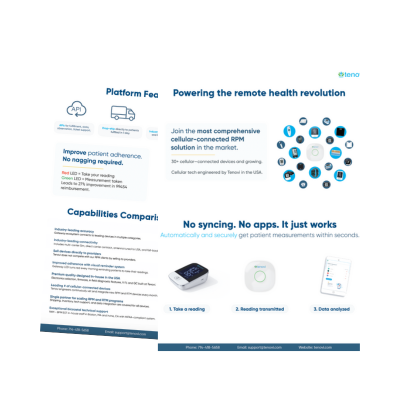
The Tenovi Gateway supports this pattern directly. Devices connect over cellular, so patients do not need Wi-Fi, a smartphone, or an app to participate. Readings move from the device to the care platform without patient action. For the older, higher-risk patients who qualify for PCM, removing that setup burden is often what determines whether monitoring data actually arrives.
Monitoring also helps with the documentation problem. Reviewing incoming physiologic data and acting on it produces exactly the kind of timestamped, condition-specific record that PCM claims depend on. Note that remote patient monitoring has its own CPT codes and its own time and data thresholds. Monitoring supports PCM clinically, but the two services are billed separately and each set of requirements must be satisfied on its own terms.
Common Principal Care Management Billing Mistakes
- Billing PCM and CCM together from the same practitioner in one month. Medicare will not pay both. Decide monthly which service fits.
- Reporting add-on codes without their base codes. CPT 99425 requires 99424, and 99427 requires 99426.
- Documenting a general care plan rather than a disease-specific one. The plan must center on the single condition being managed.
- Falling short of 30 minutes. Partial months are not billable, and undercounted time is the usual cause.
- Skipping the consent record. Consent is a program requirement, not a formality.
- Treating PCM as a permanent enrollment. Patient needs shift, and the correct code may shift with them.
Frequently Asked Questions
1) What does PCM stand for in medical billing?
PCM stands for principal care management, a Medicare service for patients who need ongoing management of one high-risk chronic condition. It is billed under CPT codes 99424, 99425, 99426, and 99427.
2) Can a patient receive both PCM and CCM in the same month?
Not from the same practitioner. The same practitioner cannot bill principal care management and chronic care management for one patient in the same calendar month. Two different practitioners managing different conditions may each bill their respective service.
3) How much time is required to bill principal care management?
At least 30 minutes of qualifying PCM time within the calendar month. Claims are not supported when documented time falls below that threshold, and each additional 30 minutes is reported with the appropriate add-on code.
4) Who can perform principal care management services?
Physicians and other qualified health care professionals report their own time under CPT 99424 and 99425. Clinical staff working under the direction of a physician or QHP report time under CPT 99426 and 99427.
5) How long must the condition be expected to last?
At least three months. This differs from chronic care management, which requires two or more chronic conditions expected to last at least 12 months.
6) Does remote patient monitoring count toward PCM time?
Remote patient monitoring is a separate service with its own CPT codes and its own requirements. Monitoring data can inform PCM care planning and clinical decisions, but time billed to RPM codes should not be double-counted toward PCM thresholds.
Understanding Principal Care Management
Principal care management gives care teams a way to support patients whose risk comes from one condition rather than many. Eligibility turns on a single complex chronic condition expected to last at least three months, with a disease-specific care plan and documented patient consent. Billing runs through four CPT codes: 99424 and 99425 for physician and QHP time, 99426 and 99427 for clinical staff time, all time-based and reported once per calendar month with a 30-minute minimum. The service cannot be billed alongside chronic care management by the same practitioner in the same month, which makes monthly enrollment decisions part of the workflow. Programs that succeed with PCM tend to share three traits: disciplined time capture, care plans genuinely built around one disease, and a steady stream of condition-specific data between visits.
Tenovi builds cellular-connected remote patient monitoring hardware and infrastructure for care-services companies, providers, and practices. Our devices pair with the Tenovi Gateway and transmit readings automatically, with no Wi-Fi, smartphone, or app required from the patient. If you are designing a principal care management program and want reliable condition-specific data behind it, contact us for a free demo and consultation.