
Remote patient monitoring software is the layer that turns readings from a patient’s home into action by a care team. Strong RPM software collects device data, routes it to the right clinician, and feeds documentation and billing without manual work. Weak RPM software leaves care teams chasing readings across spreadsheets, portals, and vendor dashboards.
The difference usually comes down to the APIs underneath. Application programming interfaces connect remote patient monitoring software to devices, electronic health records, billing systems, clinical dashboards, and fulfillment services. When those connections are thin, programs stall on fragmented data and slow care coordination.
This guide covers what remote patient monitoring software does, which API integrations matter, the interoperability standards that took effect in 2026, and how to evaluate vendors before you sign.
What Is Remote Patient Monitoring Software?
Remote patient monitoring software is the platform that receives, stores, displays, and acts on patient-generated health data from connected medical devices. RPM software sits between the device in the patient’s home and the clinician reviewing the reading.
A complete platform handles several jobs at once:
- Ingests readings from blood pressure monitors, glucometers, scales, pulse oximeters, and other RPM devices
- Applies thresholds and generates alerts when a reading falls outside a set range
- Presents trends in a clinical dashboard the care team can work from
- Tracks time spent on care management for billing documentation
- Manages device inventory, shipping, and replacement supplies
- Passes data to an EHR or a third-party platform through an API
Some organizations use a vendor’s full RPM software. Others take device data through an API and display it inside software they already own. Both models work. The choice depends on how much clinical workflow already lives in your existing systems.
Why APIs Are the Backbone of RPM Software
APIs let separate software systems exchange data in a predictable format. In remote patient monitoring, they solve a specific problem: every device manufacturer speaks a slightly different language.
A blood glucose meter, a cellular blood pressure cuff, and a peak flow meter each produce data in their own structure. Without a normalizing layer, an engineering team has to build and maintain a separate integration for every device type. That work grows every time the program adds a condition or a manufacturer.
A single well-designed API removes that burden. Device readings arrive in one consistent format, regardless of which device produced them. Adding a new device type becomes a configuration change rather than a development project.
The practical benefits show up in three places:
- Speed to launch. One integration replaces a dozen.
- Lower maintenance cost. Firmware changes and new device models are handled upstream by the device partner.
- Fewer data gaps. Readings do not sit in a vendor portal waiting to be exported.
Core Components of Remote Patient Monitoring Software
Most evaluations focus on the dashboard, which is only one piece. These are the components that determine whether a program scales past a few hundred patients.
Device Data Ingestion
The platform must accept readings automatically, without asking the patient to open an app or sync a device. Cellular-connected devices remove the most common failure points, which are missing Wi-Fi, dead phone batteries, and forgotten pairing steps.
Clinical Dashboard and Alerting
Care teams need to see which patients need attention today, not scroll through every reading. Configurable thresholds, sortable patient lists, and clear escalation paths keep review time manageable as the panel grows. A well-built RPM dashboard shows exceptions first.
Time Tracking and Documentation
Reimbursement depends on documented clinical time. RPM software should capture time spent on monitoring and patient communication as staff work, not as a separate data entry task afterward.
Fulfillment and Inventory
Devices have to reach patients, and consumables like test strips and lancets have to be replenished. Software that tracks usage and triggers reorders prevents the adherence gaps that come from a patient running out of supplies.
Billing Support
The platform should show which patients have met the day and time thresholds for each billable code, so billing staff are not reconstructing eligibility by hand.
Interoperability Standards RPM Software Must Support
Interoperability requirements tightened considerably in 2025 and 2026, and RPM software vendors are now expected to meet them.
Certified electronic health records must support the U.S. Core Data for Interoperability version 3 through FHIR APIs under the ONC HTI-1 final rule. Device readings map cleanly to FHIR Observation resources, which means a modern RPM platform can push data into Epic, Oracle Health, and other major EHRs without custom interface work for each site.
Two further changes landed in January 2026. Qualified Health Information Networks operating under TEFCA must now use HL7 FAST security procedures for FHIR transactions. Separately, state Medicaid managed care plans, CHIP managed care entities, and Medicaid fee-for-service programs on a modular MMIS must provide FHIR-based Patient Access APIs.
For a remote patient monitoring program, the practical question to ask a vendor is short. Does your platform expose a documented, versioned API, and can it deliver readings as FHIR resources? A yes shortens every future integration.
Self-Managed vs. Full-Service RPM Software
Organizations generally choose between running logistics themselves and handing them to a vendor.
| Self-managed | Full-service | |
|---|---|---|
| Device procurement | In-house | Vendor |
| Storage and shipping | In-house | Vendor |
| Patient tech support | In-house staff | Vendor support team |
| Consumable replenishment | Manual tracking | Automated |
| Upfront cost | Lower | Higher monthly fee |
| Staff time required | Significant | Minimal |
The hidden cost in the self-managed column is staff time. Hours spent storing devices, shipping boxes, and troubleshooting a patient’s setup are not billable under Medicare. A full-service arrangement carries a higher monthly cost but returns clinical staff hours to patient care, which is the work that generates both outcomes and reimbursement.
Patient adherence also tends to be higher with a full-service model, because reminder workflows and a dedicated support line resolve problems before a patient stops taking readings.
How to Evaluate Remote Patient Monitoring Software Vendors
Some remote patient monitoring vendors focus on hardware. Others sell software only. A smaller group covers hardware, software, and fulfillment together. Ask these questions before you compare pricing.
On devices:
- Is every device FDA-cleared for its intended use?
- Are cellular and Bluetooth options both available?
- Are devices available to lease or to purchase?
- Can devices ship directly to patients?
On software and APIs:
- Is the API documented publicly, and is it versioned?
- Can readings be delivered as FHIR resources?
- Is there a sandbox environment for development?
- Are historical readings retrievable, or only live data?
- What are the published uptime commitments?
On operations:
- Is HIPAA-compliant technical support offered to patients directly?
- Is the vendor SOC 2 audited?
- How is device inventory tracked and communicated?
- Is onboarding provided for the care management team?
- Are replacement supplies shipped automatically?
The answers separate a vendor that ships hardware from a partner that supports a growing program.
Billing and Reimbursement Inside RPM Software
Remote patient monitoring is preventive care first. Catching a rising blood pressure trend early avoids an emergency department visit, which is better for the patient and less expensive for the system. Reimbursement exists to make that ongoing work sustainable.
Medicare pays for RPM through a small set of CPT codes. The CY 2026 Physician Fee Schedule, finalized in November 2025, added two codes that widen eligibility.
| CPT code | What it covers |
|---|---|
| 99453 | Initial device setup and patient education, billed once |
| 99454 | Device supply and transmission, 16 or more days in 30 |
| 99445 | Device supply and transmission, 2 to 15 days in 30 |
| 99457 | First 20 minutes of monthly care management |
| 99458 | Each additional 20 minutes of care management |
| 99470 | First 10 to 20 minutes of care management |
Codes 99445 and 99470 took effect January 1, 2026. They cover clinical work that was already happening but went unpaid, such as a patient who took readings 10 times in a month rather than 16.
FQHCs and RHCs saw a related change. HCPCS G0511 was terminated effective January 1, 2026. Federally qualified health centers and rural health clinics now bill the standard RPM CPT codes at the national non-facility rate, which is generally higher per patient than G0511 provided.
Confirm current rates against the Medicare Physician Fee Schedule before you build a financial model. Payment amounts change annually and vary by locality. The U.S. Department of Health and Human Services also publishes guidance on billing Medicare for remote patient monitoring.
Good RPM software surfaces this eligibility automatically. Billing staff should be able to see, at a glance, which patients crossed which threshold in the current period.
How Tenovi Approaches RPM Software and API Integration
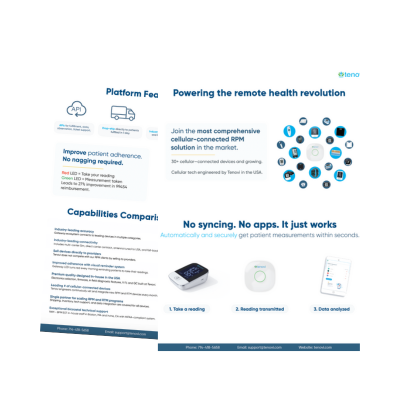
Tenovi builds for organizations that want device data without device logistics. More than 60 FDA-cleared Bluetooth and cellular devices connect to the Tenovi Cellular Gateway, which transmits readings over major U.S. cellular networks to the Tenovi Cloud.
Patients plug the Tenovi Gateway into a power outlet. There is no app to download, no account to create, and no Wi-Fi to configure. Devices arrive pre-paired.
From the Tenovi Cloud, organizations have two paths. They can use the Tenovi dashboard for monitoring, billing, fulfillment, and device management. Or they can pull readings into their own platform through a single API and keep clinicians in the software they already use.
Fulfillment runs from the Tenovi facility, with devices sorted, packaged, labeled, and shipped to patients or to the organization. Usage of consumables is tracked so replacement test strips and lancets ship before a patient runs out. HIPAA-compliant technical support is available to both care teams and patients, and the infrastructure is SOC 2 audited.
Frequently Asked Questions
1) What is remote patient monitoring software?
Remote patient monitoring software is the platform that receives readings from connected medical devices in a patient’s home, displays them for the care team, generates alerts, and supports documentation and billing. It connects the device to the clinician.
2) Does RPM software integrate with an EHR?
Yes, when the vendor provides an API. Modern platforms deliver readings as FHIR Observation resources, which certified EHRs are required to support. That removes the need for custom interface work at every site.
3) Do patients need a smartphone to use RPM software?
Not with a cellular model. Tenovi devices transmit through the Tenovi Cellular Gateway, so patients do not need a smartphone, an app, or Wi-Fi. They plug the Gateway in and take their readings.
4) How is remote patient monitoring software reimbursed?
Medicare reimburses through CPT codes 99453, 99454, 99457, and 99458, plus 99445 and 99470 as of January 1, 2026. The software itself is not billed separately; it supports the clinical services that are billed.
5) What should I look for in an RPM API?
Look for public documentation, versioning, a sandbox environment, FHIR support, retrievable historical data, and published uptime commitments. These indicate a platform built for long-term integration rather than a one-off export.
6) Is remote patient monitoring software HIPAA compliant?
It must be. Ask for evidence of encrypted transmission, encrypted storage, access controls, audit logging, and a current SOC 2 report. A signed business associate agreement is required before any patient data moves.
Understanding Remote Patient Monitoring Software
Remote patient monitoring software succeeds or fails on how reliably data moves. Devices need to transmit without patient effort. Readings need to arrive in a consistent format. Care teams need to see exceptions rather than raw feeds. Documentation and billing need to follow from the work itself rather than a separate reconciliation step.
APIs make each of those possible. A single, well-documented integration replaces a growing pile of device-specific connections, and FHIR support means the data can reach the EHR where clinicians already work. Add reliable fulfillment, patient-facing support, and clear billing visibility, and a program can grow without adding proportional staff.
Tenovi provides FDA-cleared connected devices, cellular transmission through the Tenovi Gateway, fulfillment, and a single API that delivers readings into your RPM software or ours. More than 100 RPM companies work with Tenovi, with over 100,000 devices deployed. Book a free demo and consultation to see how the integration would fit your program.