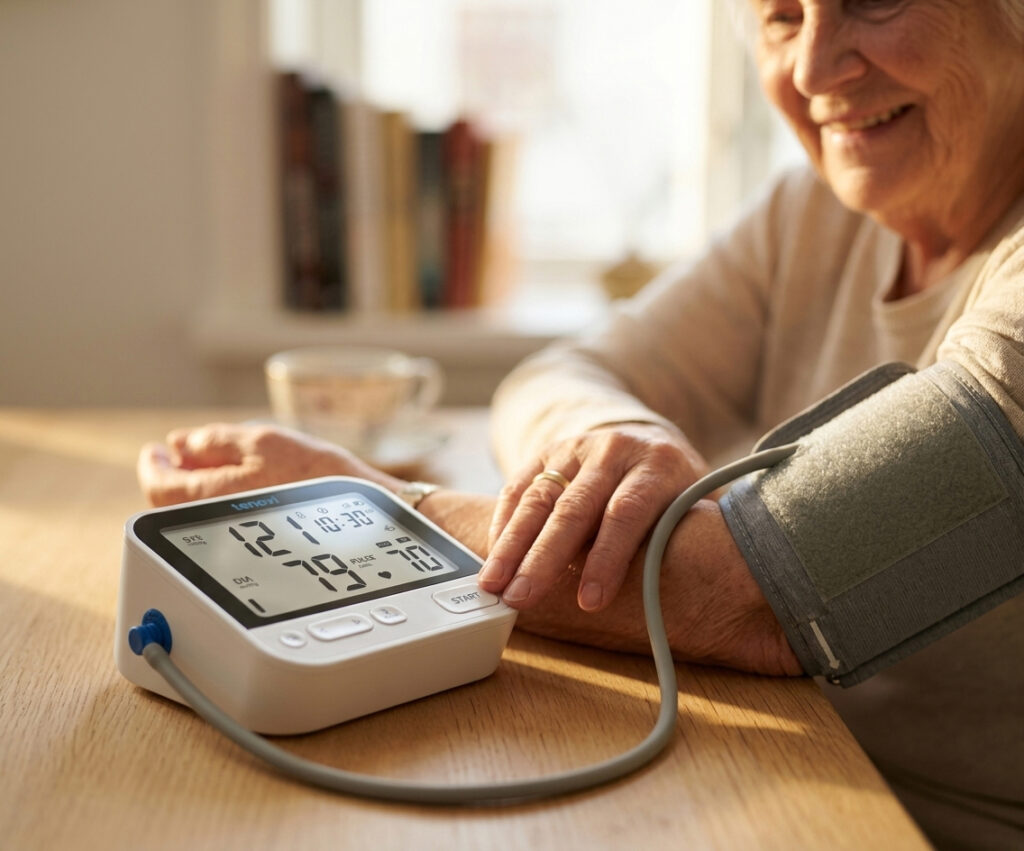
A talking blood pressure cuff speaks each reading out loud so the patient never has to see the screen. For millions of people with low vision, blindness, or reading difficulty, that voice output is the difference between monitoring blood pressure independently and depending on someone else to read the numbers.
Home monitoring already carries strong clinical evidence. Nearly half of U.S. adults have high blood pressure under the current diagnostic threshold, and self-measured readings taken outside the clinic predict cardiovascular risk better than office readings alone. A talking blood pressure cuff extends that benefit to patients a standard monitor leaves out. This article covers how the technology works, what the research shows, and where it fits in a remote patient monitoring (RPM) program.
What Is a Talking Blood Pressure Cuff?
A talking blood pressure cuff is a home blood pressure monitor that announces the measurement through a built-in speaker. Instead of showing systolic pressure, diastolic pressure, and pulse only on a display, the device reads those values aloud in a recorded or synthesized voice.
The cuff and the measurement method are the same as any validated oscillometric monitor. The cuff inflates around the upper arm or wrist, then deflates while sensors detect the pressure oscillations that mark systolic and diastolic pressure. The difference is the output. A conventional monitor ends at a number on a screen. A talking model finishes by speaking that number.
Most voice-enabled models add features that matter to patients who cannot rely on sight. These include tactile buttons a user can find by touch, an audible tone that confirms a button press, and volume control. Some include a headphone jack so a patient can hear a reading in private.
Who These Devices Are For
The clearest use case is patients who are blind or have low vision. Research on accessible monitors names speech output as the only practical way for a person with vision problems to get a result from the display screen. A patient who cannot see systolic and diastolic values has no way to act on them without a voice reading them.
The audience is wider than that, though. Patients with early cataracts, diabetic retinopathy, or age-related macular degeneration may see well enough to function but still struggle with a small, low-contrast monitor screen. Older adults with declining vision and patients with limited literacy also benefit from hearing a spoken result rather than interpreting a display.
How a Talking Blood Pressure Cuff Works
The measurement follows the same oscillometric process used across validated home monitors. Understanding that process shows where the voice feature fits.
The Measurement Sequence
First, the patient wraps the cuff around the upper arm at heart level and presses start. The cuff inflates to a pressure above expected systolic pressure, which briefly stops blood flow in the artery.
Next, the cuff slowly releases air. As pressure drops, blood begins to pulse through the artery again. A pressure sensor inside the device detects the small oscillations those pulses create.
The monitor’s algorithm reads the pattern of those oscillations. The point of maximum oscillation corresponds to mean arterial pressure, and the device calculates systolic and diastolic pressure from the surrounding curve. Pulse rate comes from the timing between oscillations.
Finally, the device reports the result. On a talking model, an audio chip plays the spoken values through the speaker. Many devices state the reading twice or let the patient replay it.
Recorded Voice Versus Synthesized Speech
Early talking monitors used a recorded human voice that spoke a fixed set of values. Studies of the first FDA-cleared talking models describe recorded voice output with a volume slider and a headphone jack. Newer devices often use text-to-speech, which can read a wider range of prompts, guide setup, and support more languages.
Both approaches serve the same goal. The patient hears the reading rather than reading it. Text-to-speech tends to handle setup and error messages better, which matters because those steps also appear only on the screen of a standard monitor.
Talking Blood Pressure Cuffs and Home Monitoring
The value of a talking blood pressure cuff sits on top of the evidence for home monitoring in general. Both parts deserve attention. The American Heart Association and American Medical Association issued a joint policy statement in 2020 endorsing self-measured blood pressure monitoring at home. Their review of randomized trials found that home monitoring lowers blood pressure and improves control, with the largest gains when readings are paired with clinical support such as education, medication management, or telemonitoring. Tenovi covers the clinical case in more depth in its guide to remote patient monitoring for hypertension.
The statement also notes that home readings help catch two conditions office visits miss. White-coat hypertension shows high pressure in the clinic but normal pressure at home. Masked hypertension is the reverse. Out-of-office readings correct both misclassifications and lead to more accurate diagnosis. Tenovi looks at the first of these in its article on how RPM helps control white coat syndrome.
Home monitoring can also reduce cost. The joint statement describes self-measured monitoring as cost-effective compared with office measurement alone, through fewer office visits, fewer cardiovascular events from better control, and less overtreatment of white-coat hypertension.
Accessibility Closes a Care Gap
A device only helps if the patient can use it. For a blind or low-vision patient, a standard monitor with a silent screen provides no usable result. A talking blood pressure cuff removes that barrier and lets the patient monitor independently, without waiting for a family member or aide to read the display.
This matters because vision loss and cardiovascular disease overlap. Diabetes is a leading cause of both hypertension and vision loss through diabetic retinopathy. A patient managing diabetes and high blood pressure at once is exactly the person who may need a talking monitor to stay on a home measurement routine.
A Canadian pilot study of home monitors for people with low vision or blindness found that participants wanted several accessibility features together. They named voice output, audible indicators, tactile buttons, and a high-contrast display as the marks of an ideal accessible monitor. Voice output alone helps, but the best devices combine it with touch and sound cues throughout the process.
Independence Supports Adherence
Blood pressure control depends on consistent measurement. A patient who can take and hear a reading without help is more likely to measure on schedule. Independence supports the self-care behaviors that drive control, and it protects patient dignity by removing the need to share a health reading with whoever happens to be available.
Talking Blood Pressure Cuffs in Remote Patient Monitoring
An accessible device and a connected care model fit together. Remote patient monitoring lets a care team receive a patient’s readings between visits and act on them.
In an RPM program, a cellular-connected monitor sends each reading to the care team automatically. The patient measures at home, and the values reach the clinician without any manual logging. For a patient who cannot see a screen, automatic transmission removes another visual task, since there is no app to read or number to type.
Pairing accessibility with automatic transmission serves patients who are often left out of digital health. A blind patient using a talking cuff connected through a cellular gateway gets the same care-team oversight as any other RPM patient, with no smartphone or home internet setup required. The reading is spoken to the patient and sent to the clinician in the same step.
This is where device choice and program design meet. A monitor that a patient can operate independently, paired with a connection method that needs no visual configuration, keeps more patients enrolled and measuring.
The Tenovi Blood Pressure Monitor With Voice Function
The Tenovi Blood Pressure Monitor Gen 3 is an FDA-cleared home monitor with a built-in voice function. It reads the result aloud so a patient can get systolic pressure, diastolic pressure, and pulse without reading the display. A large LCD screen still shows the same values for patients who prefer to look.
Setup is a single button. The patient puts on the cuff and presses one button, and the monitor inflates, measures, and sends the reading to the care team through the Tenovi Gateway. There is no app to open and no number to type, which removes the visual steps that block many low-vision patients from home monitoring.
The Gen 3 comes with a premium cuff in three sizes, from a 15 to 28 cm range up to a 32 to 52 cm range, so it fits a wide span of arm sizes. Accuracy is within +/- 3 mmHg for blood pressure and +/- 5% for pulse.
The voice readout helps in a quiet home and can be a distraction in a shared clinic or busy household. For patients who want a spoken result and those who prefer a silent reading, a monitor that lets the audio be adjusted or turned off serves both without a second device.
1) What is a talking blood pressure cuff?
A talking blood pressure cuff is a home blood pressure monitor that speaks the reading out loud through a built-in speaker. It announces systolic pressure, diastolic pressure, and pulse so a patient does not have to see the screen. The cuff and measurement method match any standard oscillometric monitor.
2) How accurate is a talking blood pressure monitor?
Accuracy depends on validation, not on the voice feature. A talking monitor that uses the validated oscillometric method measures blood pressure the same way a non-talking model does. Choose a device that has been clinically validated, and follow a standard measurement protocol for reliable readings.
3) Who should use a talking blood pressure cuff?
Patients who are are vision impaired or have low vision benefit most, since speech output is often the only way for them to get a reading from the display. Older adults with declining vision, patients with diabetic eye disease, and patients with limited literacy also benefit from hearing a spoken result.
4) Do talking blood pressure cuffs work for vision-impaired patients?
Yes. Voice output lets a patient hear the reading without seeing the screen. Some devices add tactile buttons and audible tones so the patient can also start the measurement and confirm button presses by touch and sound.
5) Can a talking blood pressure cuff connect to a remote patient monitoring program?
Yes. A cellular-connected model can send each reading to the care team automatically while speaking the result to the patient. That combination lets a blind or low-vision patient take part in RPM without needing to read an app or type a number.
6) Are talking blood pressure cuffs covered by insurance?
Coverage follows the same rules as other home blood pressure monitors and RPM devices rather than the voice feature specifically. When a monitor is used in a physician-ordered RPM program, the associated monitoring may be billable under Medicare RPM codes. Confirm coverage with the payer for each patient.
Understanding the Talking Blood Pressure Cuff
A talking blood pressure cuff measures blood pressure with the same validated oscillometric method as any home monitor, then speaks the result aloud so patients who cannot see a screen can monitor on their own. Home blood pressure monitoring has strong clinical backing for lowering blood pressure, catching white-coat and masked hypertension, and improving control when readings reach the care team. Voice output extends those benefits to blind and low-vision patients, who often have no usable way to read a standard monitor. Paired with automatic transmission in a remote patient monitoring program, an accessible monitor keeps more patients enrolled and measuring, without a smartphone or home internet setup.
Tenovi provides cellular-connected remote patient monitoring and remote therapeutic monitoring (RTM) infrastructure for care-services companies, providers, and health systems. Our devices transmit patient readings to your care team automatically through the Tenovi Gateway, with no app, Bluetooth pairing, or home Wi-Fi required. To see how Tenovi can support accessible, connected monitoring for your patient population, request a free demo and consultation.