Can You Save a Stroke Before It Happens?
Before Tenovi, Friedman started Flint Rehab, a company focused on tools that help stroke survivors recover. The work surfaced a hard truth: by the time a patient reaches rehabilitation, the life-altering event has already happened. In the podcast, Friedman describes the realization that reframed his career — preventing a stroke from occurring in the first place would have a far greater impact than rehabilitating someone after the fact.
That idea became the founding logic of Tenovi in 2018, and Friedman summarizes it as wanting to “save the stroke from happening in the first place.” The shift is from reactive to preventative care, and it points directly at chronic conditions, because conditions such as hypertension, diabetes, and congestive heart failure are exactly the ones that quietly progress between appointments and can erupt into acute, expensive, and often avoidable emergencies.
Nizan Friedman holds a PhD in biomedical engineering, and his framing is characteristically systems-minded: the problem isn’t a lack of medical knowledge, it’s a feedback loop that’s too slow to act on what we already know.
Improving the Feedback Loop
In Friedman’s telling, today’s healthcare system is reactive largely because of how infrequently data flows between patients and clinicians. If a provider only sees a patient once a year, there’s a long stretch of time in which a dangerous trend can develop unnoticed — what Friedman calls a “ticking time bomb” between visits.
Tenovi’s central goal is to shorten that loop from once a year to once a day. Instead of an annual snapshot, a clinician gets a continuous stream of vitals, so a blood pressure creeping in the wrong direction or a heart-failure patient’s weight climbing day over day gets caught early, while there’s still time to intervene with a medication change or a phone call rather than a hospital admission.
The clinical payoff Friedman cites is significant: shortening the feedback loop can reduce hospitalizations by as much as 50% for some patients, including those managing congestive heart failure. For both patients and the health system, fewer hospitalizations is the whole point of preventative chronic care.
The Technology: A Quiet Gateway Does the Heavy Lifting
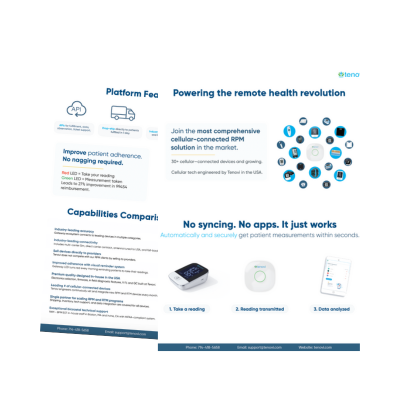
What makes daily monitoring practical is Tenovi’s proprietary Cellular Gateway. It is a small hub that sits in a patient’s home and automatically transmits their vitals to their care team in real time. There’s no app to wrestle with, no Wi-Fi to configure, and no syncing ritual for the patient to remember. The patient takes their blood pressure or steps on the scale, and the reading travels to the clinician on its own.
That Gateway connects with more than 50 different Bluetooth-enabled medical devices, from blood pressure monitors to scales to glucometers. Because the Gateway hub is device-agnostic, the same infrastructure can support a wide range of chronic conditions rather than locking a practice into a single disease or a single vendor. Friedman’s framing is expansive: while the common use cases are hypertension, diabetes, and congestive heart failure, remote monitoring can be applied to virtually any chronic condition — including chronic respiratory conditions like COPD.
Just as important is how this differs from telehealth. A telehealth visit is synchronous. It requires a one-to-one block of a clinician’s time for every interaction. Remote monitoring, by contrast, provides an asynchronous layer of support: data is transmitted and reviewed daily without a live appointment for each data point. That asynchronous model is what lets a care team keep watch over a large panel of patients with chronic conditions without needing a video call with each of them every day.
The Business Model: Infrastructure for the Whole Industry
One of the more strategic points Friedman made is that Tenovi doesn’t primarily sell to doctors. Instead, the company operates as an infrastructure layer for the RPM industry, connecting medical device manufacturers on one side with the RPM companies that serve providers on the other.
In practice, hundreds of remote monitoring companies use Tenovi’s hardware and data-aggregation services as their backbone. Those companies handle the clinical pathways and day-to-day program management for physicians who simply do not have the time or staff to stand up an RPM program themselves. Tenovi makes sure the devices work, the data flows, and the readings arrive reliably — the plumbing beneath a large and growing slice of the industry.
This B2B approach is what gives the mission its scale. Friedman describes Tenovi’s purpose as unlocking preventative care for any chronic condition at any scale, and the infrastructure model is how “any scale” becomes realistic: rather than convincing one practice at a time, Tenovi equips the companies that already serve thousands of practices.
Growth, Reimbursement, and What’s Next
In 2019, Medicare introduced reimbursement codes (CPT codes) that reimburse physicians who enroll patients in remote monitoring programs. That change turned preventative monitoring from an idea into a financially sustainable line of business for providers, and demand has climbed steadily since.
Tenovi’s numbers reflect that tailwind. The company grew from $1 million to $20 million in revenue over 48 months and currently has roughly 400,000 patient devices deployed across the United States. Tenovi has also moved into private insurance payers and the senior living space. These are two markets where continuous monitoring of chronic conditions has obvious value.
Friedman emphasized during the interview that handling patient data responsibly is non-negotiable. Tenovi maintains a strict focus on data privacy, complying with HIPAA and holding SOC-2 security certification.
Why New Hampshire
Friedman also spoke to a question every fast-growing health-tech founder eventually faces: where to build. He chose New Hampshire deliberately, viewing the state as an extension of the Boston medical hub. The proximity gives Tenovi access to exceptional clinical and engineering talent, while allowing the company to retain that talent without the inflated costs that come with Silicon Valley.
New Hampshire’s life sciences industry is transforming patient care, fostering growth, and leading groundbreaking advancements in healthcare. Being named No. 1 on the fastest-growing company in New Hampshire on the 2025 Inc. 5000 list is a clear sign that New Hampshire is attracting and retaining world-class talent and innovation. Additionally, Business NH Magazine name Tenovi one of the top three new companies to watch.
The Bigger Picture
The throughline of Friedman’s BizCast NH conversation is a simple reframing with large consequences. Chronic conditions can be managed more than at check-ups. With the right infrastructure, the standard of care can shift to daily, continuous remote patient care, giving clinicians the early warning they need to act before a manageable trend becomes an emergency.
For Tenovi, it is the answer to the question that started the company: how do you save the stroke before it ever happens?