Remote patient monitoring (RPM) improves patient care and lowers costs, yet building it into clinical workflows can feel daunting. This article examines the most common remote patient monitoring challenges and offers practical solutions for each. Understanding these obstacles is the first step toward running a successful RPM program for both patients and providers.
Below are the five remote patient monitoring challenges we see most often, along with the fixes that address them.
1. Remote Patient Monitoring Challenges in Security
One of the primary remote patient monitoring challenges is protecting sensitive medical data. Healthcare remains the most-targeted sector for cyberattacks. Providers reported a record 772 large healthcare data breaches in 2025, exposing the protected health information of roughly 138.5 million people. Hacking and IT incidents accounted for more than 80% of those breaches, and the average healthcare breach now costs $7.42 million, the highest of any industry for 14 straight years. Guarding patient information from breaches is essential for HIPAA compliance and patient trust.
The Solution
Strong security measures protect sensitive data and reduce the risk of a breach. Look for RPM infrastructure with end-to-end encryption, access controls, and independent security certification such as SOC 2. Pairing that with high-quality sensors and proper calibration also supports more reliable diagnoses and treatment decisions.
2. Remote Patient Monitoring Challenges in Data Accuracy
Another critical challenge is ensuring RPM device accuracy and the reliability of transmitted data. Faulty readings can lead to incorrect diagnoses and treatment decisions that may harm patients. Several factors affect accuracy, including sensor quality, calibration, and correct use.
The Solution
To improve data accuracy in remote patient monitoring, providers can:
- Use high-quality sensors that are accurate and reliable.
- Calibrate devices regularly to reduce drift and environmental error.
- Train staff and patients on proper device use and data recording.
- Establish quality-control processes to catch accuracy issues quickly.
- Build a feedback loop among providers, patients, and vendors.
- Choose user-friendly, out-of-box RPM devices that are portable and simple to operate.
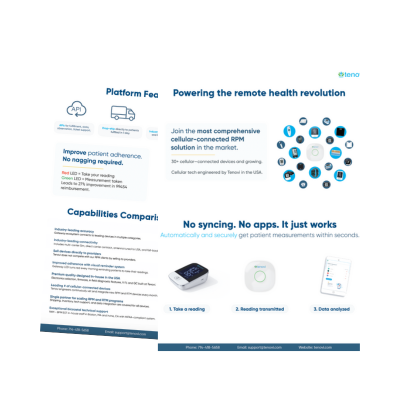
Cellular-connected devices help here. Because they transmit automatically without an app or sync step, they remove a common source of user error.
3. Remote Patient Monitoring Challenges in Real-Time Data Access
Real-time access to patient data lets clinicians intervene early, but achieving it brings its own challenges. The first is constant connectivity between the device and the monitoring platform. The second is workload: someone has to review all that data, and physicians want to focus on treating patients. Overloading staff invites burnout, while hiring more people is costly.
The Solution
Maintaining reliable connectivity and uninterrupted data transmission is critical. Tenovi cellular-connected devices that pair with the Tenovi Gateway use low-power protocols to reduce energy use and hold a steady connection, with no home Wi-Fi required.
Reviewing patient data still takes time and resources. RPM outsourcing can smooth the transition, since third-party vendors supply trained staff who handle routine monitoring. Physicians are then contacted only when the data calls for their clinical expertise.
4. Remote Patient Monitoring Challenges in System Integration
System integration is a significant hurdle, especially when providers run different software across separate networks. Outdated systems and compatibility gaps create technical friction, and interoperability is a persistent concern given how large and varied health data can be.
The Solution
Integration challenges ease with standardization and open data-exchange protocols. An API is the simplest way to add a new monitoring module to an existing system. The Tenovi Gateway sends real-time vital sign data to the Tenovi cloud automatically. Partners can then use the Tenovi dashboard or route data directly into another platform through the API, so RPM fits existing workflows rather than replacing them.
5. Remote Patient Monitoring Challenges With Cost
Implementing RPM carries costs, including devices, licensing, software, and staff time. The price of training clinicians on new technology is easy to overlook.
The Solution
Managing cost means weighing it against the long-term savings that come from better outcomes and more efficient care. Medicare reimbursement helps offset the investment, and the 2026 Physician Fee Schedule made RPM more flexible. CMS added two codes effective January 1, 2026: CPT 99445 for device supply with 2 to 15 days of data, and 99470 for shorter clinical-management time. CMS also lowered the setup threshold for CPT 99453 to just 2 days of data. The foundational codes 99453, 99454, 99457, and 99458 remain in place.
Partnering with an RPM vendor also spreads the financial load of training and implementation. Done well, RPM becomes a new source of revenue with minimal disruption to existing workflows. The point is not billing for its own sake: RPM is proactive, preventive care that improves outcomes and lowers total cost of care over time.
Frequently Asked Questions
1) What are the biggest remote patient monitoring challenges?
The most common remote patient monitoring challenges involve data security, device accuracy, real-time data access, system integration, and cost. Each has practical solutions, from cellular-connected devices and outsourced monitoring to API integration and Medicare reimbursement.
2) How does RPM stay HIPAA compliant?
RPM programs stay compliant by using encrypted data transmission, access controls, and independently certified infrastructure. Because healthcare is the top target for cyberattacks, security should be a core requirement when choosing an RPM partner.
3) Does Medicare reimbursement cover RPM in 2026?
Yes. Medicare reimburses RPM under CPT codes 99453, 99454, 99457, and 99458, and the 2026 Physician Fee Schedule added codes 99445 and 99470 for shorter monitoring and management periods.
Overcoming Remote Patient Monitoring Challenges
Remote patient monitoring challenges around security, data accuracy, real-time access, integration, and cost are all solvable. With the right infrastructure and partners, providers gain better outcomes, lower costs, and a more efficient system that supports care wherever the patient is. RPM will keep shaping the future of healthcare by extending quality monitoring beyond the clinic walls.
Visit Tenovi to see who we serve and request a free demo. Meet a better RPM experience for patients, physicians, and your team.