
Medicare has covered remote patient monitoring since 2020, and two new CPT codes took effect on January 1, 2026. For care teams weighing an RPM program, the question is rarely whether reimbursement exists. It is whether the program covers its own cost once devices, staff time, and patient support are accounted for, and whether it improves care between visits. This article walks through the RPM billing codes and how to think about remote patient monitoring ROI on both sides of the ledger. For a broader look at how these programs work, start with our complete guide to remote patient monitoring.
Remote Patient Monitoring Reimbursement
The billing period for remote patient monitoring CPT codes is 30 days, or the end of the calendar month for the time-based codes. Six codes currently apply to RPM. The rates below are rounded approximate 2026 national non-facility averages; current amounts for a specific code and locality are available through the CMS Physician Fee Schedule Look-Up Tool.
RPM CPT Codes
CPT 99453 covers medical device set-up and patient education for vital sign monitoring equipment. RPM devices include the Tenovi Cellular-Connected Blood Pressure Monitor, Tenovi Scale: Cellular-Connected Weight Tracking, Tenovi Cellular-Connected Blood Glucose Meter, and Tenovi POx: Cellular-Connected Pulse Oximeter. This code is billed one time per episode of care. The average reimbursement rate is $22.00.
CPT 99445 is new for 2026. It covers the supply of a connected device and data transmission for 2 to 15 days within a 30-day period. The average reimbursement rate is $47.00.
CPT 99454 covers the supply of RPM devices for daily recording or programmed alert transmissions. To bill this code, the patient must transmit data at least 16 days in a 30-day period. The average reimbursement rate is $47.00.
CPT 99470 is new for 2026. It covers the first 10 minutes of RPM treatment management services in a calendar month and requires at least one real-time interactive communication with the patient or caregiver. The average reimbursement rate is $26.00.
CPT 99457 covers the initial 20 minutes of treatment management, which requires remote or virtual communication with the patient. Communication can occur through video calls, text messaging, email, or phone calls. This code is billable as “incident to” under general supervision, so Medicare providers can contract third-party companies to assist with remote patient monitoring services. This gives practices a way to extend monitoring capacity when clinical staff time is the constraint. The average reimbursement rate is $52.00.
CPT 99458 covers each additional 20 minutes of RPM services, including data interpretation. Documentation of how the time was used is required. The average reimbursement rate is $41.00.
Two pairs of these codes are mutually exclusive. For a given 30-day period, bill either 99445 or 99454 based on the number of days the patient actually transmitted data, not both. The same applies to 99470 and 99457, where the code follows the documented minutes.
This material is provided for general informational and educational purposes only and does not constitute legal, compliance, billing, coding, or reimbursement advice. CPT® codes, descriptions, and Medicare payment rates referenced here are drawn from publicly available sources, are subject to change, and may vary by payer, locality, and patient circumstances. Tenovi makes no representation or guarantee regarding coverage, payment, or the appropriateness of any code for a particular patient or service, and any presented are illustrative only. Providers are solely responsible for independently determining medical necessity and applicable coding, coverage, documentation, and billing requirements and for submitting accurate claims. Consult applicable payer guidance and qualified billing, coding, compliance, or legal professionals before making billing decisions. CPT® is a registered trademark of the American Medical Association.
How to Think About Remote Patient Monitoring ROI
Estimating what an RPM program returns starts with understanding which codes a patient’s engagement actually supports, then subtracting what the program costs to run. Because 99445 and 99454 cannot both be billed in the same 30-day period, and 99470 and 99457 follow documented time, per-patient reimbursement depends on how consistently patients transmit data and how much clinical time the program requires.
Remote patient monitoring companies offer different service models depending on how much work the practice takes on internally.
A full-service model typically covers:
- Device set-up
- Patient education
- Data review
- Patient interaction
A more basic service model may cover device set-up and patient education while leaving data review and patient interaction to the practice. That lowers the direct per-patient cost and adds clinical workload, so neither model is automatically the better fit. The deciding factor is usually the cost and availability of clinical time in your organization.
Alongside the service model, a realistic estimate accounts for shipping devices to patients, onboarding time, technical support, and patients who leave the program after set-up. Weighed against the cost of staff time, many organizations find a full-service model is worth the investment.
Long-Term Remote Patient Monitoring ROI
Even setting reimbursement aside, remote patient monitoring can lower the total cost of care over time. Catching problems early is less expensive than treating them late, for the health system and for the patient. The same logic is why payers are looking at remote monitoring in chronic care. The sections below cover where that return tends to show up.
Benefit #1: Reduces Hospital Readmission Rates
Medicare continues to shift toward value-based care. One mechanism is the Hospital Readmissions Reduction Program (HRRP), which reduces payments to hospitals with excess readmissions. CMS applies 30-day risk-standardized unplanned readmission measures to six conditions and procedures:
- acute myocardial infarction
- chronic obstructive pulmonary disease
- heart failure
- pneumonia
- coronary artery bypass graft surgery
- elective primary total hip arthroplasty and total knee arthroplasty
Remote patient monitoring gives clinicians a way to identify complications early and intervene before a readmission happens. A systematic review published in BMJ Open examined 91 studies and concluded that remote patient monitoring can reduce acute care use among patients with cardiovascular disease and COPD, while noting that effectiveness varies within and between populations.
Benefit #2: RPM Can Reduce Emergency Department Visits
Monitoring between visits gives care teams a chance to act before a problem becomes urgent. UC Davis Health reports that participants in its remote monitoring program for blood pressure lowered their readings from an average of 150/80 mmHg before enrollment to 125/74 mmHg during the program, which lasts six months and can be extended to a year for patients who have not reached their goals.
The EVOLVO randomized trial found that remote monitoring of heart failure patients with implantable defibrillators reduced emergency department and urgent in-office visits for heart failure, arrhythmias, and device-related events by 35% over 16 months, and reduced total healthcare visits by 21%. Detecting and treating complications early keeps patients out of the emergency department, which is better care and lower cost at the same time. One physician practice running a blood pressure control program on Tenovi devices cut its high-critical readings by 75% in a single quarter.
Benefit #3: RPM Transmits a Steady Stream of Health Data
Reliable data between visits is one of the most useful things an RPM program produces. Blood pressure in particular can read differently in an office than it does at home. Some patients experience elevated readings in a clinical setting, known as white coat hypertension. The reverse pattern also occurs: in masked hypertension, office readings look normal while blood pressure is elevated outside the clinic.
A large 2023 cohort study published in The Lancet found that masked hypertension was associated with an increased risk of death, and noted that these patients usually go undetected when screening relies on clinic blood pressure alone. Readings taken outside the office are how care teams tell these patterns apart.
Consistent readings taken at home give clinicians a more accurate picture of a patient’s condition between visits. More data allows care teams to fine-tune treatment plans, check how patients are responding to medications, and adjust prescriptions promptly.
Benefit #4: Improves Patient Adherence to Treatment Plans
Patient engagement may be the most durable return remote patient monitoring offers. A study in Telemedicine and e-Health following 1,354 patients with type 2 diabetes found that higher levels of patient activation and engagement with remote monitoring technology were associated with better glycemic control, and that patients who uploaded data about once a day were less likely to finish the program with an HbA1c above 9% than those who uploaded every two days or less often.
Patients’ everyday decisions have the largest influence on their health. A clinician can build an effective treatment plan, but it only works if the patient follows it. Knowing that a care team is watching and can step in between visits helps patients stay with their plans, as these patient success stories from a rural hypertension program show.
Benefit #5: Allows Clinicians to Care for More Patients
Unlike telehealth, remote patient monitoring has no originating site restrictions, which makes it available to more patients. Not all RPM services have to be performed directly by the billing physician either.
As noted above, CPT 99457 can be billed “incident to” under general supervision, and Medicare providers can contract third-party vendors to assist with RPM services. This allows a care team to follow more patients between visits without a proportional increase in in-office workload.
Understanding ROI on Remote Patient Monitoring: Key Points
Remote patient monitoring returns value in the near term through reimbursement and over the long term through earlier intervention and lower total cost of care. Reaching either depends on the same things: choosing a monitoring system patients will actually use, and adjusting workflows so clinical time is spent on the patients who need it. Done well, that serves patients and keeps the program sustainable.
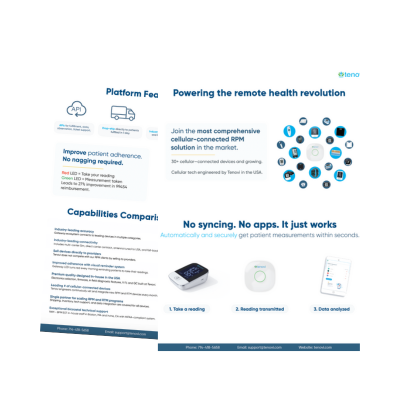
Tenovi remote patient monitoring devices are easy for patients to use. There is no syncing and no app required. Care teams automatically and securely receive patient measurements within seconds. Schedule your free demo and consultation today.