
Companies offering remote patient monitoring (RPM) solutions often face the question: How does remote patient monitoring work? Many healthcare providers understand the benefits of RPM but are unsure where to begin. This comprehensive guide explains how remote patient monitoring works, benefiting RPM service providers, software companies, chronic care management organizations, and telehealth businesses. It also covers Medicare reimbursement for RPM services.
How Does Remote Patient Monitoring Work?
Before we can answer the specific question of how does remote patient monitoring work, let’s review exactly what it entails. The Department of Health and Human Services defines RPM as a form of telehealth that allows providers to monitor and manage their patients’ acute and chronic conditions outside of a traditional clinical setting. It is used in programs, chronic care management, and care facilities.
Though RPM is not a new practice, it continues to see massive growth due to its convenience for both patients and providers. Today, RPM technology utilizes cellular and IoT (Internet of Things) connected devices to stream physiological data directly to a clinician’s dashboard. It is routinely used to manage chronic conditions, such as hypertension, diabetes, and COPD, and in and palliative care and acute hospital at home programs.
Research shows that RPM reduces hospital admissions, promotes patient engagement, and boosts workflow and revenue. In addition, measuring vital signs consistently from home promotes better care between visits. Thus helping clinicians identify complications early and provide prompt treatment. For example, one systematic review of remote patient monitoring shows RPM maximizes patient care and the effectiveness of treatment.
Clinical and Overall Cost Impact of Remote Patient Monitoring
Recent clinical research illustrates exactly why RPM is becoming an indispensable tool for modern healthcare providers:
- According to a recent systematic review of remote patient monitoring, RPM programs significantly maximize patient care and treatment effectiveness, cutting hospital readmissions by up to 38%.
- Measuring vital signs consistently from home promotes better care between visits, allowing clinicians to identify complications early, provide prompt treatment, and reduce overall healthcare delivery costs.
- RPM minimizes patients’ travel costs and infection risks while keeping them actively involved in their daily health metrics.
How Does Remote Patient Monitoring Work? A Step-by-Step Guide
This 5-step guide answers the question: how does remote patient monitoring work for Medicare reimbursement?
This material is provided for general informational and educational purposes only and does not constitute legal, compliance, billing, coding, or reimbursement advice. CPT® codes, descriptions, and Medicare payment rates referenced here are drawn from publicly available sources, are subject to change, and may vary by payer, locality, and patient circumstances. Tenovi makes no representation or guarantee regarding coverage, payment, or the appropriateness of any code for a particular patient or service, and any presented are illustrative only. Providers are solely responsible for independently determining medical necessity and applicable coding, coverage, documentation, and billing requirements and for submitting accurate claims. Consult applicable payer guidance and qualified billing, coding, compliance, or legal professionals before making billing decisions. CPT® is a registered trademark of the American Medical Association.
Step 1: Patient Opt-In
The first step in explaining how remote patient monitoring works begins when a patient opts into remote patient monitoring services. If the physician hasn’t had a face-to-face interaction with the patient in over a year or if the patient is new, RPM services must be initiated in person. Medicare beneficiaries are subject to a copay for remote patient monitoring services. Remote patient monitoring technology can manage a multitude of acute and chronic conditions and symptoms, such as high blood pressure, heart disease, stroke, kidney disease, sepsis, febrile neutropenia in cancer patients, and more.
A remote blood pressure monitoring device measures systolic and diastolic pressure and pulse rate. Glucose monitors allow physicians and diabetes patients to track blood sugar levels in real-time. Thresholds and alerts can be set to notify the physician if the reading exceeds the set limit. Weight tracking scales are another option for monitoring conditions such as obesity and cancer. Pulse oximeters measure oxygen saturation and pulse rate for Chronic obstructive pulmonary disease (COPD) patients. Once the patient takes the reading on their wireless device, the data is instantly and automatically sent to their physician for review.
Step 2: Ordering the Device and Set-Up
Next, the physician will order the FDA-cleared remote patient monitoring device transmission equipment for the patient. As previously mentioned, available devices include wireless cellular or Bluetooth blood pressure monitors, scales, pulse oximeters, and blood glucose meters. Devices vary in ease of use, but in general, RPM devices are simple to use, and some rpm devices work right out of the box. In addition, some third-party remote patient monitoring companies even ship the devices directly to the patient.
CPT code 99453 covers device set-up and patient education on how to use the device. This one-time payment (per patient) is billed after the initial 16 days of monitoring.
Step 3: Patient Use of Device
The patient must use the IoT health monitoring device for at least 16 days a month to bill for CPT codes 99453 and 99454. CPT code 99454 pays for supplying the device, collection, transmission, and daily recordings or programmed alerts. When parameters are set for each patient, the physician is automatically alerted if a reading is outside those set parameters. Every time a patient uses the device, the reading will be sent to the clinician portal in real time. The clinician will have access to all of the patient’s previous recordings there. Patients can be rest assured that their healthcare team has them covered.
Step 4: Data Analysis
To bill for CPT 99457, the physician, qualified healthcare professional, or clinical staff must perform 20 minutes of remote patient monitoring services per month. Part of that 20 minutes must involve live, interactive communication with the patient. This can be completed remotely via video, text, or phone call.
Remote patient monitoring services can include:
- Data review
- Interactive communication with the patient
- Creating/ adjusting treatment plans
Clinicians should keep a record describing what they did and how much time was spent. They must send this documentation in when billing Medicare. For every additional 20 minutes of RPM services, the billing physician can bill CPT 99458. Timing does not round up, and billing occurs monthly. For example, if a care provider performs 35 minutes of RPM services, the billing physician can only bill for the initial 20 minutes.
It is important to note that CPT 99457 is billed “incident to” under general supervision. That is, Medicare providers are allowed to contract third-party remote patient monitoring companies to help with RPM services. As a result, healthcare organizations can manage more patients and generate increased income without significantly impacting organizational workflows.
CPT code 99091 was introduced by CMS in 2022. In contrast to the preceding codes, it has more requirements. Correspondingly, it covers a minimum of 30 minutes in a calendar month for the tie it takes clinical staff to gather, interpret and process data transmitted by a patient. This code also covers at least one communication by phone or email whereby medical management or monitor advising occurs.
Step 5: Submit the Claim
The billing physician can submit a claim for reimbursement at the end of each billing period or wait until the end of the month to submit all claims together.
Below is a summary of the billing cycle per CPT code:
CPT 99453 can be billed after the initial 16 days of monitoring.
CPT 99454 can be billed every 30 days, given that the device has been used for at least 16 days.
Lastly, CPT 99457, 99458, and 99091 can be billed at the end of every month.
*In 2026 CMS introduced billing codes for 2-15 days.
How Does Remote Patient Monitoring Work at Tenovi?
- teach patients how to set up and use the device
- check up on patients who are not using the device regularly
- provide HIPPA-compliant patient technical support
- have APIs for billing, physician dashboards, and device shipping
- provide cloud services
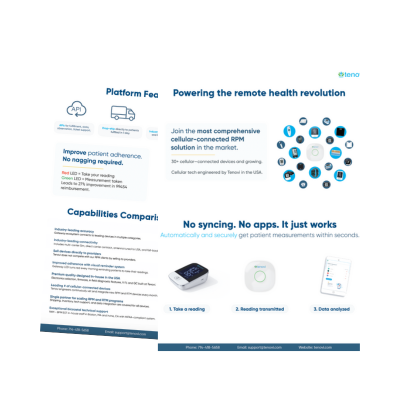
Tenovi RPM devices are incredibly user-friendly, so even the most technology-adverse patients can easily use them. Additionally, if patients ever need any help with their devices, Tenovi customer service is available to troubleshoot. The intuitive, HIPAA-compliant clinician portal ensures patient privacy. It keeps track of patient health history so all necessary data can be effortlessly accessed.
RPM provides better support between appointments so clinicians can better understand their patient’s conditions and provide timely care. Are you interested in learning more about how remote patient monitoring works at Tenovi? Join us for a free demo and consultation.